Uploaded Tactic
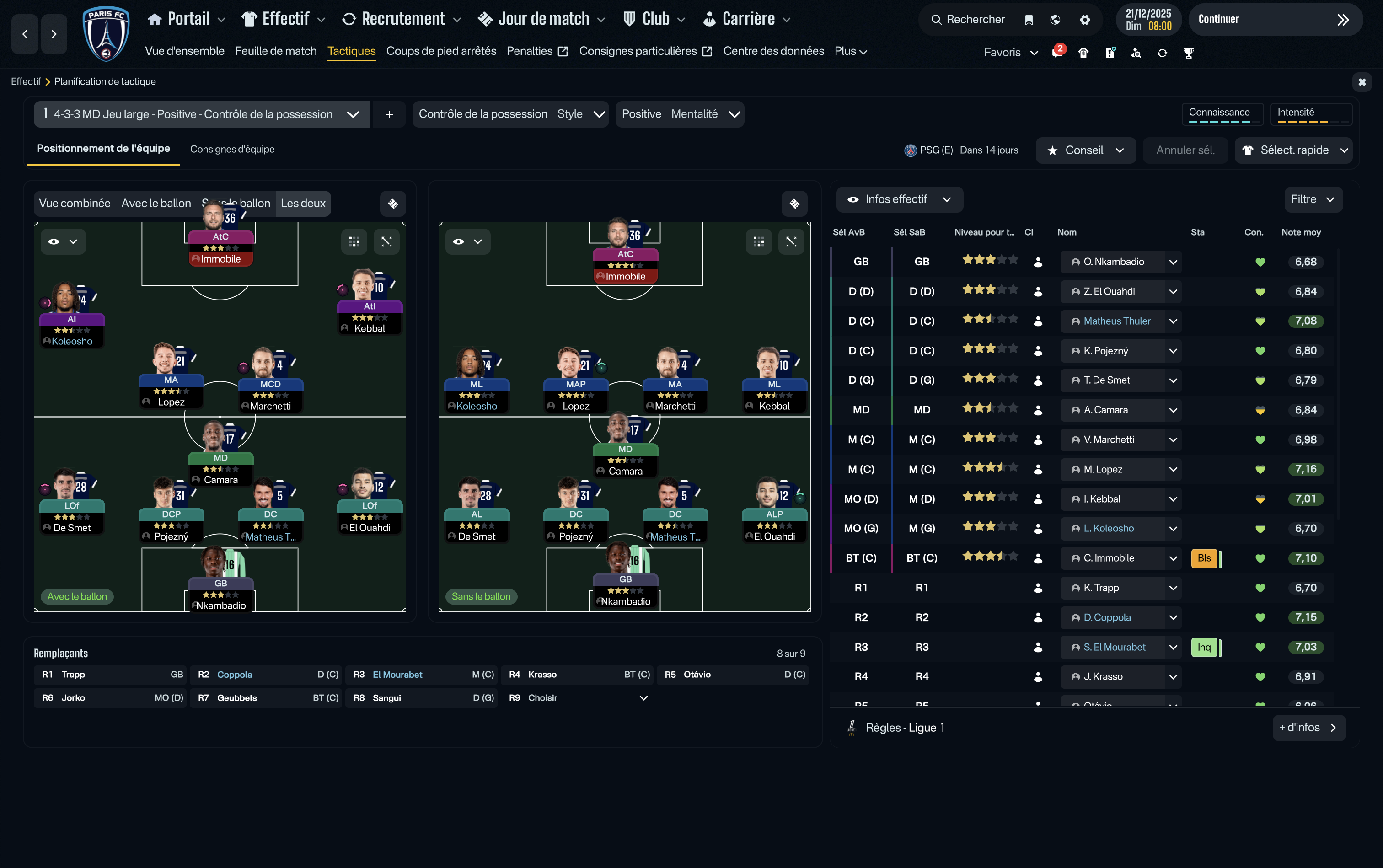
Formation & Style
Tactical Style:Positif - Contrôle de la possession
Mentality:Positive
Formation:4-3-3 MD large
Team Fluidity:Structured
In Possession
Shorter Passing
Play Out of Defence
Work Ball into Box
Focus Play through Middle
In Transition
Counter-Press
Counter
Out of Possession
Higher Defensive Line
More Aggressive Pressing
Team Shape Without Ball
Shape:Compact 4-4-2
Description:Defensive structure aims to close down space with a solid back four and organized midfield.
Evidence:Defenders positioned in a line with a DM supporting from behind, creating density.
Team Shape With Ball
Shape:Fluid 4-3-3
Description:Fluid attacking shape allows for dynamic movement and positional interchange among forwards.
Evidence:Inside forwards pull wide, creating room for the advanced forward to exploit central spaces.
Phase Description
Attacking Play
Focus on possession retention through patient play and controlled build-up, utilizing wide areas with overlapping full-backs.
Defensive Transition
Quick to press after losing the ball, aiming to regain possession rapidly.
Main Focus
Maximizing midfield control while using attacking width.
Key Strengths
Possession Control
Utilization of DLP-S at [4,3] allows for controlled build-up and linking the defense to attack.
Dynamic Attack
Inside forwards (IF-A) at [6,2] and [6,4] provide width and scoring options, complementing the central striker.
Strong Midfield Presence
With a mix of BWM-S and AP-A, the midfield can disrupt opposition play while also supporting attacks.
Conflicting Directions
Wide Play vs. Central Focus
Potential conflict between the inside forwards and midfield focus play through the middle.
Pressing Despite Compact Shape
Aggressive pressing may lead to spaces being exploited through fast counter-attacks.
Defensive Midfield Responsibility
DLP-S may lack defensive cover if not supported adequately by the BWM-S.
Tactical Suggestions
Adjust Midfield Setup
Consider adding a more defensive midfielder to enhance protection against counter-attacks.
Incorporate Overlapping Runs
Encourage full-backs to make overlapping runs to support inside forwards, creating more width.
Balance Pressing Intensity
Modulate pressing to ensure defensive stability while keeping pressing effectiveness.
Ask Questions About Your Lineup
Related Tactics
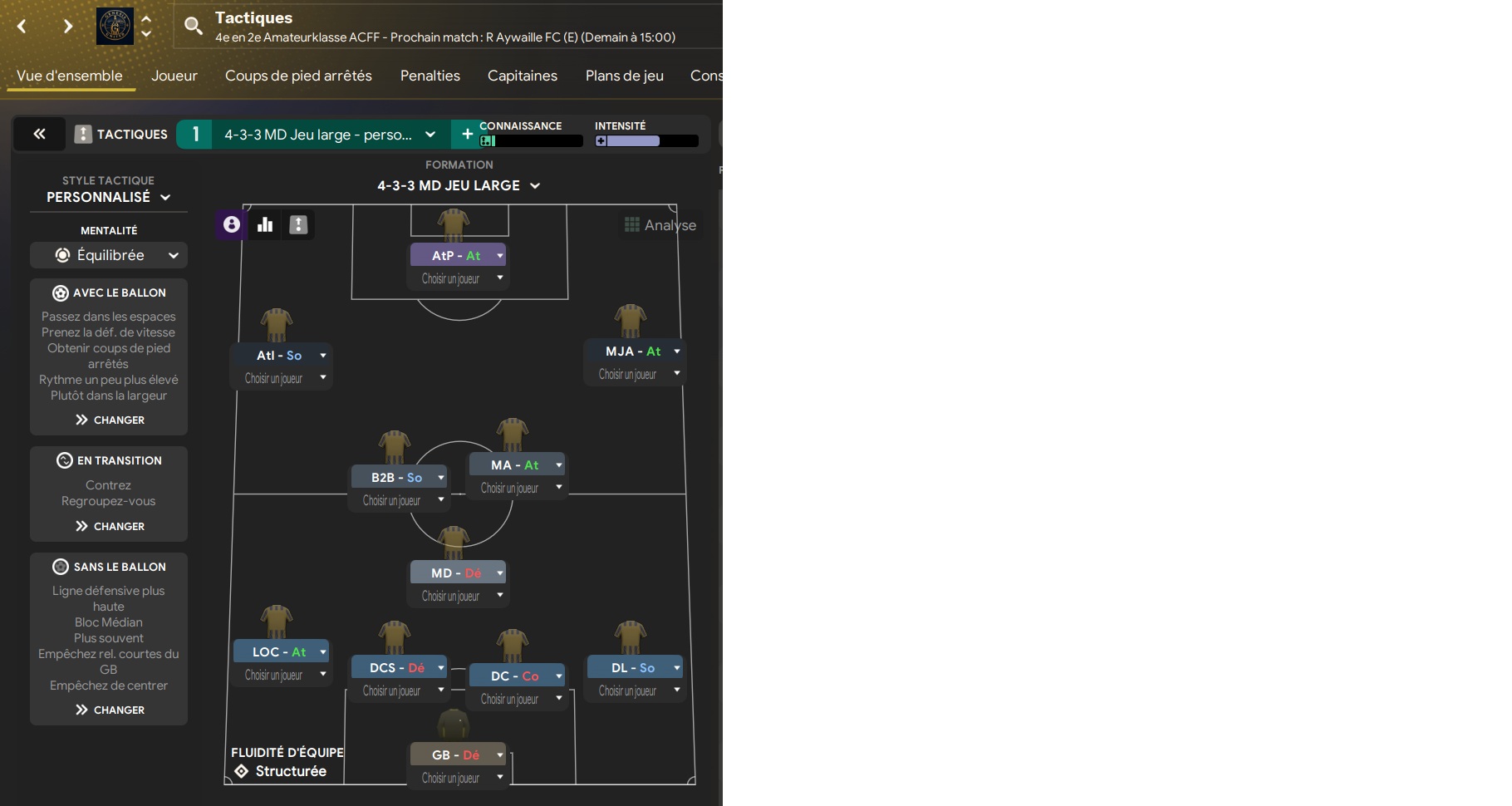
More Positif - Contrôle de la possession tactics
Guides for this formation
The tactical theory behind the 4-3-3 MD large: roles, instructions, and the trade-offs that decide whether the system holds up.
Foundations
Understanding the 4-3-3 Formation
Master the classic 4-3-3: player roles, tactical variations, and the trade-offs that decide whether it sings or stalls.
Read guide
Player pairings
Midfield Trios
Holder, runner, creator: the role distribution rule for three-man midfields, the AMC variants, and the antipatterns that break them.
Read guide
Playing styles
Gegenpressing: A Full Guide
Klopp-style gegenpressing in FM, including squad profile, line-and-press pairing, sustainable workload, and the antipatterns to avoid.
Read guide