Uploaded Tactic
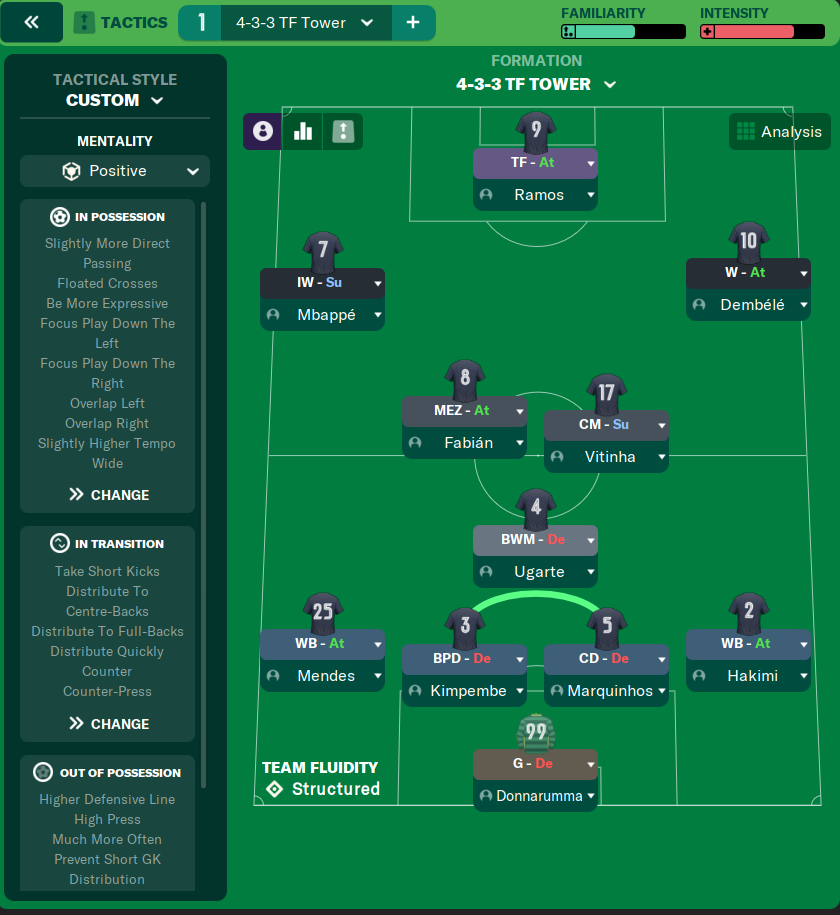
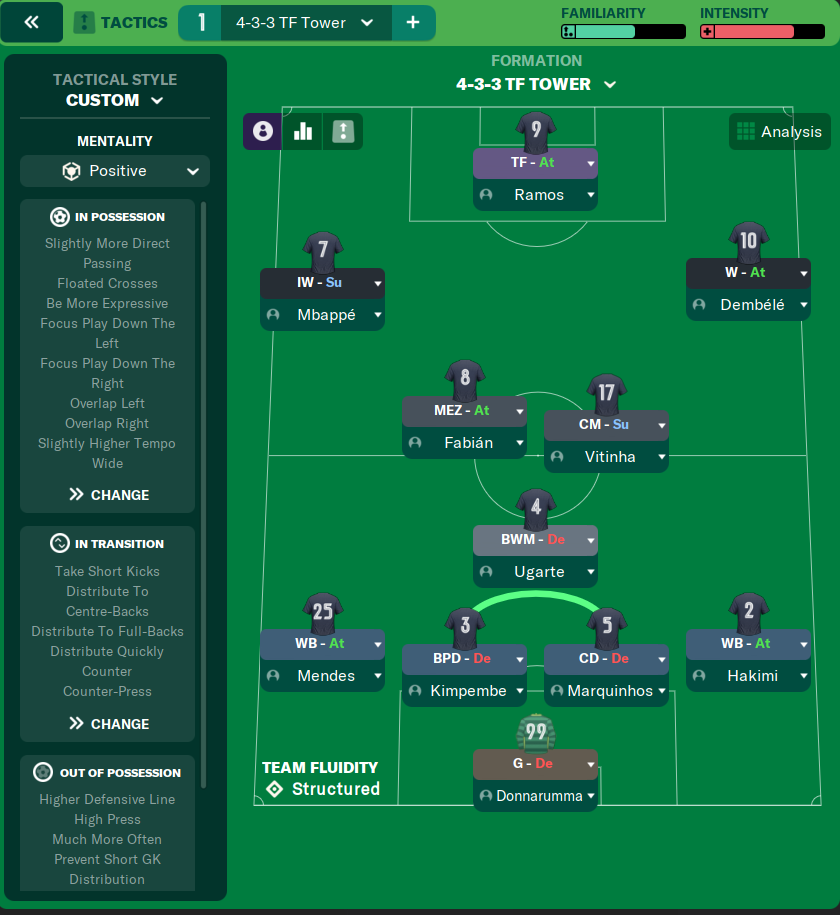
Formation & Style
Tactical Style:Custom
Mentality:Positive
Formation:4-3-3 TF Tower
Team Fluidity:Structured
In Possession
Slightly More Direct Passing
Floated Crosses
Be More Expressive
Focus Play Down The Left
Focus Play Down The Right
Overlap Left
Overlap Right
Slightly Higher Tempo
Wide
In Transition
Take Short Kicks
Distribute To Centre-Backs
Distribute To Full-Backs
Counter
Counter-Press
Out of Possession
Higher Defensive Line
High Press
Much More Often Prevent Short GK Distribution
Team Shape Without Ball
Shape:Compact
Description:A compact defensive shape utilizing a higher defensive line to compress space for the opposition, supported by an aggressive press.
Evidence:High Press and Higher Defensive Line with BWM at [4,3] maintaining structure.
Team Shape With Ball
Shape:Wide and Vertical
Description:A wide attack supported by overlapping full-backs, allowing for vertical movement in the final third.
Evidence:Overlap instructions and the dynamic positioning of Wing-Backs at [2,1] and [2,5], combined with the target forward at [6,3].
Phase Description
Attacking Play
Focuses on utilizing width through overlapping wing-backs and inside forwards, creating space for attacking options.
Defensive Transition
Employs a quick counter-press and short distribution to regain possession immediately after losing the ball.
Main Focus
Leverage the combined attacking threat of inside forwards and wing-backs to maximize offensive output while maintaining a solid midfield presence.
Key Strengths
Width and Overlap
Utilizing overlapping wing-backs creates space for wingers and inside forwards.
Midfield Control
A solid midfield triangle ensures dominance in central areas.
Dynamic Attack
Flexible attacking options from various roles exploit defensive weaknesses.
Conflicting Directions
High Defensive Line and Counter-Press
A high line may expose the defense during counter-attacks if the pressing is ineffective.
Inverted Wide Play
The wingers may become too narrow, leading to a lack of width unless the wing-backs provide support.
Aggression vs. Stability
Excessive pressing might lead to defensive vulnerabilities against counter-attacks.
Tactical Suggestions
Adjust Defensive Line
Consider lowering the defensive line against pacey opponents to reduce vulnerability to through balls.
Utilize Central Options
Encourage central midfielders to contribute more to attacks, especially the CM role.
Enhance Ball Distribution
Implement tactical instructions for the goalkeeper to vary distribution based on the game situation.
Ask Questions About Your Lineup
Related Tactics
Guides for this formation
The tactical theory behind the 4-3-3 TF Tower: roles, instructions, and the trade-offs that decide whether the system holds up.
Foundations
Understanding the 4-3-3 Formation
Master the classic 4-3-3: player roles, tactical variations, and the trade-offs that decide whether it sings or stalls.
Read guide
Player pairings
Midfield Trios
Holder, runner, creator: the role distribution rule for three-man midfields, the AMC variants, and the antipatterns that break them.
Read guide
Playing styles
Gegenpressing: A Full Guide
Klopp-style gegenpressing in FM, including squad profile, line-and-press pairing, sustainable workload, and the antipatterns to avoid.
Read guide