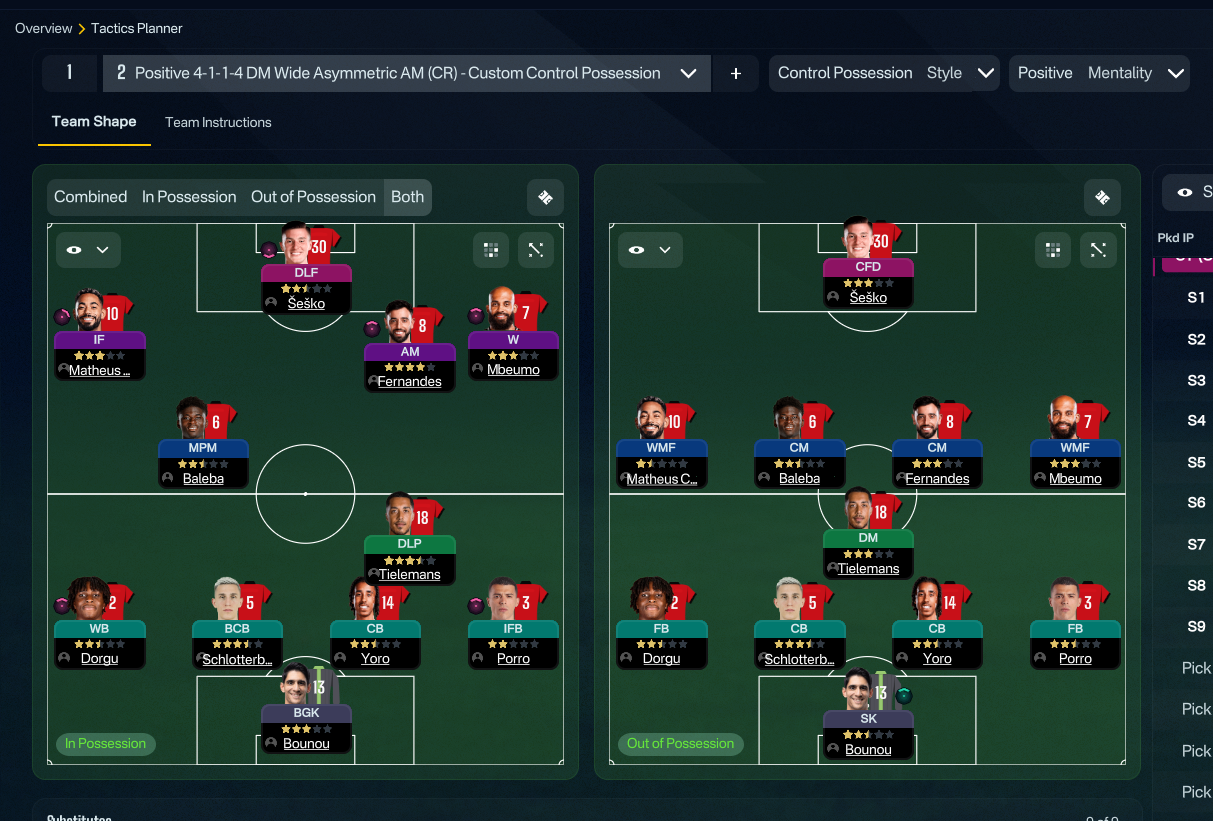
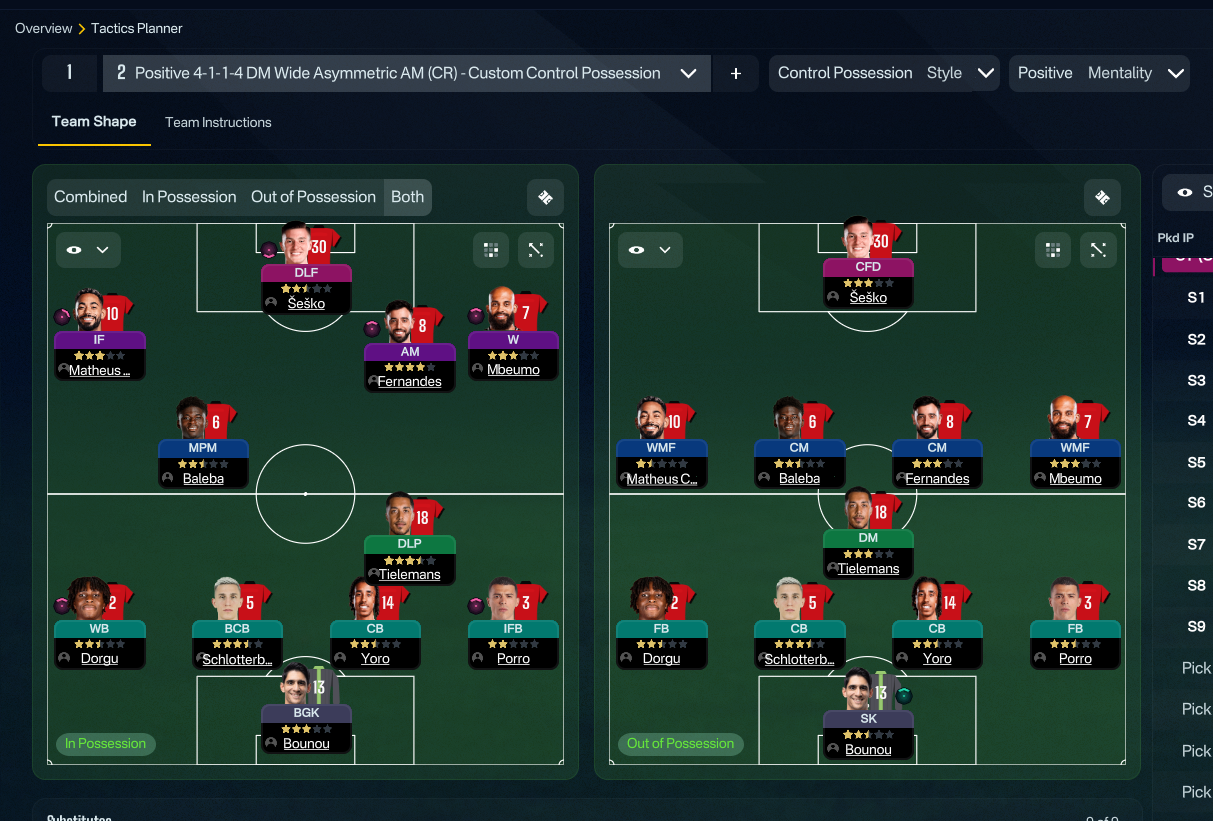
4-1-1-4 Wide Asymmetric
Maintaining control of the game while being direct in attacking phases. Utilizes inside forwards and attacking midfielder to create numerical superiority…
Loading tactical analysis...
Custom Control Possession
Positive
4-1-1-4 Wide Asymmetric
Control Possession
Work Ball Into Box
Shorter Passing
Counter-Press
Counter
Higher Line of Engagement
Higher Defensive Line
Prevent Short GK Distribution
GK
Sweeper Keeper
Support
DEF
Ball-Playing Defender
Defend
DEF
No-Nonsense Centre-Back
Defend
DEF
Inverted Full-Back
Support
DEF
Wing-Back
Support
DM
Deep-Lying Playmaker
Support
CM
Central Midfielder
Support
CM
Mezzala
Support
AM
Attacking Midfielder
Attack
ST
Complete Forward
Attack
AM
Inside Forward
Attack
Focuses on quick ball movement and utilizing wide players to stretch the opposition.
Emphasis on quickly regaining possession through a counter-press.
Maintaining control of the game while being direct in attacking phases.
4-1-4-1
A compact formation with a solid midfield cover behind the attacking line.
DM (DLP-S) at [3,3] supports the back line while maintaining a balance.
4-1-1-4
Asymmetrical setup allowing width through the wing-backs and attacking width through inside forwards.
IF (Matheus at [6,1]) and WMF (at [5,1]) provide wide threats, complemented by inner midfielder runs.
Utilizes inside forwards and attacking midfielder to create numerical superiority in the final third.
IF (Matheus) at [6,1] and AM (Fernandes) at [5,2].
Focus on short passing and working the ball into the box helps maintain possession and control.
Control Possession and Work Ball Into Box tactics.
A higher defensive line can expose the team to counter-attacks, especially against fast forwards.
Higher Defensive Line evident with potential vulnerability to through balls.
Heavy reliance on wing-backs might lead to central midfield being overrun if wing play is ineffective.
WB (Dorgu and Porro) are instrumental in attack but could leave midfield exposed.
Defensive Vulnerability
High defensive line increases exposure to quick counters.
Higher Defensive Line and Higher Line of Engagement may invite pressure.
Central Overload
Potential for midfield to be outnumbered against a 2 or 3-man opposition midfield.
Asymmetric formation leads to potential gaps in central areas.
DLP with Complete Forward
DLP (Tielemans) can provide through balls for the CF (Šeško), enhancing attacking opportunities.
DLP (Tielemans) at [3,3] supporting the CF (Šeško) at [6,3].
Wing-Backs with Inside Forwards
Wing-Backs can overlap with Inside Forwards, providing width and attacking options.
WB (Dorgu at [2,1] and Porro) can create space for IF (Matheus) at [6,1].
How can I improve ball recovery in midfield?
Should I consider rotating key attacking players frequently?
What are the best ways to adjust my team for different opponent styles?
The tactical theory behind the 4-1-1-4 Wide Asymmetric: roles, instructions, and the trade-offs that decide whether the system holds up.
FM27 keeps FM26's tactic system. Here is what stays the same, the small changes that can catch you out, and what the new Tactical Effectiveness system asks of you.
How Mentality, Duty, and Role interact in FM, why duty trumps mentality every time, and the role-on-top-of-duty composition rules.
Counter-Press, Regroup, Stand Off, Trigger Press: what each pressing instruction does in FM and how to pair them without contradicting.