3-2-1-4
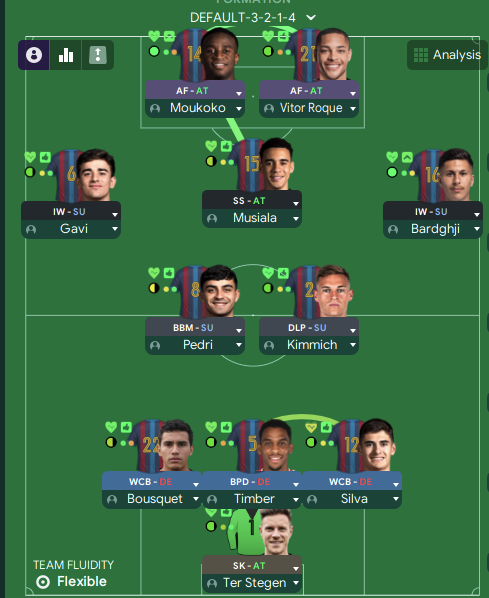
Exploit the space behind the opposition with pacey forwards. Moukoko and Vitor Roque both have attacking duties, providing depth in the final third.
Loading tactical analysis...
Balanced
Attacking
3-2-1-4
Flexible
Work ball into box
Play out of defence
Focus play down the wings
Counter-press
Counter
Higher Line of Engagement
Higher Defensive Line
Prevent Short GK Distribution
GK
Sweeper Keeper
Defend
CB
Ball-Playing Defender
Defend
CB
Wide Centre-Back
Defend
CB
Wide Centre-Back
Defend
CM
Deep-Lying Playmaker
Support
CM
Box-to-Box Midfielder
Support
AM
Shadow Striker
Attack
AM
Inside Winger
Support
AM
Inside Winger
Support
ST
Advanced Forward
Attack
ST
Advanced Forward
Attack
Focus on using the width created by the inside wingers to spread the defence and create central lanes for the striker and shadow striker.
Immediately recover the shape and apply pressure on the ball when possession is lost.
Exploit the space behind the opposition with pacey forwards.
3-2-1-4
Solid triangular formation in defence, offering both stability and flexibility to press.
Three Centre-Backs at [2,1] [2,2] [2,3] and two midfielders ready to cover.
3-2-1-4
Wide attackers occupying full-backs, supporting central penetration from the shadow striker and forwards.
The configuration allows for both width and depth in attack.
Moukoko and Vitor Roque both have attacking duties, providing depth in the final third.
AF-AT roles at [6,2] and [6,3] enabling quick transitions into attack.
Kimmich and Pedri can transition between offensive support and defensive duties, allowing flexible movement.
DLP-S and BBM-S roles at [4,2] and [4,3] contributing to both attack and defence.
With multiple attackers, the team risks defensive vulnerabilities when possession is lost.
AF-AT roles at [6,2] and [6,3] are exposed in transition without adequate support.
The midfield structure may struggle against teams with strong central presence.
Only two central midfielders at [4,2] and [4,3] versus potential 3 or 4 in opposition.
Defensive Transitions
High pressing could leave the defense exposed to counter-attacks if possession is lost.
High Line of Engagement may invite through balls against a fast opposition.
Midfield Overload
Opponents could exploit the two-man midfield against three-man systems.
BBM-S at [4,2] and DLP-S at [4,3] may be overrun.
DLP-S and BBM-S
Kimmich and Pedri complement each other, balancing defensive and offensive responsibilities.
Deep-Lying Playmaker's distribution pairs well with Box-to-Box Midfielder's late runs.
IW-S and AF-AT
Inside Wingers Gavi and Bardghji create spaces for advanced forwards Moukoko and Roque.
Wingers drawing defenders allows strikers to exploit gaps.
How can we improve our defensive resilience against counter-attacks?
Should we consider a more conservative approach when facing stronger opponents?
What roles might best suit an incoming player to enhance our tactical setup?
The tactical theory behind the 3-2-1-4: roles, instructions, and the trade-offs that decide whether the system holds up.
Why circulation density and zonal occupation aren't the same thing in FM, and the half-space occupation rule that decides build-up.
Mentality, duty, role, instruction, sub. The change hierarchy from lightest to heaviest intervention, and 60th-minute patterns by game state.
Pass map, average position, xG, possession by zone: what each tablet panel tells you in FM and the tactical change it should trigger.