3-2-3-1 DM, Asymmetric AM (R)
Utilizing width and creating overloads on the flanks. The tactical setup allows the wingers to exploit space down the flanks, creating opportunities.
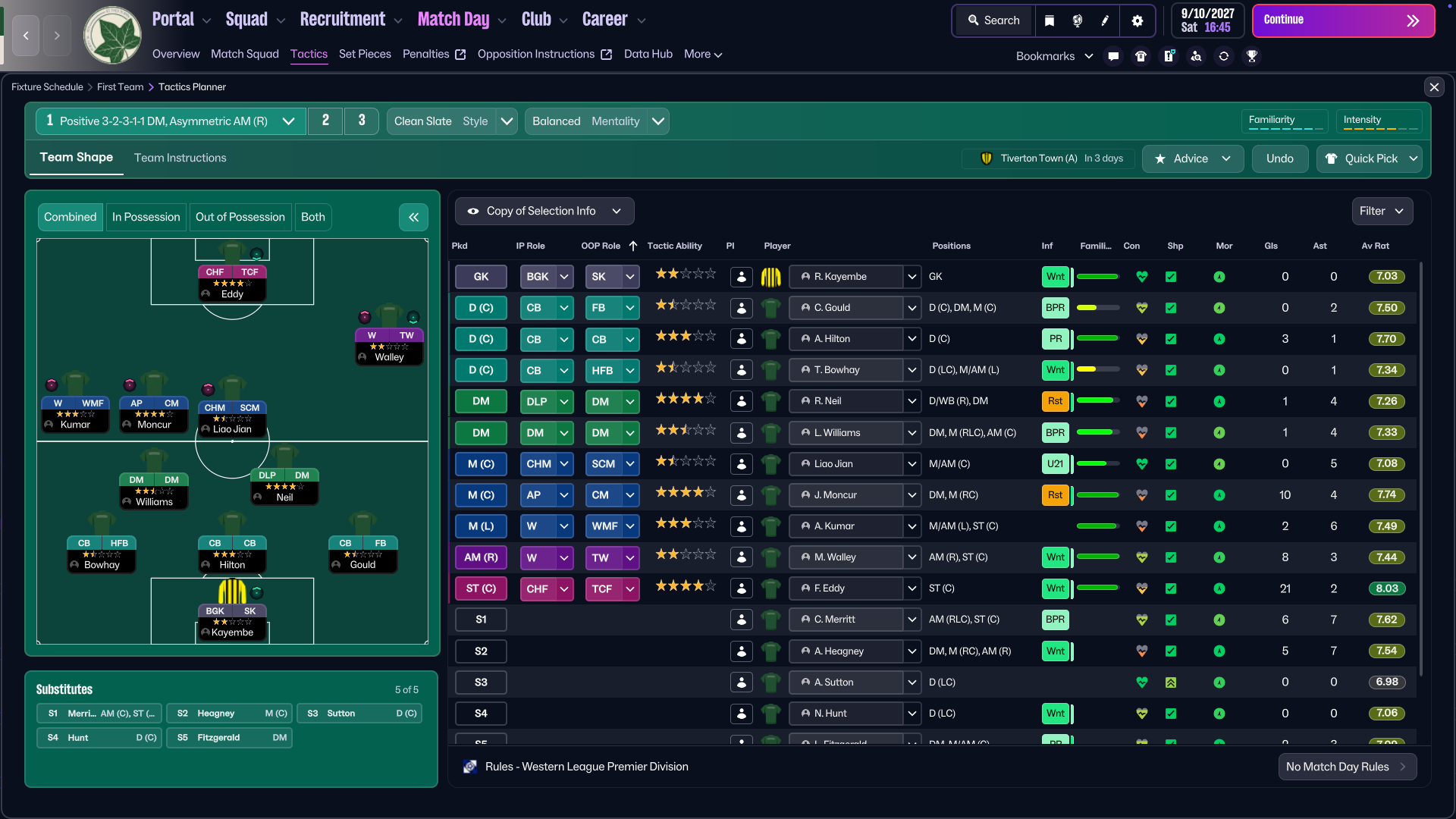
Loading tactical analysis...
Balanced
Positive
3-2-3-1 DM, Asymmetric AM (R)
Work Ball Into Box
Play Out of Defence
High Tempo
Counter
Counter Press
Higher Defensive Line
Higher Line of Engagement
Prevent Short GK Distribution
Trigger Press More Often
GK
Goalkeeper
Defend
CB
Centre-Back
Defend
CB
Centre-Back
Defend
FB
Full-Back
Support
DM
Deep-Lying Playmaker
Support
DM
Defensive Midfielder
Defend
CM
Central Midfielder
Support
AM
Advanced Playmaker
Support
W
Winger
Support
W
Wide Playmaker
Support
ST
Target Forward
Attack
Quick transitions with a focus on both wings and an advanced playmaker feeding the strikers.
Aim to recover possession quickly through counter-pressing.
Utilizing width and creating overloads on the flanks.
3-2-3-1
Compact defensive structure with emphasis on central solidity and support from midfield.
Three centre-backs and two defensive midfielders providing stability.
3-2-3-1
Maximizes width with wingers and a central attacking threat, focusing on quick passing combinations.
Wingers positioned wide, creating space for the central players.
The tactical setup allows the wingers to exploit space down the flanks, creating opportunities.
W and TW roles at [6,1] and [6,5] support wide attacks.
The presence of a deep-lying playmaker helps in dictating the pace and controlling the midfield passages.
DLP-S at [3,3] combined with DM-S at [3,2].
While focusing on quick recoveries, the team's defensive shape may be disrupted if possession is lost.
Counter-Press in conjunction with higher line of engagement.
Heavy reliance on wing play might leave the team vulnerable if the wingers are effectively neutralized.
Presence of multiple wide roles (W and WM) without sufficient central support.
Defensive Transition
Potentially exposed during counter-attacks due to higher lines.
Higher Defensive Line and Trigger Pressing create risk.
Wide Defensive Areas
The formation could lead to vulnerabilities if wingers fail to track back.
W and WM roles may not provide sufficient defensive cover.
DLP-S and Wingers
DLP role can create through balls for wingers to exploit defensive lines.
DLP-S at [3,3] can supply W and WM roles directly.
Central Midfield and Advanced Playmaker
The synergy allows for quick one-twos and dynamic movement in the attacking phase.
AP roles combined with CM and CHM facilitate attacking transitions.
How can the wingers be more effectively integrated into central play?
What adjustments can be made during transitions to maintain shape?
Should roles be reconsidered when facing stronger opponents?
The tactical theory behind the 3-2-3-1 DM, Asymmetric AM (R): roles, instructions, and the trade-offs that decide whether the system holds up.
Why circulation density and zonal occupation aren't the same thing in FM, and the half-space occupation rule that decides build-up.
Pass map, average position, xG, possession by zone: what each tablet panel tells you in FM and the tactical change it should trigger.
FM27 keeps FM26's tactic system. Here is what stays the same, the small changes that can catch you out, and what the new Tactical Effectiveness system asks of you.