
4-2-3-1 Wide
The Gegenpress style effectively utilizes players to pressure opponents immediately after losing possession, recovering the ball quickly.
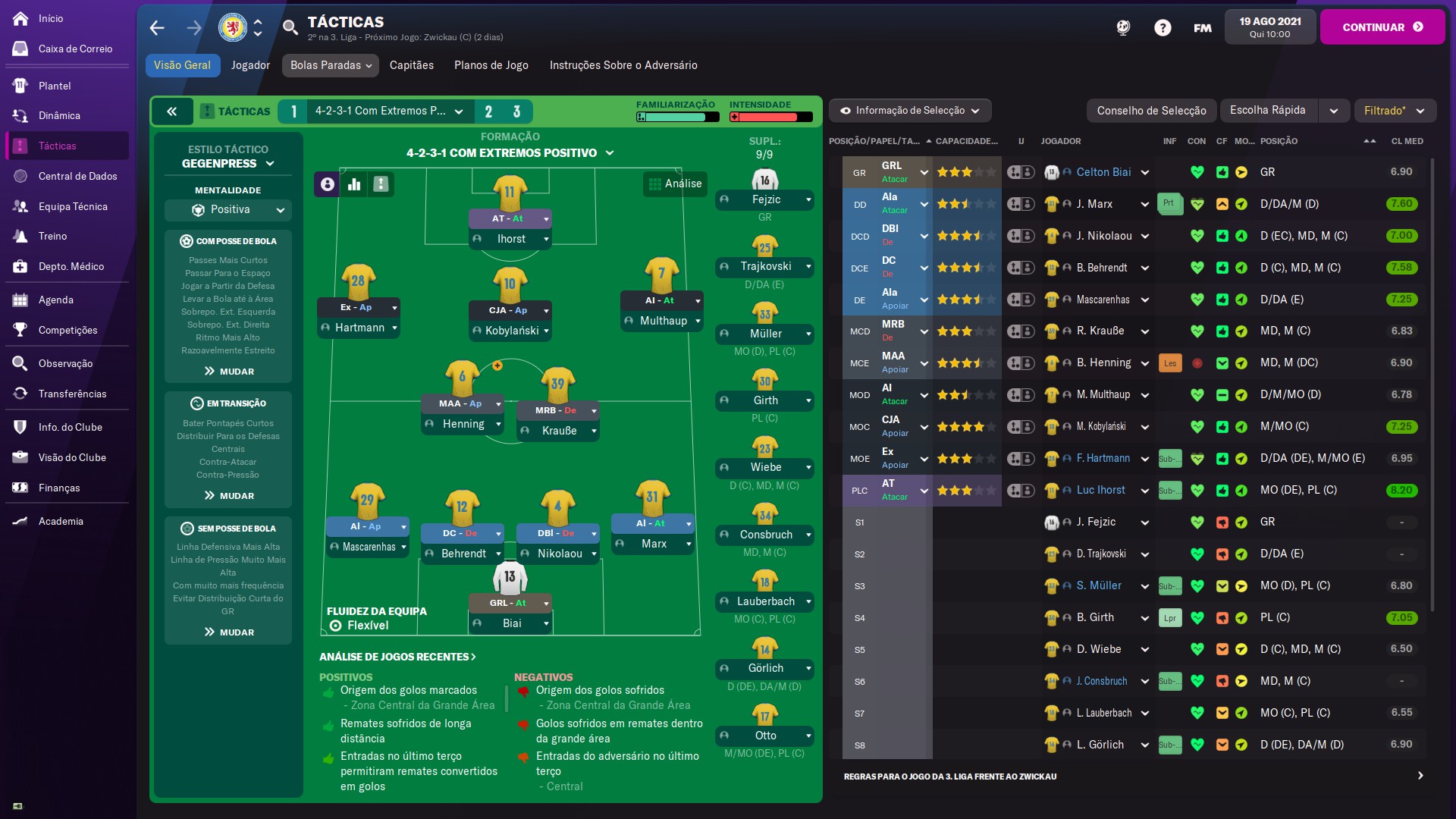
Loading tactical analysis...
Gegenpress
Positive
4-2-3-1 Wide
Flexible
Short Passing
Play Out of Defence
Attack Down Left
Overlap Left
Counter-Press
Counter
Higher Defensive Line
More Urgent Pressing
Defensive Width Narrow
GK
Goalkeeper
Attack
DM
Ball-Winning Midfielder
Support
MCL
Advanced Playmaker
Attack
MCR
Box-to-Box Midfielder
Support
AML
Inside Forward
Attack
AMR
Inside Forward
Attack
ST
Advanced Forward
Attack
The Gegenpress style effectively utilizes players to pressure opponents immediately after losing possession, recovering the ball quickly.
With Inside Forwards and an overlapping fullback, the formation can stretch opponents and create more space for attackers.
Using a Goalkeeper with an Attack duty could lead to too much risk, potentially leaving the team exposed on counter-attacks.
Excessive focus on the left flank might make the attack predictable, allowing opponents to adjust and defend more efficiently.
How can we improve our right-sided attacking threat?
Are our defensive shapes effectively holding against counter-attacks?
Is the current midfield combination providing enough defensive support?
How can we better utilize set pieces with our aerial strengths?
What strategies can be implemented to reduce goals conceded from counter-attacks?
Is the distribution from the goalkeeper suitable for our playing style?
The tactical theory behind the 4-2-3-1 Wide: roles, instructions, and the trade-offs that decide whether the system holds up.
Double pivots and flat pairs in 4-2-3-1 and 4-4-2: when each pairing works, when it collapses, and the AMC unicorn that rescues both.
Klopp-style gegenpressing in FM, including squad profile, line-and-press pairing, sustainable workload, and the antipatterns to avoid.
Counter-Press, Regroup, Stand Off, Trigger Press: what each pressing instruction does in FM and how to pair them without contradicting.











