
4-2-3-1 Wide
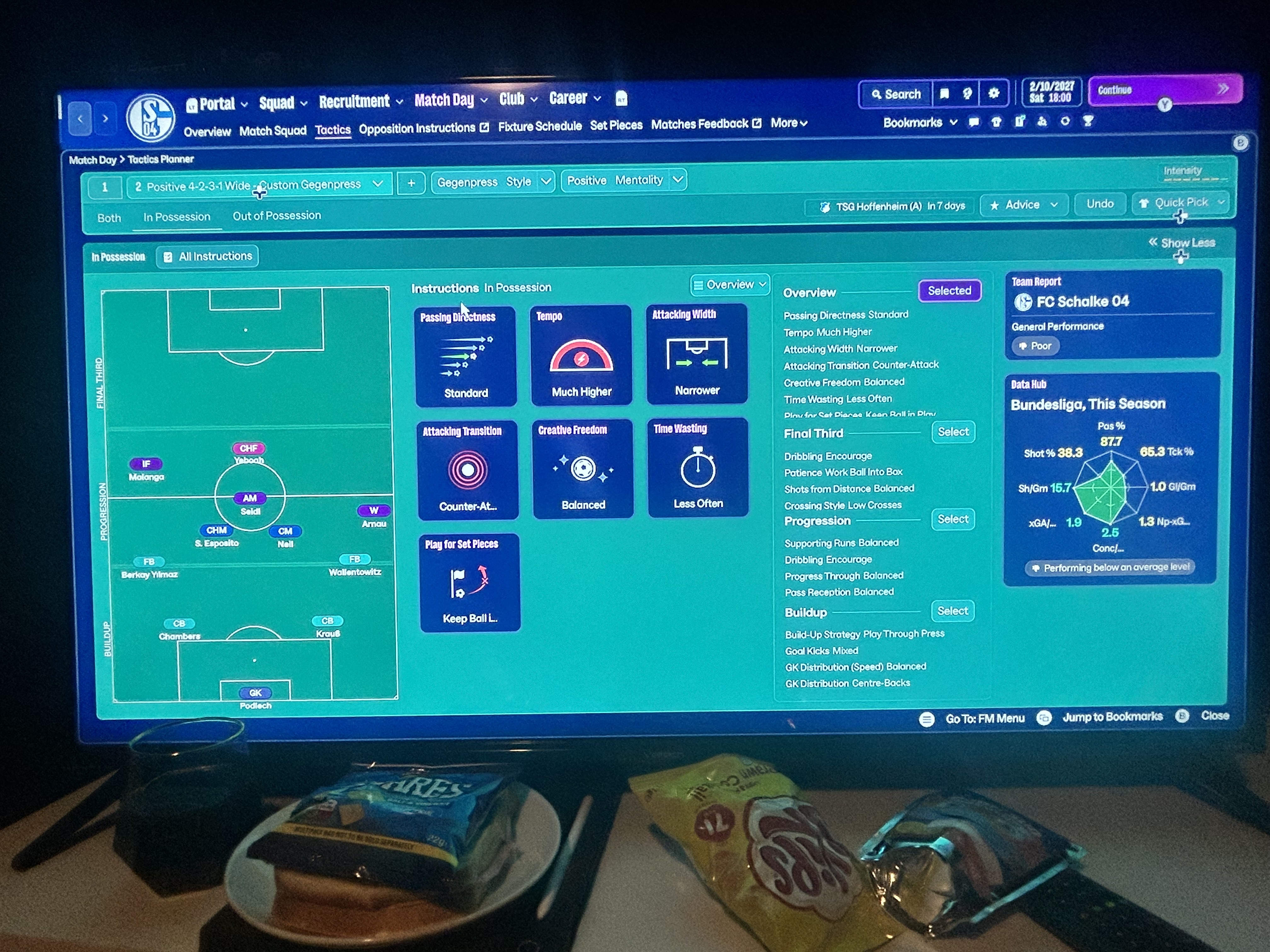
Exploit width with wing-backs while creating central overloads using the AM Utilization of varied roles in attack creates unpredictability.
Loading tactical analysis...
Gegenpress
Positive
4-2-3-1 Wide
Much Higher Tempo
Narrower
Counter-Attack
Creative Freedom Balanced
Play for Set Pieces: Keep Ball
Counter-Press
Distribute to Centre-Backs
Higher Defensive Line
Higher Line of Engagement
Prevent Short GK Distribution
Trigger Press Much More Often
GK
Goalkeeper
De
CB
No-Nonsense Centre-Back
De
CB
No-Nonsense Centre-Back
De
FB
Wing-Back
At
FB
Wing-Back
At
CM
Central Midfielder
Su
CM
Ball-Winning Midfielder
De
AM
Attacking Midfielder
At
IF
Inside Forward
At
W
Winger
At
Quick transitions leveraging agility of inside forward and winger while using the AM as a creative hub.
Immediate press upon losing possession to regain control and initiate counter-attack.
Exploit width with wing-backs while creating central overloads using the AM
Flat 4-2 with aggressive pressing
Central midfielders drop back to form a double pivot during defensive situations.
BWM at [3,3] and CM at [4,3] providing cover for centre-backs.
Dynamic shape with fluid movements
Wingers and inside forward interchanging positions to create confusion and space.
IF at [6,2] and W at [6,5] maintaining width while also cutting inside.
Utilization of varied roles in attack creates unpredictability.
AM at [5,3], IF at [6,2], and W at [6,5] offering numerous options.
The presence of a BWM adds additional cover and aggression in midfield.
BWM at [3,3] ensuring control in central areas.
High line might leave space for opposing forwards to exploit should possession be lost.
Higher Defensive Line instruction.
May find it hard to break down teams that deploy a deep and wide defensive setup.
Narrower attacking width instruction could conflict with breaking wid
Defensive Vulnerability
High pressing and a narrow midfield may leave gaps for counter-attacks.
Trigger Press Much More Often and Higher Defensive Line.
Over-reliance on Width
Dependence on wing-backs creates risk of being one-dimensional.
Wing-Backs at [2,4] and [2,5] might be targeted if isolated.
AM and Winger
Provides a dynamic triangle for swapping positions and confusing defenders.
AM at [5,3] creates space for Winger at [6,5].
Wing-Backs and Inside Forward
Allows for overlapping runs which can overload the opposition.
FB at [2,4] and IF at [6,2] can create two-on-one situations.
How does the formation perform against teams that play compactly?
What adjustments can be made against counter-attacking teams?
Is the current width effective in creating space in tight matches?
The tactical theory behind the 4-2-3-1 Wide: roles, instructions, and the trade-offs that decide whether the system holds up.
Double pivots and flat pairs in 4-2-3-1 and 4-4-2: when each pairing works, when it collapses, and the AMC unicorn that rescues both.
Klopp-style gegenpressing in FM, including squad profile, line-and-press pairing, sustainable workload, and the antipatterns to avoid.
Mentality, duty, role, instruction, sub. The change hierarchy from lightest to heaviest intervention, and 60th-minute patterns by game state.











