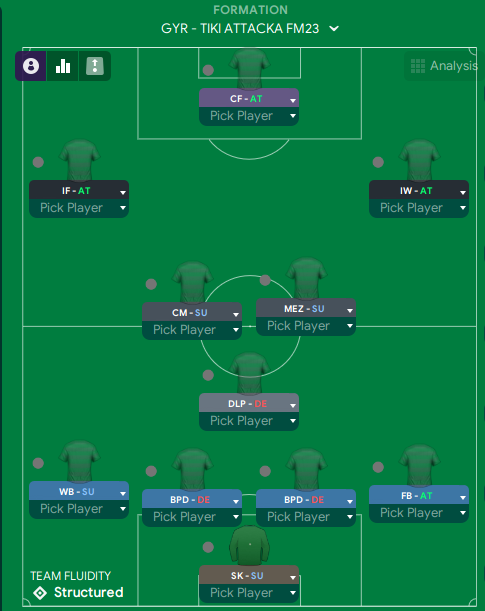
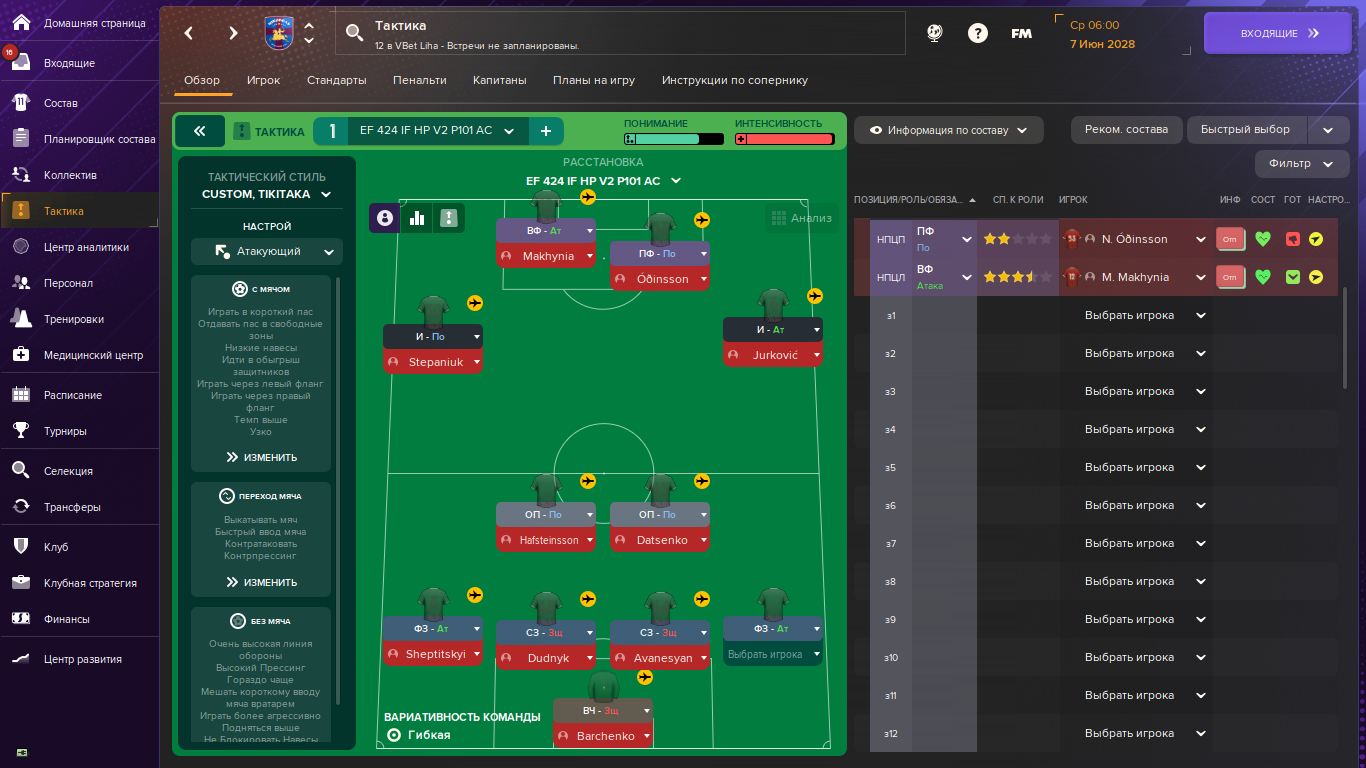
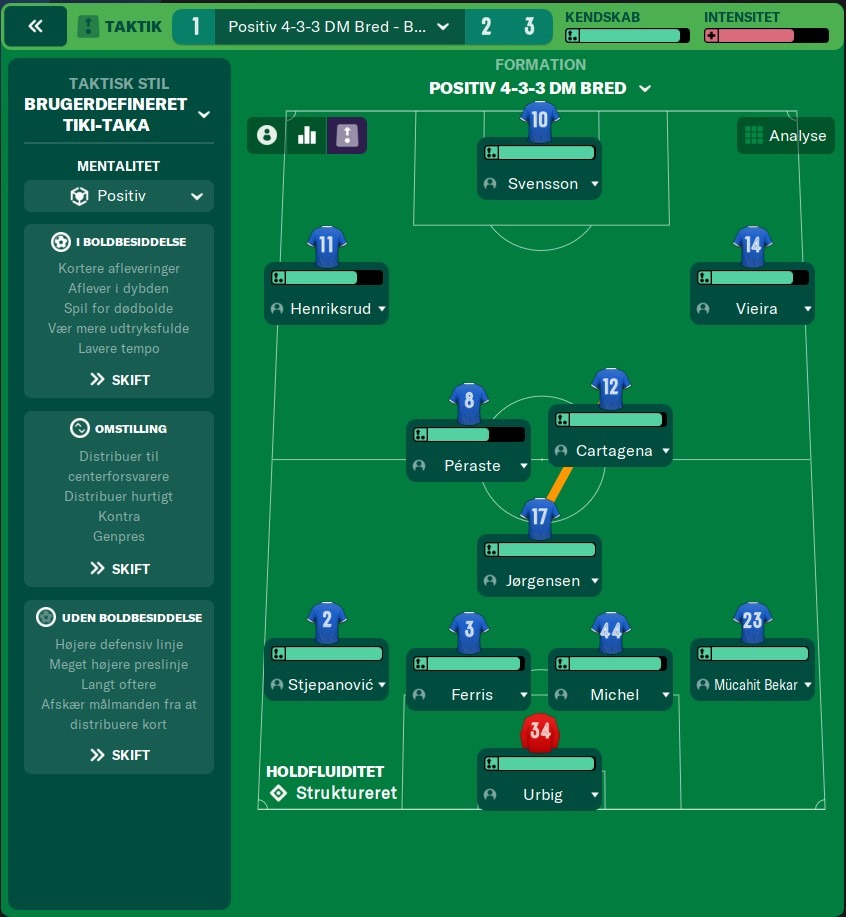
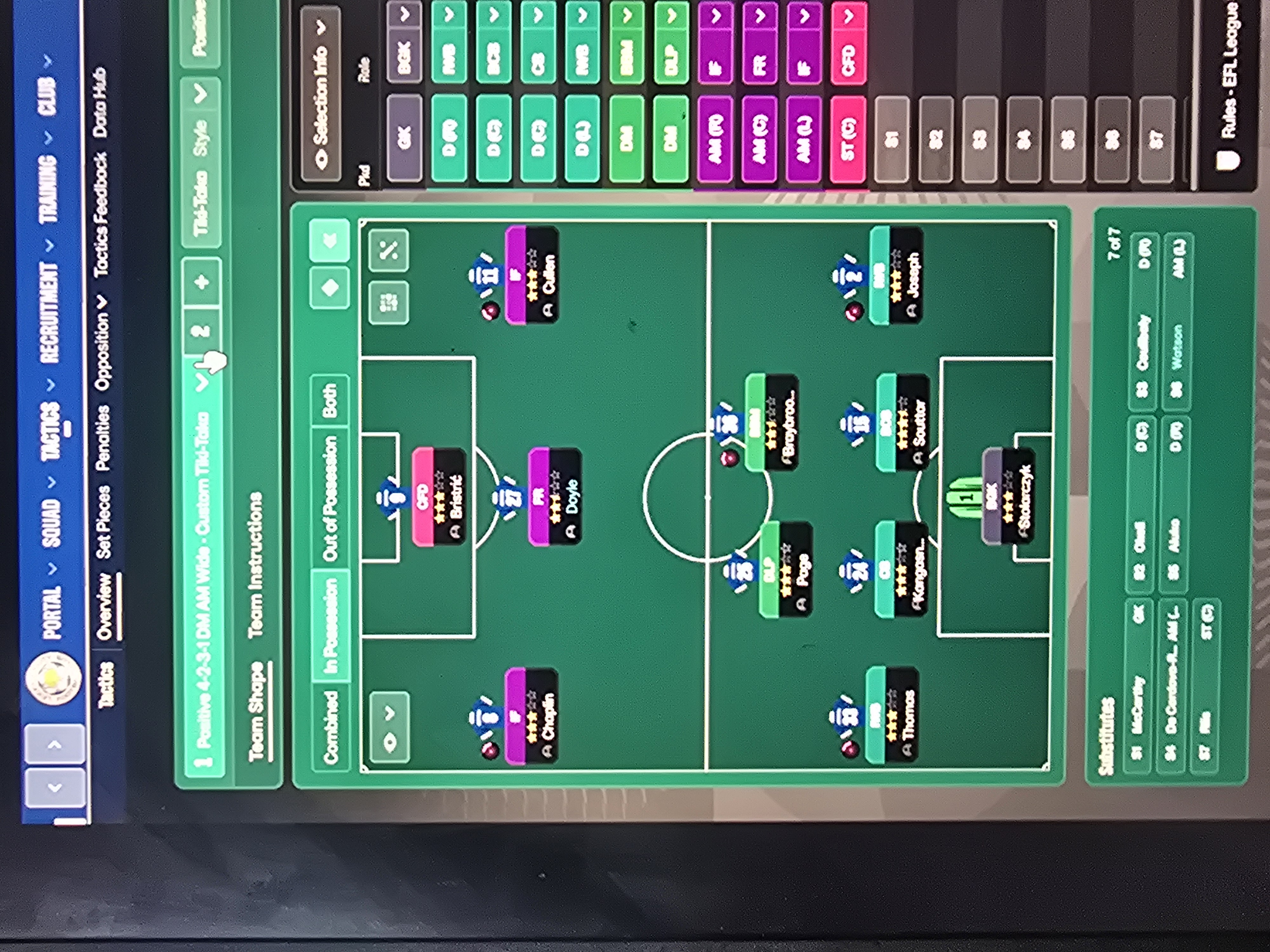
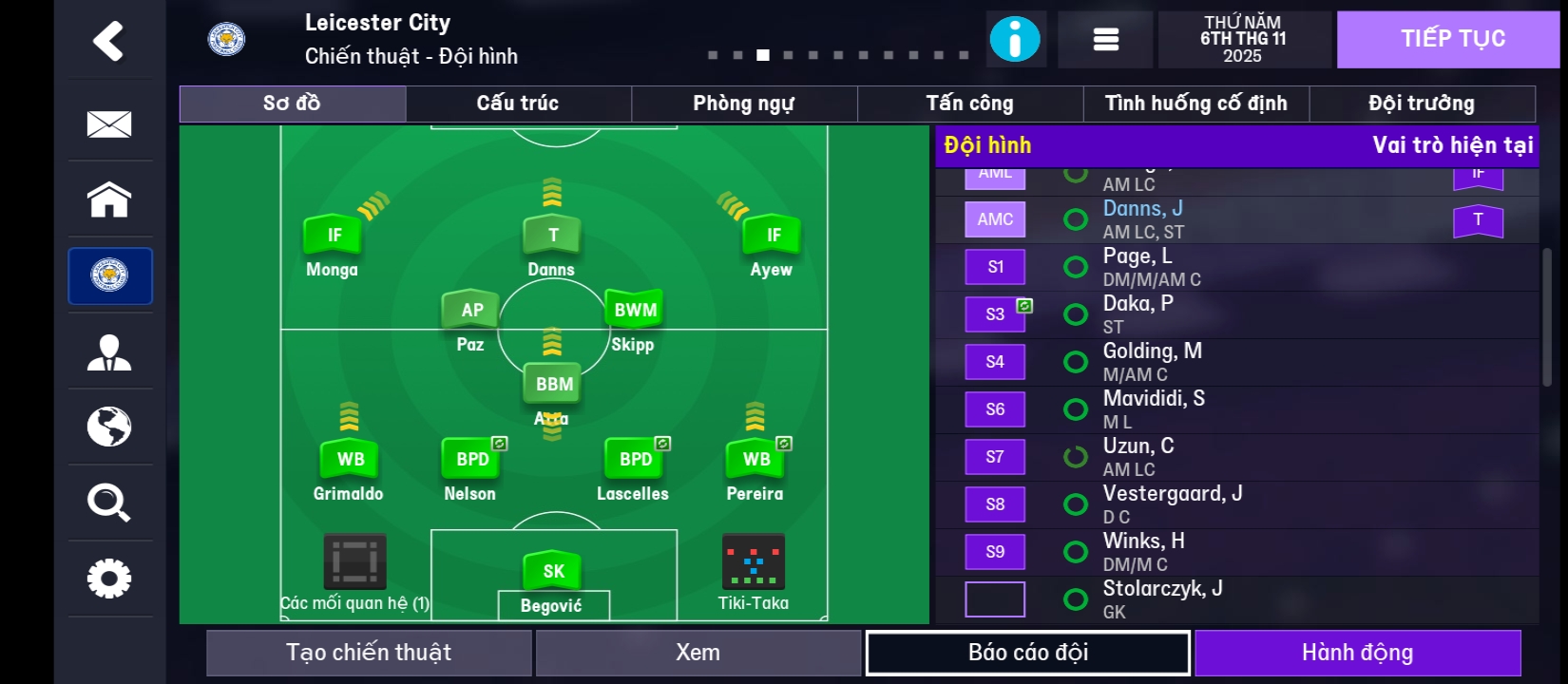
4-2-3-1 Wide
Controlling possession through central combinations. Tiki-taka with shorter passing, play out of defence, rolling it out and distributing to centre-backs…

Loading tactical analysis...
Tiki-Taka
Positive
4-2-3-1 Wide
Structured
GK
Sweeper Keeper
Defend
DL
Inverted Full-Back
Defend
DC
Centre-Back
Defend
DC
Centre-Back
Defend
DR
Full-Back
Attack
MC
Central Midfielder
Support
MC
Deep-Lying Playmaker
Defend
AML
Winger
Attack
AMC
Attacking Midfielder
Attack
AMR
Inside Forward
Support
ST
Pressing Forward
Support
Shorter Passing
Play Out of Defence
Focus Play Through the Middle
Work Ball Into Box
Low Crosses
Slightly Lower Tempo
Fairly Narrow Attacking Width
Counter-Press
Roll It Out
Distribute to Centre-Backs
Higher Defensive Line
Trigger Press More Often
Standard Line of Engagement
Tiki-taka with shorter passing, play out of defence, rolling it out and distributing to centre-backs gives a consistent possession-based build-up from the keeper.
SK (De) at [1,3] plus CB at [2,2] and [2,4] fit the short build-up instructions.
Focusing play through the middle with a DLP, AM and PF gives many passing options between the lines.
DLP (De), AM (At) and PF (Su) at [4,4], [5,3] and [6,3] link the central play.
A higher defensive line with a standard line of engagement and no explicit pressing urgency leaves a gap between the lines for opponents to exploit.
CB at [2,2] and [2,4] hold a high line while the front line engages at a standard height.
Low crosses are of little use when attacking width is fairly narrow and the central areas are crowded, which makes the wide roles less effective.
W (At) at [5,1] and FB (At) at [2,5] are the wide outlets.
Space behind the high line
Slow centre-backs with a high line are exposed to through balls, and the keeper is in a defensive duty.
CB at [2,2] and [2,4] with SK (De) at [1,3].
high
Right flank exposure
An attacking FB on one side and an IF behind a Su duty winger leave the right side open to counters.
FB (At) at [2,5] and IF (Su) at [5,5].
medium
DLP + AM + PF
The deep playmaker feeds the attacking midfielder, who combines with the supporting false-nine style forward.
DLP at [4,4], AM at [5,3], PF at [6,3].
DLP + AM + PF
IFB + CM
The inverted full-back tucks into midfield and adds a passing option beside the central midfielder.
IFB (De) at [2,1] and CM (Su) at [4,2].
IFB + CM
Do your centre-backs have the pace to defend a higher line?
Are your wide players strong enough to justify wider play?
Patient short passing from the back, focused through the middle with a narrow shape.
Counter-press immediately after losing the ball.
Controlling possession through central combinations.
4-4-1-1
A compact block with a high line and the front players pressing from the middle.
CM at [4,2] and DLP at [4,4] form the midfield pair, with PF at [6,3].
3-2-4-1
The inverted full-back tucks into midfield, the other full-back pushes on, and the attacking line is narrow.
IFB at [2,1], FB at [2,5], AM at [5,3] and PF at [6,3].
This is a coherent possession tactic with a good short build-up and strong central combinations. Its main weakness is a high defensive line that is not supported by a higher line of engagement, which leaves space between the lines and behind the defence. Raising the line of engagement and widening the attacking shape slightly would make the system more balanced.
The tactical theory behind the 4-2-3-1 Wide: roles, instructions, and the trade-offs that decide whether the system holds up.
Klopp-style gegenpressing in FM, including squad profile, line-and-press pairing, sustainable workload, and the antipatterns to avoid.
Double pivots and flat pairs in 4-2-3-1 and 4-4-2: when each pairing works, when it collapses, and the AMC unicorn that rescues both.
Build through the wide areas or through the middle? A working framework for picking the right one for your squad.