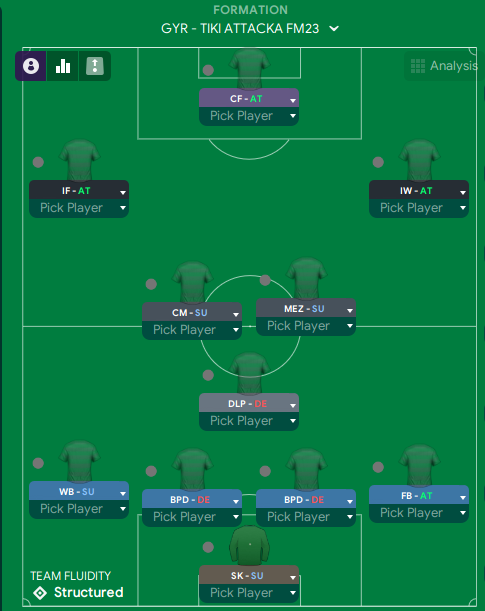
4-2-3-1 Wide
Winning the ball high through pressing and attacking quickly through the middle and flanks. A ball-winning midfielder alongside a deep playmaker gives the…

Loading tactical analysis...
Gegenpress
Positive
4-2-3-1 Wide
Structured
GK
Sweeper Keeper
Defend
DL
Inverted Full-Back
Defend
DC
Centre-Back
Defend
DC
Centre-Back
Defend
DR
Full-Back
Attack
MC
Ball-Winning Midfielder
Support
MC
Deep-Lying Playmaker
Defend
AML
Winger
Attack
AMC
Attacking Midfielder
Attack
AMR
Inside Forward
Support
ST
Pressing Forward
Support
A ball-winning midfielder alongside a deep playmaker gives the Gegenpress style a combative base while keeping a passer behind the ball.
BWM at [4,2] and DLP at [4,4] form the double pivot.
A winger on one side and an inside forward on the other, with an attacking midfielder and a pressing forward in the middle, provide width, goal threat and pressing from the front.
W at [5,1], IF at [5,5], AM at [5,3], PF at [6,3].
Gegenpress benefits from fluid, compact movement, while structured fluidity keeps roles rigid and can leave pressing gaps.
PF at [6,3] and AM at [5,3] must press together under a structured setup.
Three defensive-duty defenders sit deep, which clashes with a high press and leaves a gap between the lines.
CB at [2,2], CB at [2,4] and IFB at [2,1] all have the De duty.
Right flank behind the attacking full-back
The attacking full-back and inside forward leave space on the right when possession is lost, and only a deep playmaker covers it.
FB at [2,5] (At) and IF at [5,5] (Su), with DLP at [4,4].
high
No instructions set
The extraction has no in-possession, transition or out-of-possession instructions, so the press has no defined triggers or line settings.
Empty lists for all phases while PF at [6,3] is expected to lead the press.
high
BWM + DLP
The ball winner wins the ball and releases the deep playmaker, who starts attacks.
BWM at [4,2] and DLP at [4,4].
BWM + DLP
AM + PF
The attacking midfielder links with the pressing forward and joins the front press.
AM at [5,3] and PF at [6,3].
AM + PF
How aggressive should the press be against stronger opponents?
Do you prefer a possession or a counter-attacking approach after winning the ball?
Build through the double pivot, then use the winger and inside forward for width while the attacking midfielder links to the pressing forward.
Intended to counter-press, but no transition instructions are set and the attacking full-back leaves space behind.
Winning the ball high through pressing and attacking quickly through the middle and flanks.
4-4-1-1
The wide players drop to form two banks of four, with the pressing forward leading the line.
W at [5,1] and IF at [5,5] drop beside BWM at [4,2] and DLP at [4,4].
2-4-3-1
The inverted full-back joins the pivot, the attacking full-back pushes up, and the front four spread across the pitch.
IFB at [2,1], FB at [2,5], AM at [5,3] and PF at [6,3].
A sensible 4-2-3-1 built around a ball-winning and playmaking pivot, with a mobile front four suited to Gegenpress. Its main weaknesses are that no instructions are set, the deep defenders and structured fluidity work against the high press, and the right flank is open behind the attacking full-back. Add pressing and transition instructions and slightly raise fluidity to make the system coherent.
The tactical theory behind the 4-2-3-1 Wide: roles, instructions, and the trade-offs that decide whether the system holds up.
Klopp-style gegenpressing in FM, including squad profile, line-and-press pairing, sustainable workload, and the antipatterns to avoid.
Double pivots and flat pairs in 4-2-3-1 and 4-4-2: when each pairing works, when it collapses, and the AMC unicorn that rescues both.
The pairing rule for Defensive Line and Line of Engagement, all 9 combinations, and the gap that costs goals.