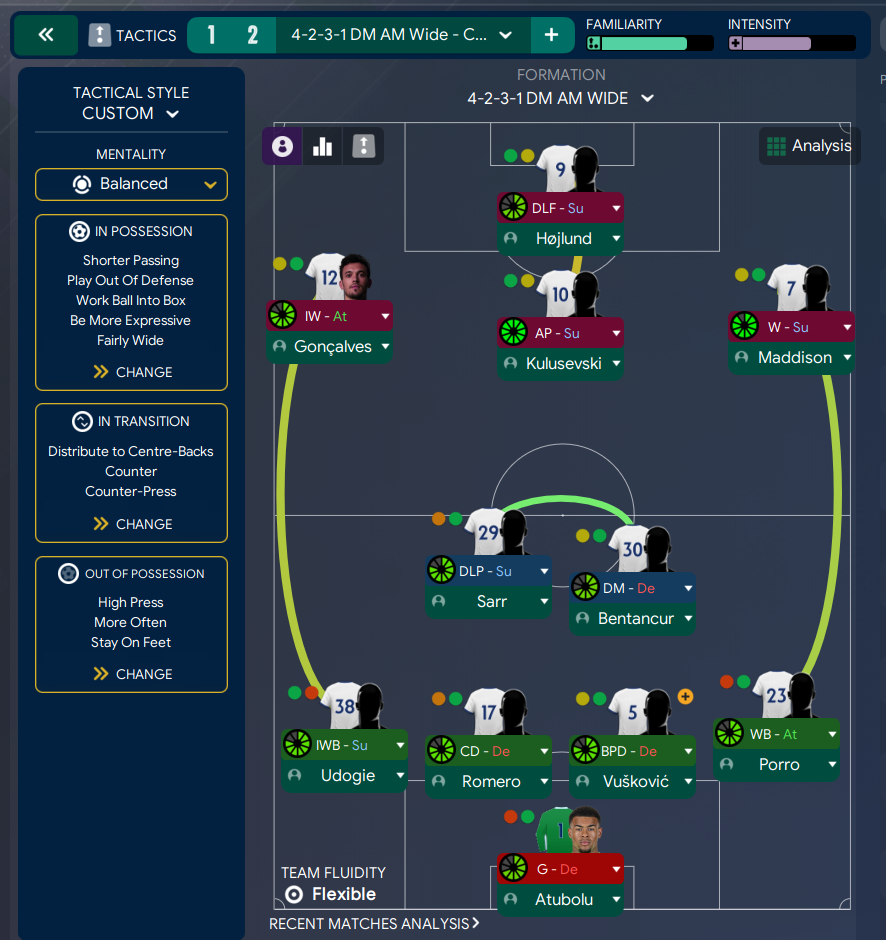
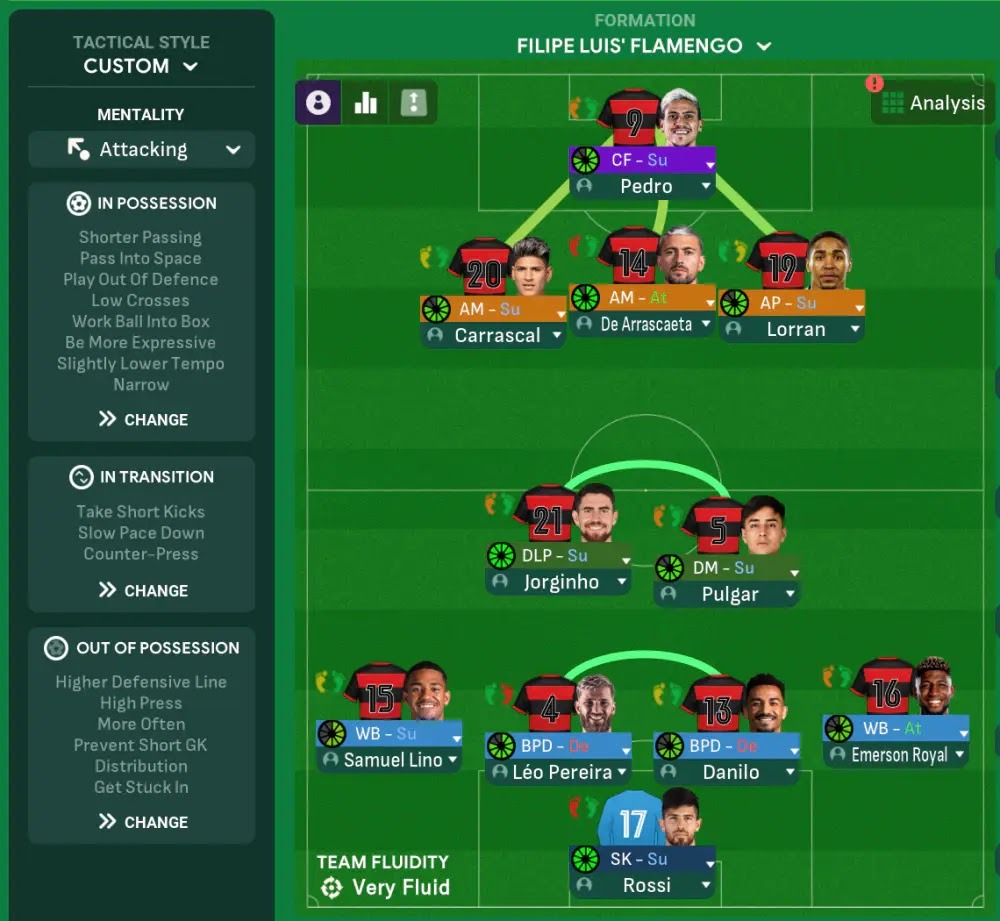
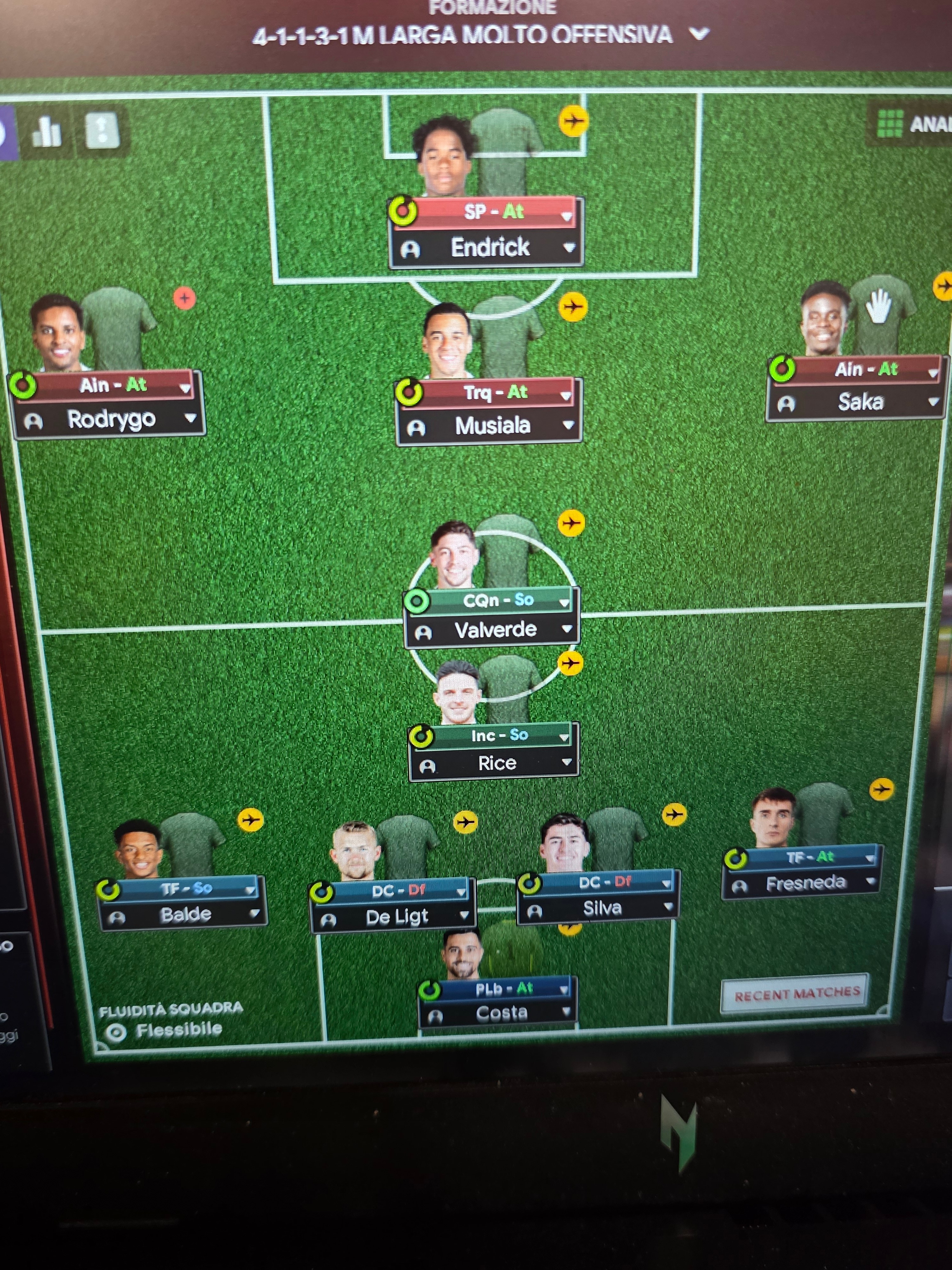
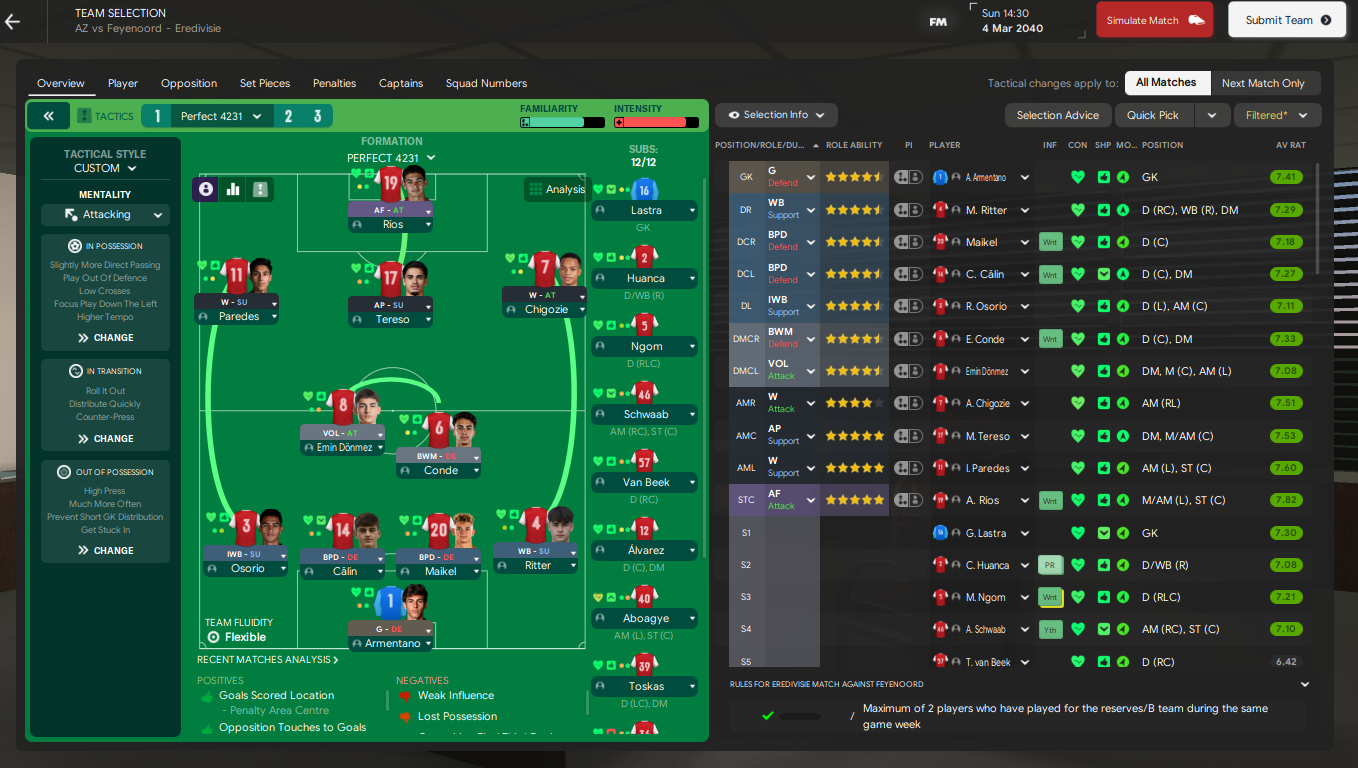
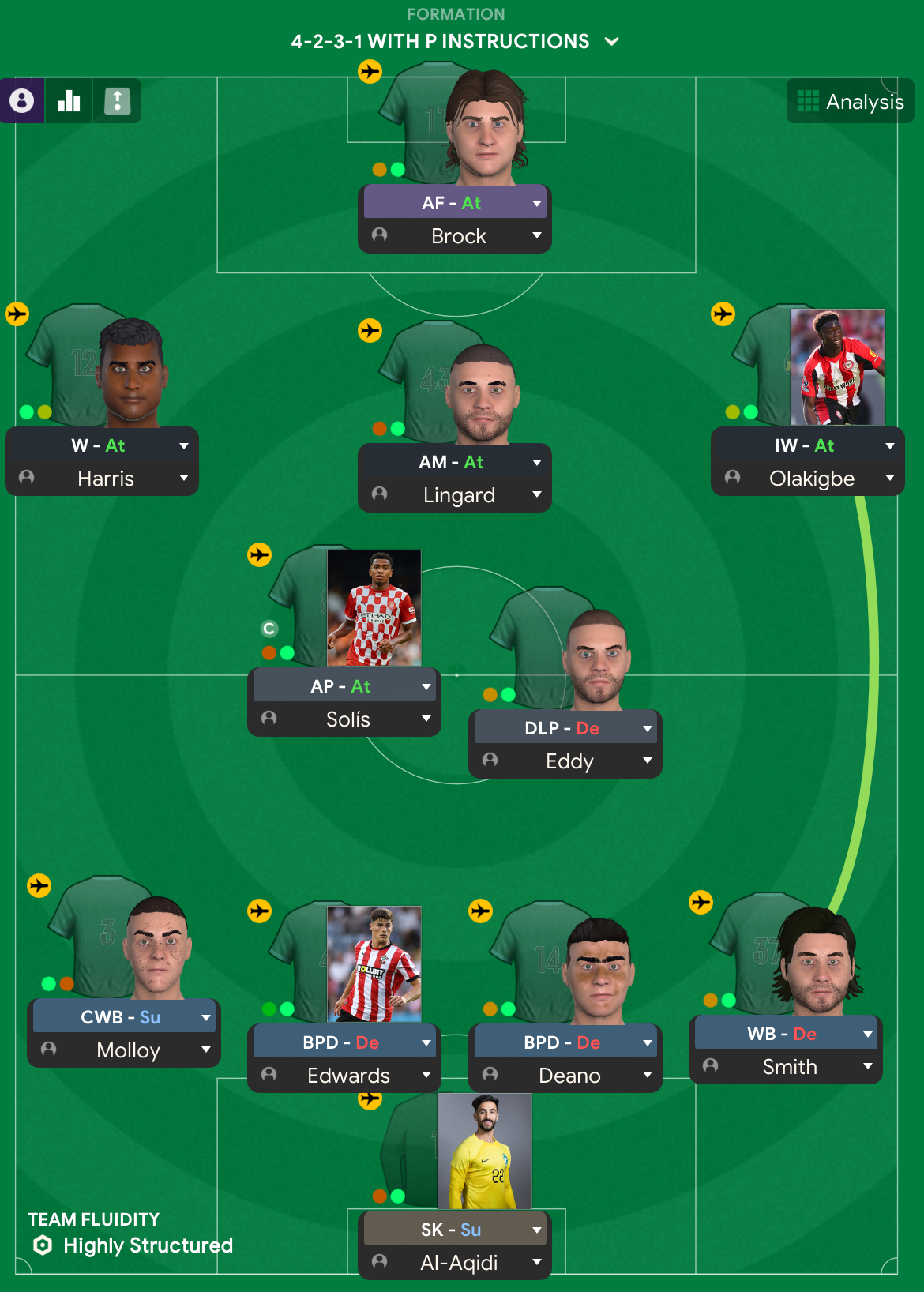
4-2-3-1
Aggressive wide attacks and rapid counter-pressing, with the attacking midfielder supporting the centre-forward through the middle. Both wing-backs are…

Loading tactical analysis...
Gegenpress
Positive
4-2-3-1
Very Structured
GK
Goalkeeper
Defend
DL
Wing-Back
Attack
DC
Centre-Back
Defend
DC
Centre-Back
Defend
DR
Wing-Back
Attack
MC
Defensive Midfielder
Defend
MC
Central Midfielder
Defend
AML
Winger
Attack
AMC
Attacking Midfielder
Support
AMR
Winger
Attack
ST
Complete Forward
Attack
Shorter Passing
Low Crosses
Run At Defence
Be More Expressive
Overlap Left
Overlap Right
Waste Time
Counter
Counter-Press
More Urgent Pressing
Prevent Short GK Distribution
Force Opposition Inside
Both wing-backs are set to Attack and both wide players are Wingers on Attack, giving the tactic several high wide outlets and support for overlaps.
WB (At) on both flanks, W (At) on both flanks, with Overlap Left and Overlap Right.
Counter-Press and more urgent pressing fit the Gegenpress style and can help the team win possession back quickly after losing it.
The transition settings include Counter-Press, and out of possession includes More Urgent Pressing; the shape also has a DM (De) and two CB (De).
Waste time can slow attacks and reduce the urgency of a positive Gegenpress approach, especially when the tactic also uses Counter and attacking wide roles.
Waste Time sits alongside the positive mentality, gegenpress style, counter, and both WB (At).
Wide defensive transition
Both wing-backs are on Attack while both wingers are also on Attack. If possession is lost with the wing-backs advanced, the two CBs can be exposed to wide breaks before the midfield recovers.
Both WB (At), both W (At), and Counter-Press.
high
Pressing space behind the midfield
The tactic commits to more urgent pressing and a counter-press, but the two central midfield roles are defensive and the extraction does not indicate a dedicated holding screen beyond the DM. Opponents who bypass the first press may find space ahead of the CBs.
DM (De), CM (De), both CB (De), More Urgent Pressing, and Counter-Press.
medium
Attacking wide overloads
The attacking wing-backs can overlap the attacking wingers to create width and numerical pressure on the flanks.
WB (At) with W (At) on both sides, plus Overlap Left and Overlap Right.
Attacking wide overloads
Central support for the striker
The supporting attacking midfielder can connect the two attacking wingers with the centre-forward and help supply the central finishing option.
AM (Su) behind CF (At), with both W (At).
Central support for the striker
How can I protect the space behind my attacking wing-backs when I lose possession?
What should I change if my Gegenpress is leaving space between my midfield and centre-backs?
How can I make my overlaps work better with my attacking wingers?
Shorter passing, expressive play, and run-at-defence instruction support close combinations and direct dribbling, while attacking wing-backs are encouraged to overlap and low crosses provide deliveries into the area. Waste time is at odds with the otherwise forward-moving plan.
The team is instructed to counter after winning possession and counter-press after losing it, aiming to turn recoveries into attacks and disrupt opponents immediately.
Aggressive wide attacks and rapid counter-pressing, with the attacking midfielder supporting the centre-forward through the middle.
4-2-3-1
The nominal shape has two defensive central midfield roles ahead of two defensive centre-backs, with a high-urgency press and an instruction to force opponents inside. Both wing-backs are set to Attack, which may leave the flanks exposed when possession turns over.
The formation is 4-2-3-1; DM (De), CM (De), both CB (De), both WB (At), More Urgent Pressing, and Force Opposition Inside.
4-2-3-1 with attacking width from both flanks
Both attacking wing-backs overlap the attacking wingers, while the supporting attacking midfielder links the wide players to an attacking centre-forward. Low crosses provide the preferred delivery.
Both WB (At), both W (At), AM (Su), CF (At), Overlap Left, Overlap Right, and Low Crosses.
This is an aggressive 4-2-3-1 built to press high, counter quickly, and attack through fast wide combinations around an attacking centre-forward. The attacking wing-backs and wingers offer strong flank pressure, but committing both players on each side forward can leave the centre-backs exposed during transitions. The clearest adjustment is to remove waste time, which works against the tactic’s positive, counter-pressing identity; monitor the space left behind the wing-backs and consider moderating their duties if opponents repeatedly break into it.
The tactical theory behind the 4-2-3-1: roles, instructions, and the trade-offs that decide whether the system holds up.
Klopp-style gegenpressing in FM, including squad profile, line-and-press pairing, sustainable workload, and the antipatterns to avoid.
Double pivots and flat pairs in 4-2-3-1 and 4-4-2: when each pairing works, when it collapses, and the AMC unicorn that rescues both.
Mentality, duty, role, instruction, sub. The change hierarchy from lightest to heaviest intervention, and 60th-minute patterns by game state.