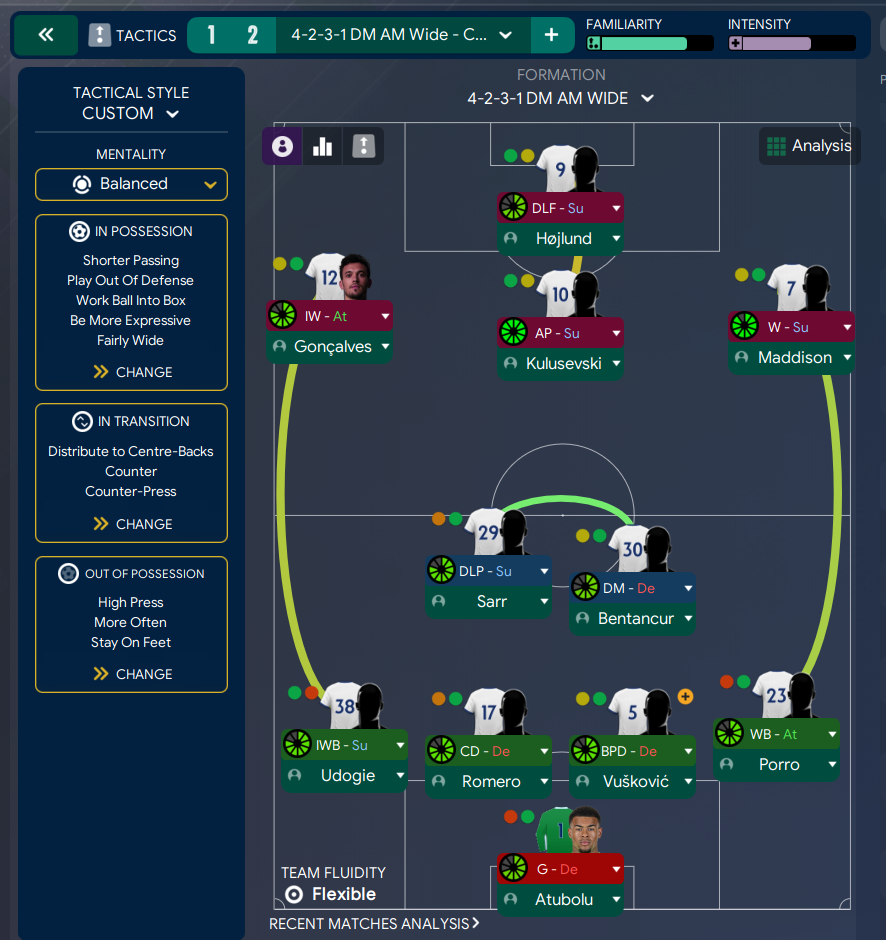
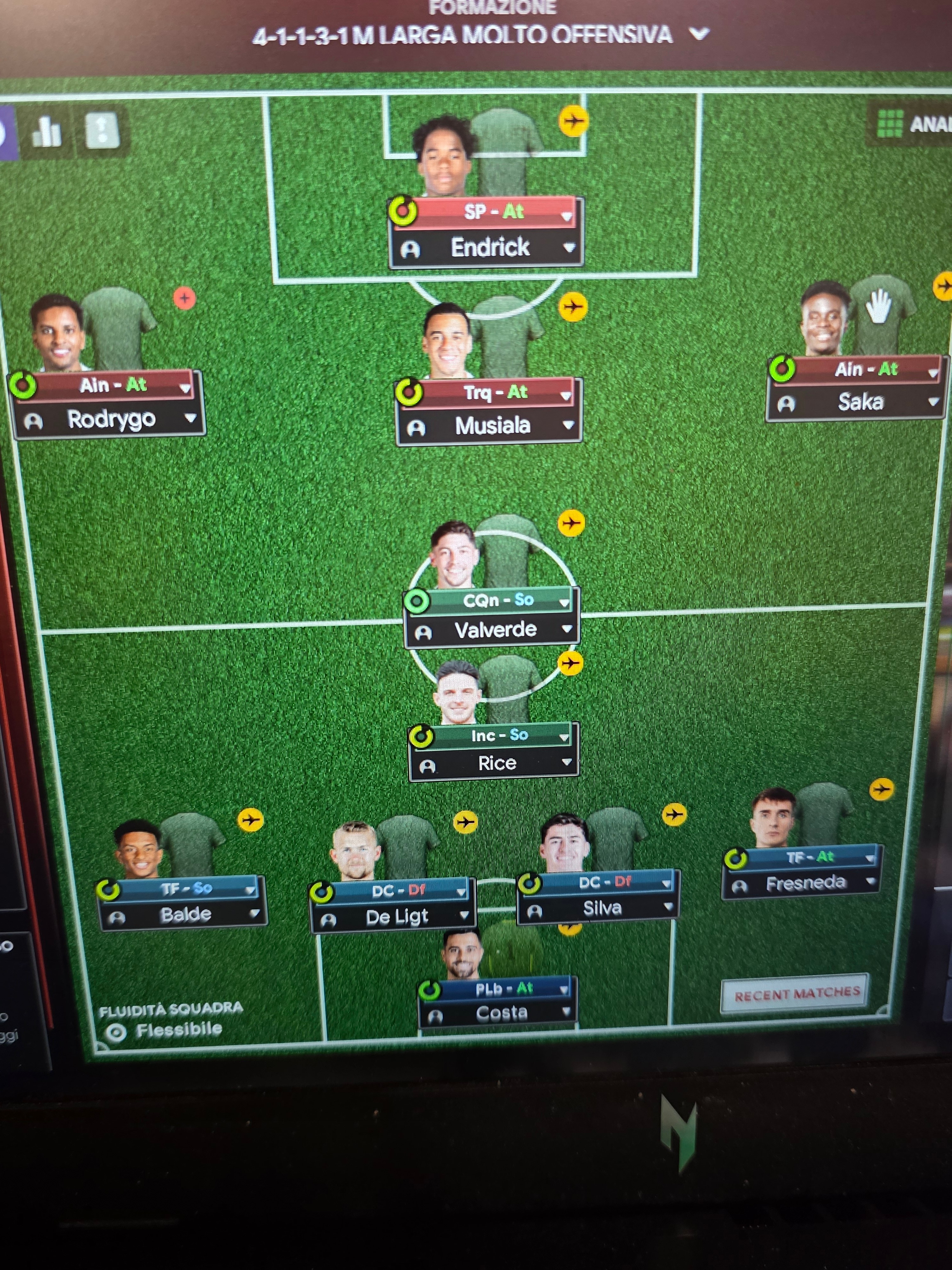
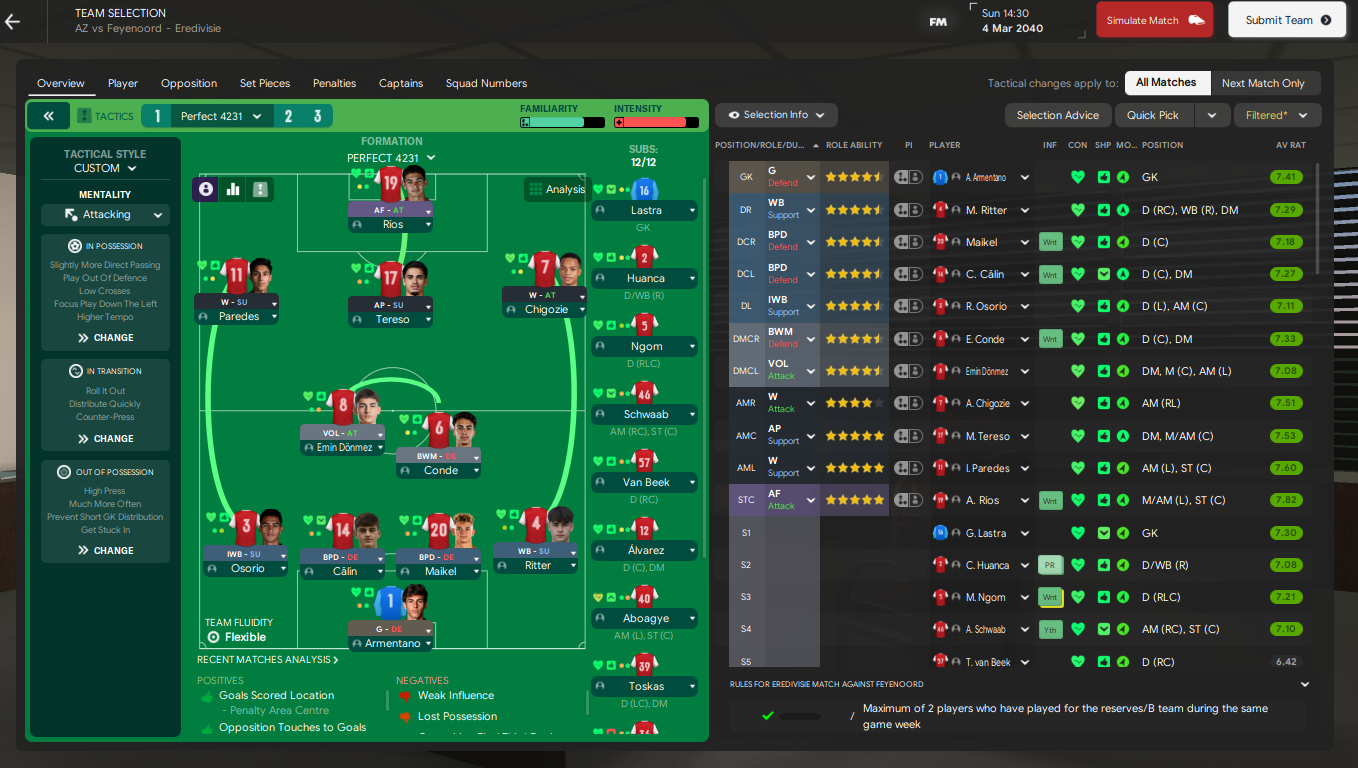
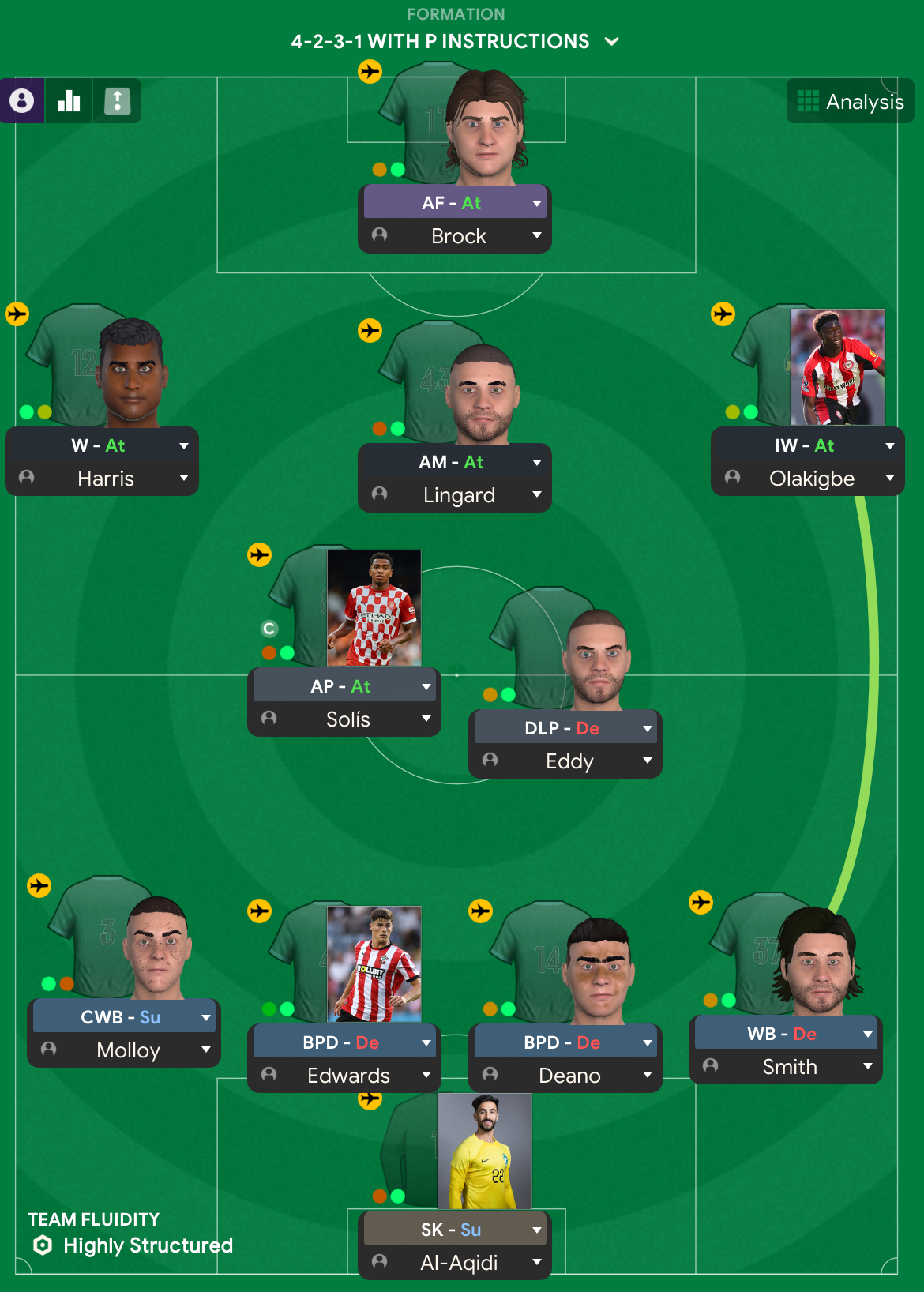
4-2-3-1
Create combinations through the three attacking midfielders, then use the attacking wing-back and forward movement to reach the box. The DLP and DM…
Loading tactical analysis...
Control Possession
Attacking
4-2-3-1
Very Fluid
GK
Sweeper Keeper
Support
DL
Wing-Back
Support
DC
Ball-Playing Defender
Defend
DC
Ball-Playing Defender
Defend
DR
Wing-Back
Attack
DM
Deep-Lying Playmaker
Support
DM
Defensive Midfielder
Support
AML
Attacking Midfielder
Support
AMC
Attacking Midfielder
Attack
AMR
Advanced Playmaker
Support
ST
Complete Forward
Support
Shorter Passing
Pass Into Space
Play Out of Defence
Low Crosses
Work Ball Into Box
Be More Expressive
Slightly Lower Tempo
Narrow Attacking Width
Take Short Kicks
Counter-Press
Higher Defensive Line
Trigger Press More Often
Prevent Short GK Distribution
Get Stuck In
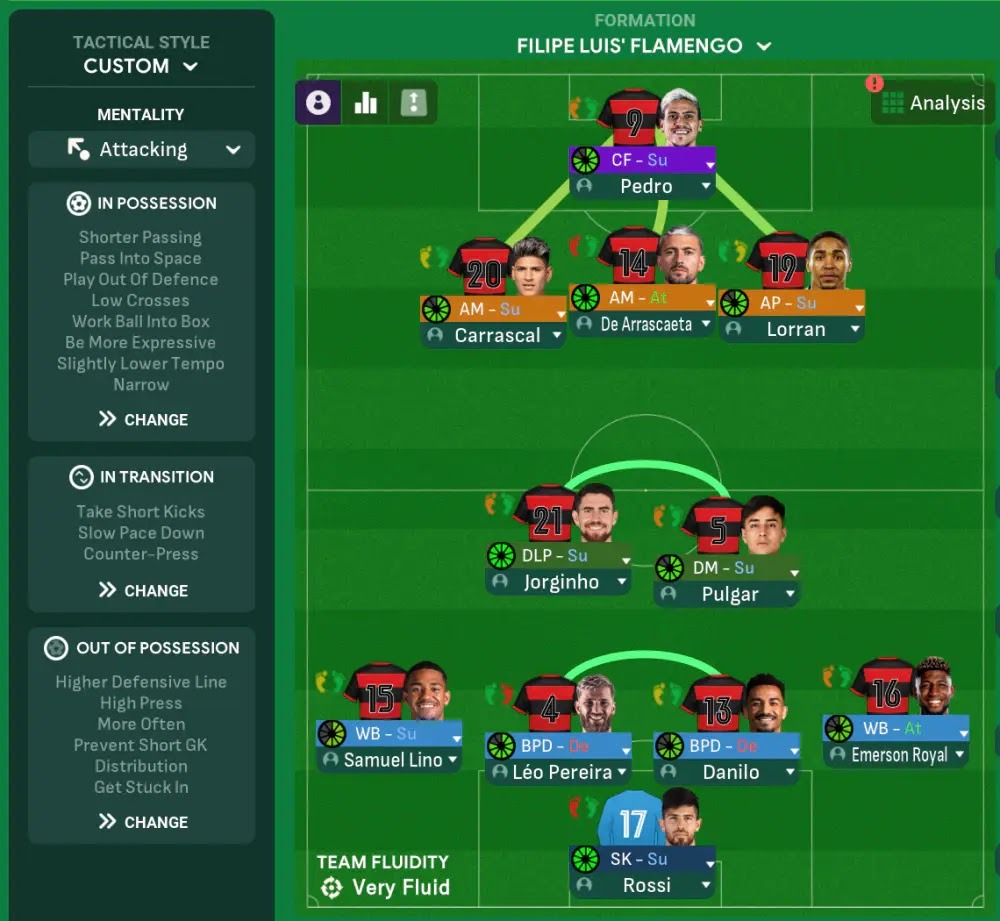
The DLP and DM provide two supporting outlets ahead of the centre-backs, while the attacking midfield line offers several close options for patient combinations.
The DLP (Su) and DM (Su) sit behind the AM (Su), AM (At) and AP (Su), supported by Shorter Passing and Play Out of Defence.
Pass Into Space can turn the forward runs of the attacking wing-back and attacking midfielder into chances, while low crosses and Work Ball Into Box favor controlled deliveries and cutbacks.
The WB (At), AM (At) and CF (Su) can make forward movements for Pass Into Space, with Low Crosses and Work Ball Into Box.
Shorter passing, a slightly lower tempo and Work Ball Into Box encourage patient circulation, while Pass Into Space and Be More Expressive can prompt earlier or riskier attempts to break lines. This can make the attack less consistent if runners are not available.
Shorter Passing, Slightly Lower Tempo, Work Ball Into Box and Pass Into Space combine with the DLP (Su), AP (Su) and CF (Su).
An attacking mentality and an attacking wing-back commit players forward, while Counter-Press asks them to hunt immediately after losing possession. If that first press is bypassed, the supporting midfield pair may have to cover wide and central space.
The WB (At), DLP (Su) and DM (Su) are paired with attacking mentality and Counter-Press.
Space behind the defensive line
A higher defensive line can be vulnerable to balls in behind, particularly when the team is committing players forward and the counter-press is beaten.
Higher Defensive Line is used behind the BPD (De) pair, alongside attacking mentality and Counter-Press.
medium
Discipline and fouls
Get Stuck In can increase the chance of mistimed challenges, giving opponents free kicks or penalties and risking cards.
Get Stuck In is active with the WB (At) and DLP (Su) involved in the defensive structure.
medium
DLP and DM behind the attacking midfield line
The DLP offers a deeper passing outlet while the DM supports the base of midfield, giving the three advanced midfielders options to combine without requiring the centre-backs to force every forward pass.
The DLP (Su) and DM (Su) play behind AM (Su), AM (At) and AP (Su), with Play Out of Defence.
DLP and DM behind the attacking midfield line
Attacking wing-back with central runners
The right wing-back's attacking duty can add width and provide a delivery route, while the attacking midfielder and centre-forward can occupy or attack central spaces.
The WB (At) is alongside AM (At) and CF (Su), with Low Crosses.
Attacking wing-back with central runners
How can I protect the space behind my higher defensive line without losing the pressure of my counter-press?
What should I change if my shorter passing and Pass Into Space instructions are producing rushed or wasteful attacks?
How can I make my attacking wing-back's runs safer when I lose possession?
A narrow, short-passing possession approach that builds from the back, looks for runs in behind, and aims to work the ball into the box for low deliveries.
The team counter-presses after losing possession and slows goalkeeper distribution, favoring a settled restart rather than an explicitly quick distribution.
Create combinations through the three attacking midfielders, then use the attacking wing-back and forward movement to reach the box.
4-2-3-1
The listed roles suggest a back four with two supporting deeper midfielders shielding the centre-backs, ahead of three attacking midfielders and a central forward. The higher defensive line and frequent pressing make the defensive approach proactive.
The WB (Su), BPD (De), BPD (De) and WB (At) form the back four, with DLP (Su) and DM (Su) in front.
Narrow 4-2-3-1 with an attacking right flank
The narrow attacking width brings the three attacking midfield roles into central combinations, while the WB (At) can provide an advanced wide route on the right. Short passing and Work Ball Into Box support controlled progress toward the area.
The AM (Su), AM (At) and AP (Su) occupy the attacking line, alongside the WB (At), with Narrow Attacking Width and Work Ball Into Box.
This is an ambitious possession-oriented 4-2-3-1 built around short combinations, a crowded attacking midfield line and a forward-passing outlet to runners. Its main strengths are central support and the potential for the attacking wing-back and attacking midfielder to give the CF (Su) options. The biggest concerns are the tension between patient circulation and Pass Into Space, plus the space that can open behind a higher line when the counter-press is bypassed. I would first reduce the challenge risk by changing Get Stuck In to Stay on Feet, then test a Positive mentality if the attacking setup is leaving the team too exposed.
The tactical theory behind the 4-2-3-1: roles, instructions, and the trade-offs that decide whether the system holds up.
Double pivots and flat pairs in 4-2-3-1 and 4-4-2: when each pairing works, when it collapses, and the AMC unicorn that rescues both.
Klopp-style gegenpressing in FM, including squad profile, line-and-press pairing, sustainable workload, and the antipatterns to avoid.
Protect a 1-0, chase a 1-0, hold a draw away. How to manage game state in FM through duties and roles, not by lurching to Defensive.