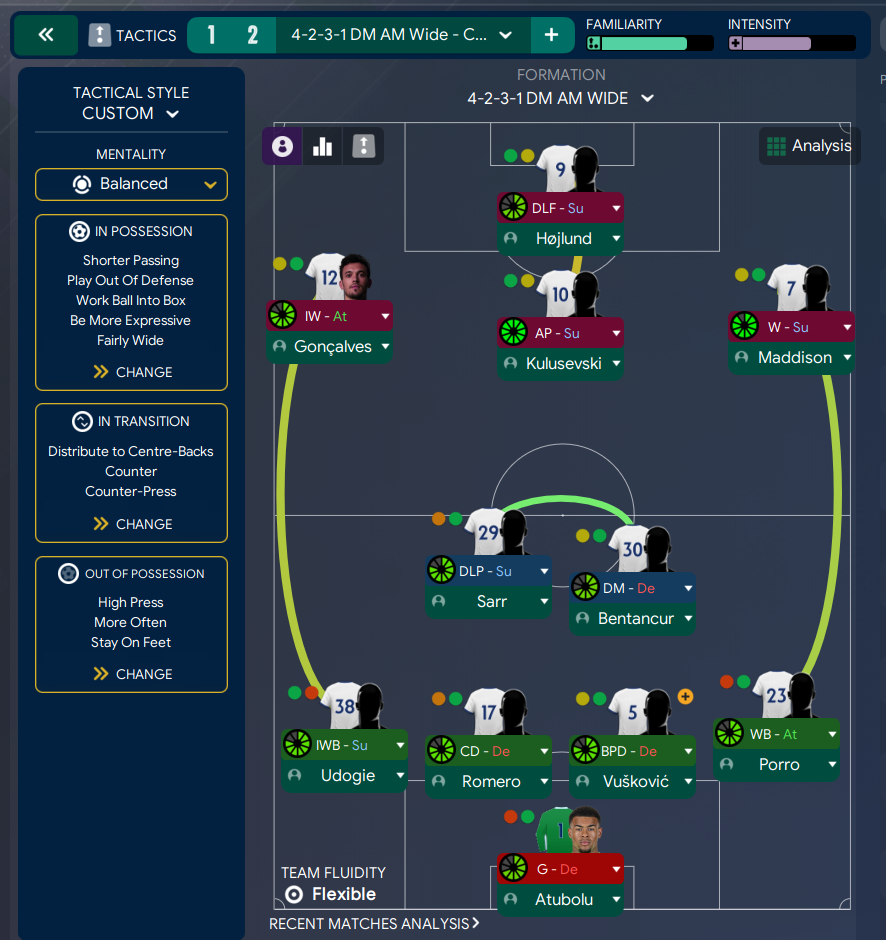
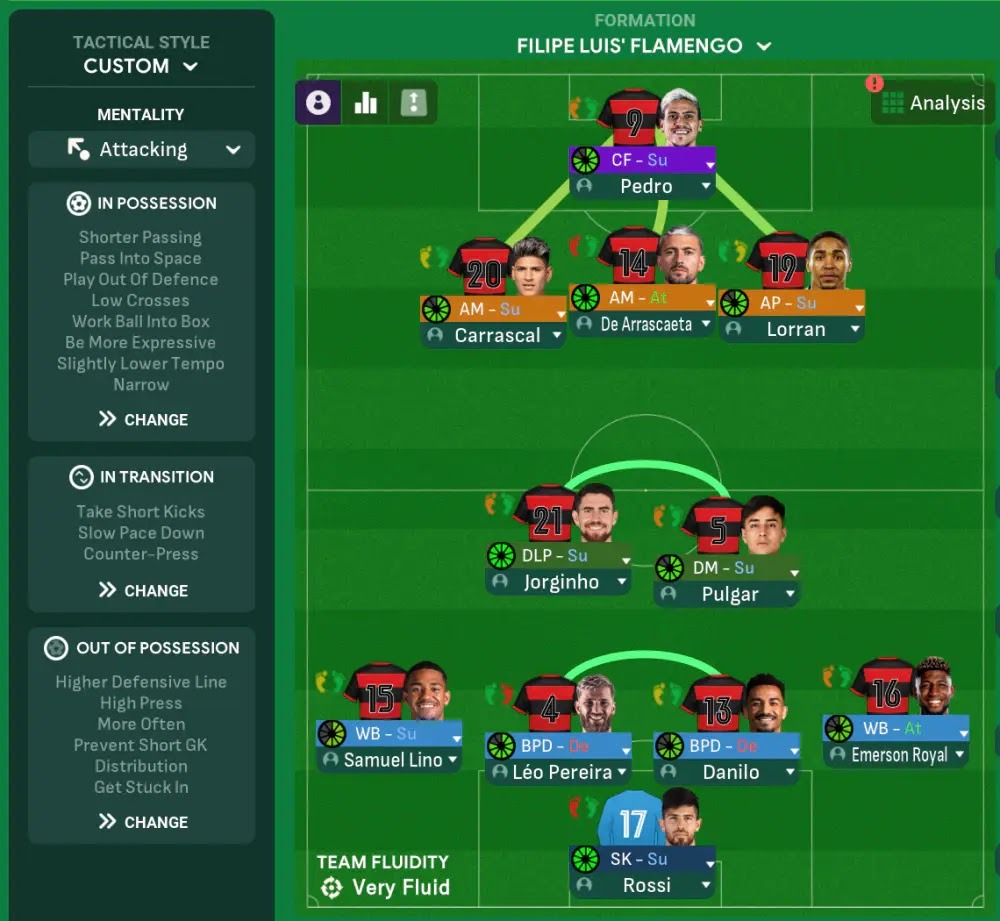
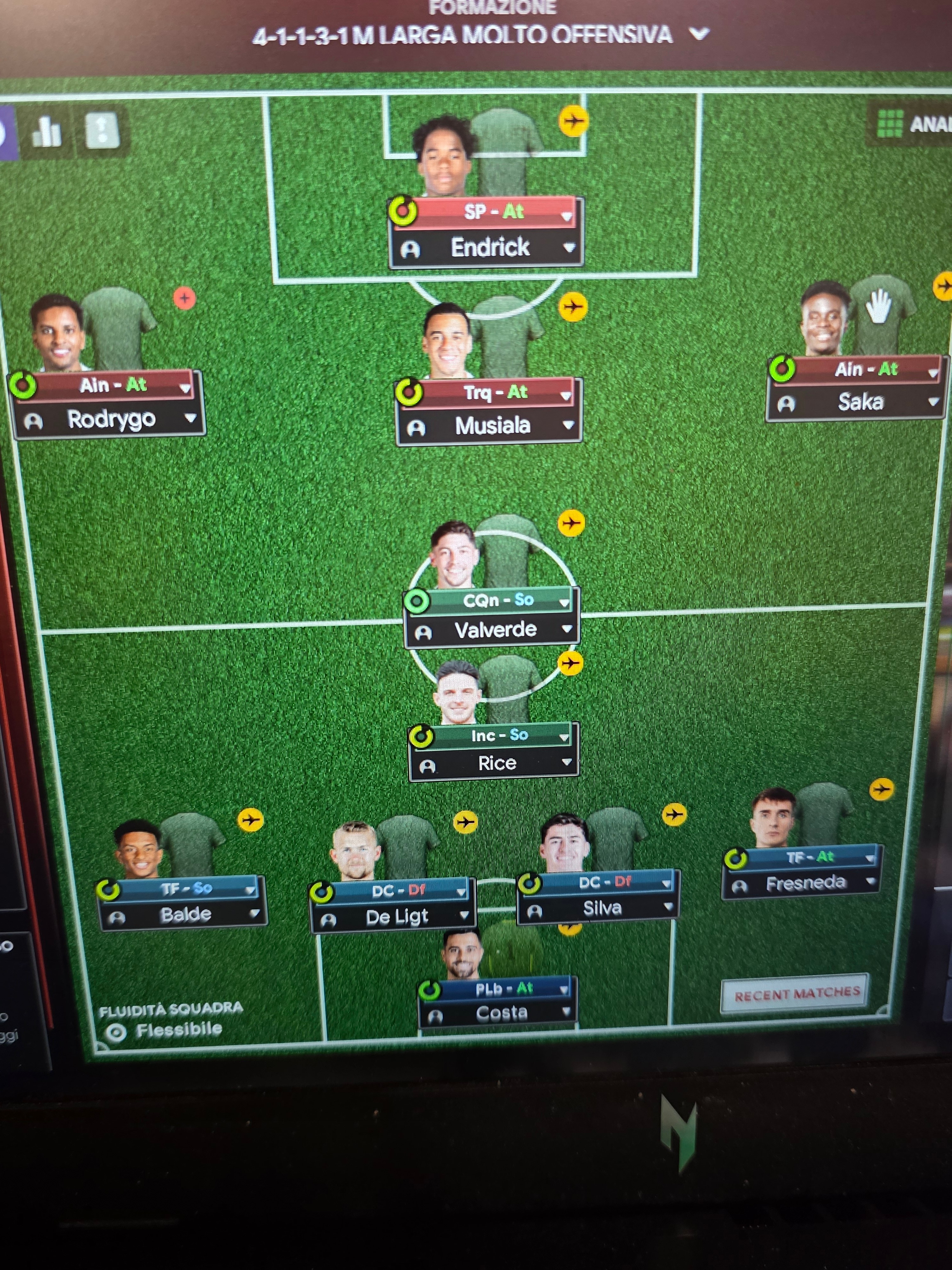
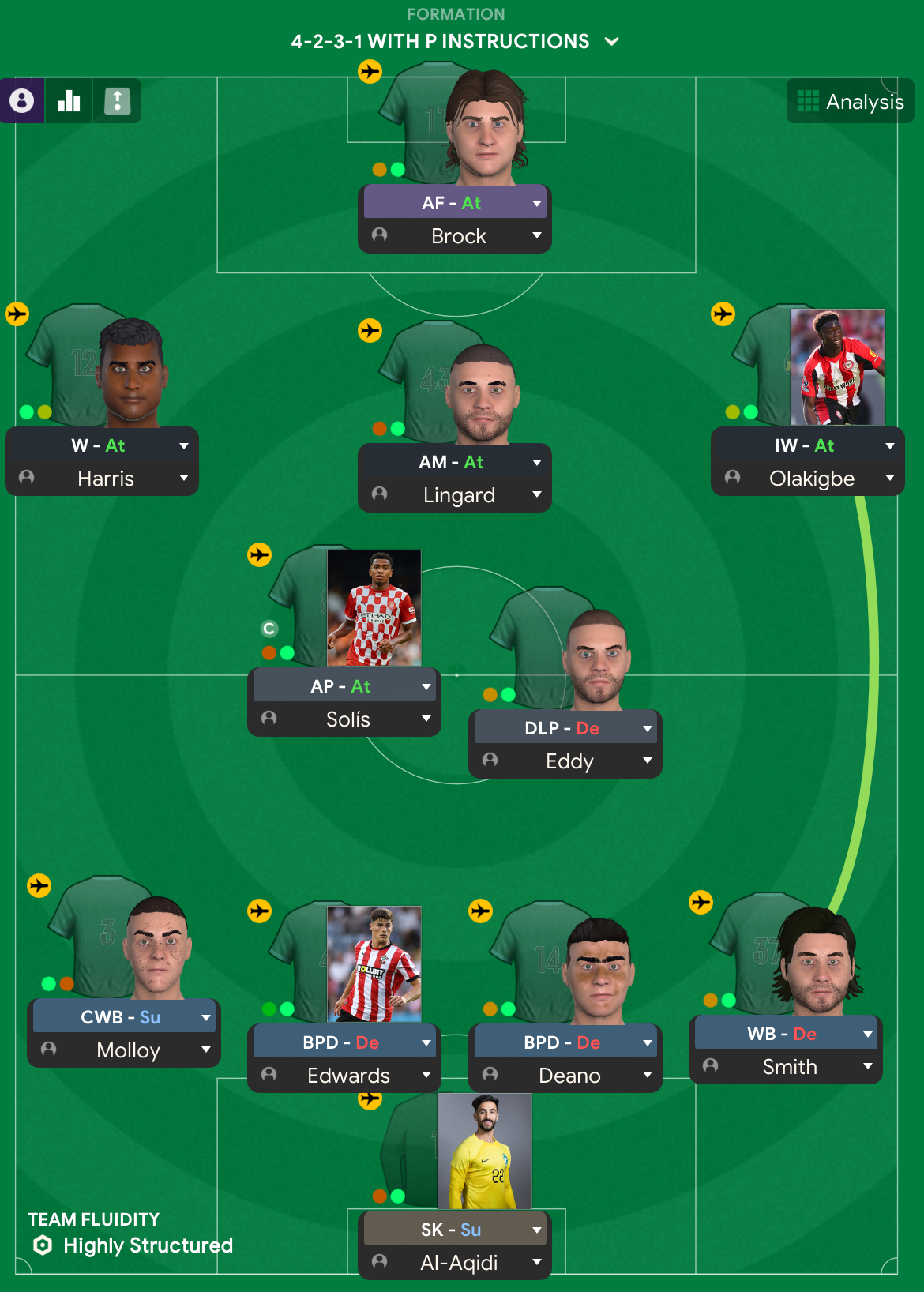
4-2-3-1
High-intensity pressing and quick attacks built on short build-up and left-sided play. Counter-press, a higher line of engagement and a much more frequent…
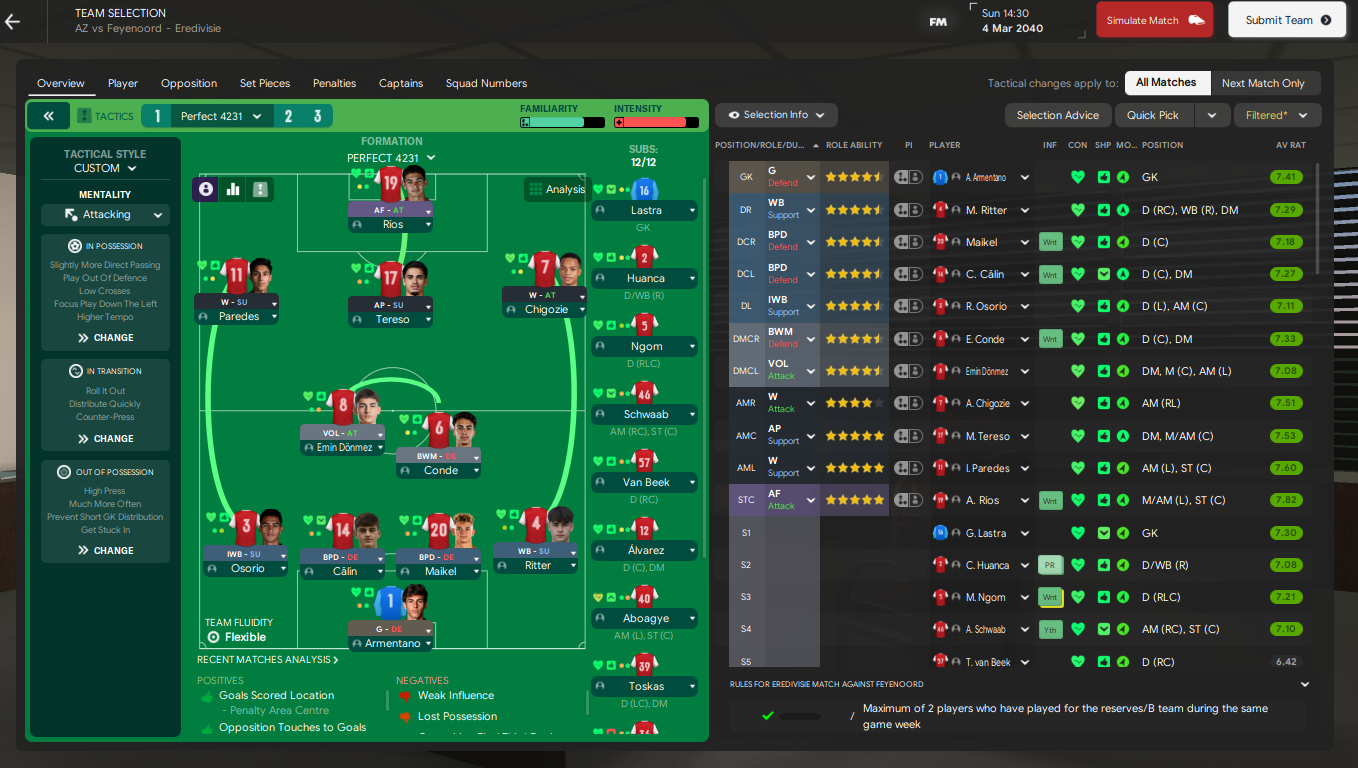
Loading tactical analysis...
Attacking
4-2-3-1
Fluid
GK
Goalkeeper
Defend
DL
Inverted Wing-Back
Support
DC
Ball-Playing Defender
Defend
DC
Ball-Playing Defender
Defend
DR
Wing-Back
Support
DM
Segundo Volante
Defend
DM
Ball-Winning Midfielder
Defend
AML
Winger
Support
AMC
Advanced Playmaker
Support
AMR
Winger
Attack
ST
Advanced Forward
Attack
Slightly More Direct Passing
Play Out of Defence
Low Crosses
Focus Play Down the Left
Higher Tempo
Roll It Out
Distribute Quickly
Counter-Press
Higher Line of Engagement
Trigger Press Much More Often
Prevent Short GK Distribution
Get Stuck In
Counter-press, a higher line of engagement and a much more frequent press trigger give an aggressive win-back approach. Prevent short GK distribution adds pressure on the opposition keeper.
BWM [3,4] and SV [3,2] with AF [6,3] and W [5,5]
An Advanced Playmaker supported by an Advanced Forward gives a clear creator and a clear finisher. Winger duties on both flanks stretch the opposition.
AP [5,3] and AF [6,3]
The BWM and SV both have Defend duties, which suits a deeper block better than a high press. The line of engagement is higher but no defensive line is set, so the gaps behind the press are unclear.
BWM [3,4], SV [3,2]
Low crosses and Wingers suit crossing play, but the lone Advanced Forward is not a box-presence striker. Focusing play down the left also reduces the use of the right-hand Winger.
W [5,5], W [5,1], AF [6,3]
Counter-attacks down the flanks
The fullbacks are a WB on Support and an IWB on Support, so both push on or tuck inside. With an attacking mentality and counter-press, a lost ball leaves a lot of space behind them.
WB [2,5], IWB [2,1]
high
Fatigue and press breaking
Counter-press, much more frequent triggers, get stuck in, higher tempo and an attacking mentality will tire players quickly. Once the press is beaten the shape is stretched.
BWM [3,4], AF [6,3]
medium
AP + AF
The playmaker feeds the forward, who runs in behind or drops to link play.
AP [5,3], AF [6,3]
AP + AF
IWB + SV
The IWB moves into midfield and the SV covers behind to balance the left side.
IWB [2,1], SV [3,2]
IWB + SV
Do you have the pace in defence to cover a high press?
Do you want the left side to be the main attacking route?
Is the squad fit enough for constant pressing?
Plays out from the back with slightly more direct passing and a higher tempo, favouring the left side and finishing with low crosses and the AP/AF axis.
Counter-presses on loss to win the ball back immediately, with quick distribution after saves.
High-intensity pressing and quick attacks built on short build-up and left-sided play.
4-4-2 / 4-2-3-1 press
A back four with a defensive double pivot, with the wingers and the AF pressing high from a higher line of engagement.
BWM [3,4], SV [3,2], W [5,5], AF [6,3]
3-2-4-1
The IWB tucks inside, the WB pushes on, and the wide players and the AP form an attacking line behind the AF.
IWB [2,1], WB [2,5], AP [5,3], AF [6,3]
This is an aggressive, pressing 4-2-3-1 with a good build-up and a clear creator-finisher axis in the AP and AF. It is held back by the defensive-duty pivot and the lack of a set defensive line, which leaves the high press exposed. The attacking mentality plus counter-press and two advancing fullbacks is risky, so setting a higher defensive line and dropping to positive would add balance.
The tactical theory behind the 4-2-3-1: roles, instructions, and the trade-offs that decide whether the system holds up.
Double pivots and flat pairs in 4-2-3-1 and 4-4-2: when each pairing works, when it collapses, and the AMC unicorn that rescues both.
Klopp-style gegenpressing in FM, including squad profile, line-and-press pairing, sustainable workload, and the antipatterns to avoid.
The pairing rule for Defensive Line and Line of Engagement, all 9 combinations, and the gap that costs goals.