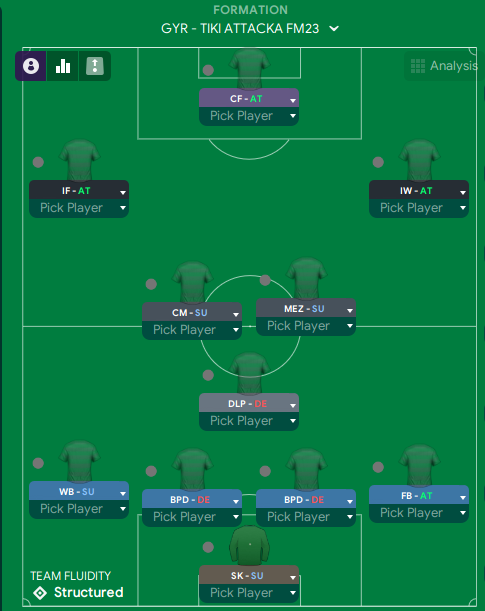
4-2-3-1 Wide
Recover possession high, then transition quickly into space for the AF (At), AM (At), and supporting IF (Su) roles. Gegenpress, Counter-Press, an…

Loading tactical analysis...
Gegenpress
Attacking
4-2-3-1 Wide
Fluid
GK
Sweeper Keeper
Defend
DL
Full-Back
Attack
DC
Ball-Playing Defender
Defend
DC
Ball-Playing Defender
Defend
DR
Full-Back
Attack
DM
Defensive Midfielder
Support
DM
Defensive Midfielder
Support
AML
Inside Forward
Support
AMC
Attacking Midfielder
Attack
AMR
Inside Forward
Support
ST
Advanced Forward
Attack
Shorter Passing
Pass Into Space
Low Crosses
Run At Defence
Focus Play Down the Left
Focus Play Down the Right
Higher Tempo
Roll It Out
Distribute Quickly
Counter
Counter-Press
Much Higher Defensive Line
Trigger Press Much More Often
Prevent Short GK Distribution
Get Stuck In
Step Up More
Gegenpress, Counter-Press, an extremely high defensive line and very frequent pressing can help the team win the ball back high and attack before the opposition is organized.
The tactic combines the SK (De) behind a much higher defensive line with the Counter-Press instruction.
Pass Into Space and high tempo suit the AF (At), while the AM (At) and two IF (Su) provide support around the central striker.
The AF (At) is paired with Pass Into Space and Higher Tempo, with an AM (At) and IF (Su) on both sides.
Shorter passing encourages combinations, while Pass Into Space and higher tempo favour quicker forward progression. These can pull the build-up in different directions, especially when opponents leave little room behind.
Shorter Passing is paired with Pass Into Space and Higher Tempo, supporting the AF (At).
Space behind the defensive line
The very high line and Step Up More can leave substantial space behind for quick forwards to attack, particularly if the press is bypassed.
The BPD (De) pair plays in front of a Much Higher Defensive Line with Step Up More.
high
Wide-channel counter-attacks
Both full-backs attack, so turnovers can leave the flanks open; the two supporting DM roles may need to cover large spaces between them and the defenders.
Both FB (At) roles advance while the two DM (Su) roles are the only midfield screen.
high
AF (At) with AM (At)
The advanced forward threatens the space behind while the attacking midfielder can arrive centrally to support scoring chances.
The central AM (At) sits directly behind the AF (At).
AF (At) with AM (At)
Inverted wide attackers with attacking full-backs
The IF (Su) roles can move inside to combine, while the FB (At) roles provide width and crossing options on both sides.
The IF (Su) roles occupy both wide attacking positions alongside FB (At) on each flank.
Inverted wide attackers with attacking full-backs
How can I protect the space behind my much higher defensive line?
What should I change if my gegenpress is leaving the flanks exposed?
What should I look for in players for my AF (At) and AM (At) partnership?
Shorter passing at higher tempo, with Pass Into Space and low crosses supporting forward runs; play is encouraged down both flanks.
Counter-Press immediately after losing possession, and counter quickly when possession is won; the goalkeeper rolls the ball out and distributes quickly.
Recover possession high, then transition quickly into space for the AF (At), AM (At), and supporting IF (Su) roles.
4-2-3-1
The nominal four defenders are supported by two DM (Su) roles, with an aggressive high line and frequent pressing intended to compress play.
The BPD (De) pair and both FB (At) roles form the back four, ahead of two DM (Su) roles.
4-2-3-1 with attacking width
The IF (Su) roles can move infield, while both attacking full-backs provide width around the AM (At) and AF (At).
Both FB (At) roles advance alongside the two IF (Su) roles, with the AM (At) behind the AF (At).
This is an aggressive, high-tempo 4-2-3-1 built to win the ball high and send runners forward quickly, with useful width from the attacking full-backs and a clear AF (At)/AM (At) threat. The main concern is defensive exposure: the much higher line and Step Up More risk balls over the top, while both attacking full-backs can leave wide counter-attacking lanes open. Consider lowering the line one step and managing the full-backs’ risk when protecting a lead.
The tactical theory behind the 4-2-3-1 Wide: roles, instructions, and the trade-offs that decide whether the system holds up.
Klopp-style gegenpressing in FM, including squad profile, line-and-press pairing, sustainable workload, and the antipatterns to avoid.
Double pivots and flat pairs in 4-2-3-1 and 4-4-2: when each pairing works, when it collapses, and the AMC unicorn that rescues both.
Routines, takers, and target picks. How to turn corners and free-kicks into a reliable third of your goal output.