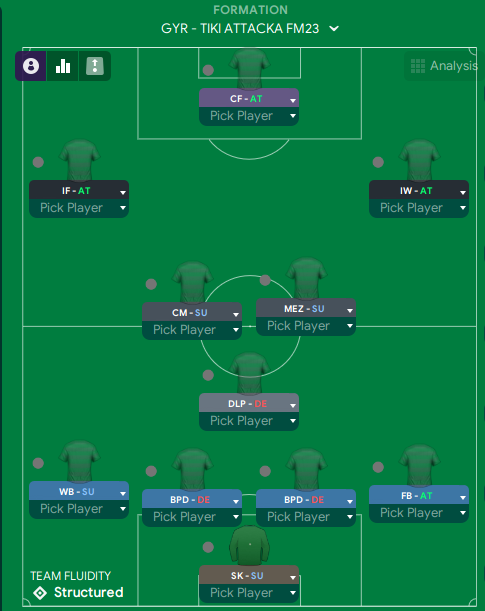
4-2-3-1 Wide
Central possession and a high press to win the ball back close to the opponent's goal. Shorter passing, playing out of defence and rolling it out fit a…

Loading tactical analysis...
Gegenpress
Positive
4-2-3-1 Wide
Structured
GK
Sweeper Keeper
Defend
DL
Inverted Full-Back
Defend
DC
Centre-Back
Defend
DC
Centre-Back
Defend
DR
Full-Back
Attack
MC
Box-to-Box Midfielder
Support
MC
Deep-Lying Playmaker
Defend
AML
Winger
Attack
AMC
Attacking Midfielder
Attack
AMR
Inside Forward
Support
ST
Pressing Forward
Support
Shorter Passing
Play Out of Defence
Slightly Lower Tempo
Fairly Narrow Attacking Width
Focus Play Through the Middle
Work Ball Into Box
Counter-Press
Roll It Out
Distribute to Centre-Backs
Much Higher Defensive Line
Trigger Press More Often
Standard Line of Engagement
Shorter passing, playing out of defence and rolling it out fit a keeper and defenders who recycle the ball and set up a central attack.
SK [1,3] with CB [2,2] and CB [2,4], DLP at [4,4]
Focusing play through the middle with an AM, a PF and a DLP gives several link options between the lines.
AM [5,3], PF [6,3], DLP [4,4]
A much higher line needs an aggressive sweeping keeper and quick centre-backs. A defensive-duty SK and plain CBs leave a lot of space behind them.
SK [1,3] De, CB [2,2], CB [2,4]
Slightly lower tempo and fairly narrow width reduce the directness a gegenpress style normally uses after winning the ball.
PF [6,3] Su and W [5,1] At receive the ball more slowly
Space behind the high line
If the press is beaten, one ball over the top finds the two CBs exposed, with a defensive keeper unlikely to cover.
CB [2,2], CB [2,4], SK [1,3]
high
Right flank balance
The attacking FB and supporting IF on the right leave the channel open when possession is lost, with only one DLP covering.
FB [2,5] At, IF [5,5] Su, DLP [4,4] De
high
DLP and BBM double pivot
The DLP dictates play while the BBM provides legs, pressing support and runs from deep.
DLP [4,4], BBM [4,2]
DLP and BBM double pivot
AM and PF link play
The AM feeds the PF, who drops to link, creating central combinations.
AM [5,3], PF [6,3]
AM and PF link play
Do your centre-backs have the pace to cope with a much higher line?
Is your goalkeeper comfortable sweeping and playing with his feet?
Do you want a patient possession side or a fast pressing side?
Patient short build-up from the keeper, funnelled through the middle to the AM and PF, with the wide players supporting.
Counter-press immediately after losing the ball, backed by a very high line and frequent press triggers.
Central possession and a high press to win the ball back close to the opponent's goal.
4-4-1-1 high press
A compact, high block with the wide players dropping in and the PF and AM leading the press.
W [5,1], IF [5,5], AM [5,3], PF [6,3]
2-4-3-1 build-up
The FB pushes forward and the IFB tucks in, while the AM and PF combine centrally with a wide-left winger.
FB [2,5] At, IFB [2,1] De, AM [5,3], PF [6,3]
A coherent possession-based gegenpress with a strong central creative core in the AM, PF and DLP. The main concern is the much higher defensive line behind a defensive-duty keeper and a pair of ordinary centre-backs, which is easy to exploit, along with an unbalanced right side. Lowering the line a notch, raising the line of engagement and slightly increasing tempo would make the tactic more compact, aggressive and consistent.
The tactical theory behind the 4-2-3-1 Wide: roles, instructions, and the trade-offs that decide whether the system holds up.
Double pivots and flat pairs in 4-2-3-1 and 4-4-2: when each pairing works, when it collapses, and the AMC unicorn that rescues both.
Klopp-style gegenpressing in FM, including squad profile, line-and-press pairing, sustainable workload, and the antipatterns to avoid.
Pass map, average position, xG, possession by zone: what each tablet panel tells you in FM and the tactical change it should trigger.