
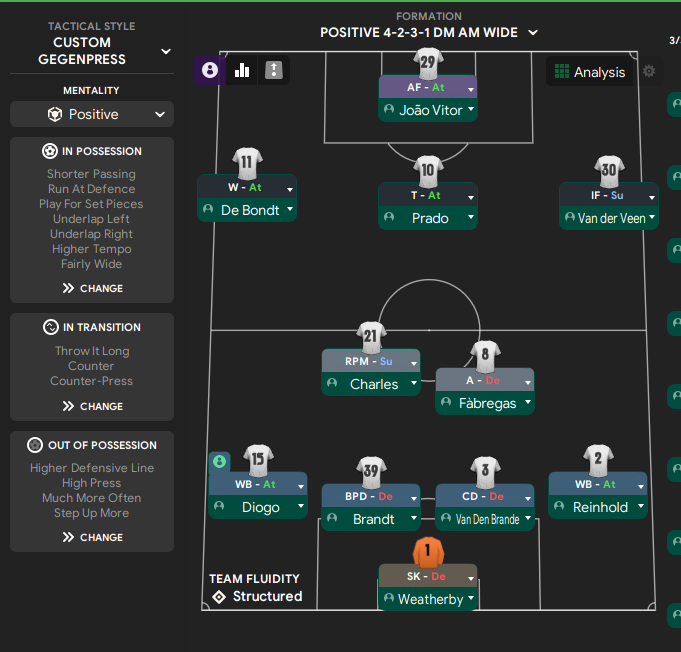
4-2-3-1 Wide
The combination of wingers, inside forwards, and a trequartista allows for fluid passing and movement, creating multiple attacking options.
Loading tactical analysis...
Gegenpress
Positive
4-2-3-1 Wide
Structured
Shorter Passing
Run At Defence
Play For Set Pieces
Underlap Left
Underlap Right
Higher Tempo
Fairly Wide
Throw It Long
Counter
Counter-Press
Higher Defensive Line
High Press
Much More Often Step Up
ST
Advanced Forward
Attack
AM
Trequartista
Attack
W
Winger
Attack
IF
Inside Forward
Support
CD
Ball-Playing Defender
Defend
CD
Centre Back
Defend
WB
Wing Back
Attack
RPM
Roaming Playmaker
Support
A
Advanced Playmaker
Defend
GK
Sweeper Keeper
Defend
The combination of wingers, inside forwards, and a trequartista allows for fluid passing and movement, creating multiple attacking options.
The gegenpress style coupled with a high defensive line creates pressure on the opposition quickly, leading to turnovers.
A high defensive line may expose the defense against fast counter-attacking teams, especially if the wing-backs push forward.
While underlapping can create confusion in defense, it may conflict with the wingers' roles to provide width, potentially leading to positional conflicts.
How effectively are the wingers transitioning from attacking to defensive roles?
Is the counter-press resulting in significant turnovers high up the pitch?
Are the roles of the two central midfielders complementary enough?
Is the team maintaining its shape during high press situations?
How well are the wing-backs supporting both defense and attack?
Are players comfortable with the transitions between possession play and counter-attacking?
The tactical theory behind the 4-2-3-1 Wide: roles, instructions, and the trade-offs that decide whether the system holds up.
Klopp-style gegenpressing in FM, including squad profile, line-and-press pairing, sustainable workload, and the antipatterns to avoid.
Double pivots and flat pairs in 4-2-3-1 and 4-4-2: when each pairing works, when it collapses, and the AMC unicorn that rescues both.
The pairing rule for Defensive Line and Line of Engagement, all 9 combinations, and the gap that costs goals.











