
4-2-3-1 Wide
Utilizes Gegenpress to dominate possession and force errors from the opposition.
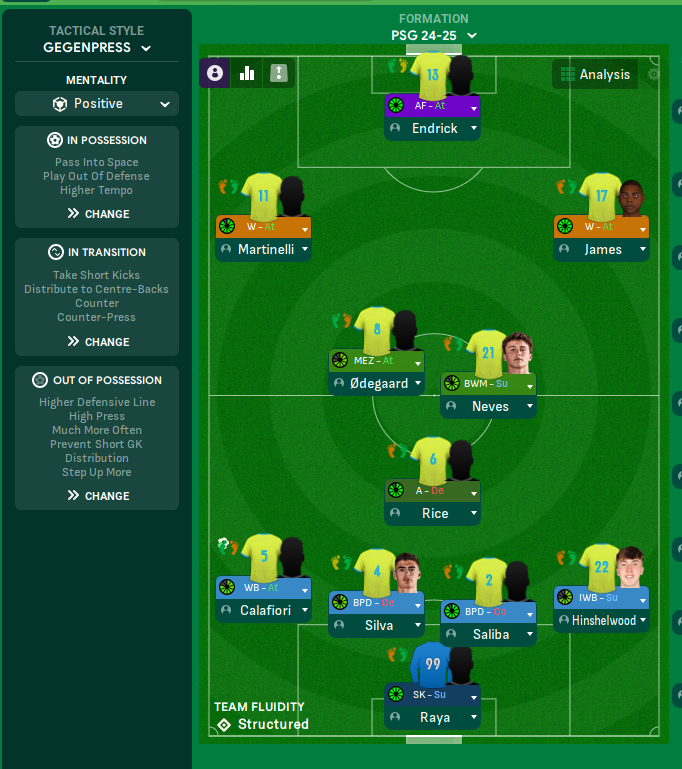
Loading tactical analysis...
Gegenpress
Positive
4-2-3-1 Wide
Structured
Pass Into Space
Play Out Of Defense
Higher Tempo
Take Short Kicks
Distribute to Centre-Backs
Counter
Counter-Press
Higher Defensive Line
High Press
Much More Often
Prevent Short GK Distribution
Step Up More
ST
Advanced Forward
Attack
LW
Winger
Attack
CAM
Mezzala
Attack
CM
Box to Box Midfielder
Support
CM
Ball Winning Midfielder
Support
RB
Wing Back
Attack
CB
Ball Playing Defender
Defend
CB
Ball Playing Defender
Cover
LB
Inverted Wing Back
Support
GK
Sweeper Keeper
Support
Utilizes Gegenpress to dominate possession and force errors from the opposition.
Wingers and an Advanced Forward can exploit opponent's defensive gaps due to the emphasis on passing into space.
While a high line can trap opponents, slower defenders may struggle to recover against pacey attackers.
This role may conflict with the high pressing strategy if not positioned well, potentially leaving defensive gaps.
How effective is the high press against teams with strong ball control?
Are the wingers tracking back sufficiently in the defensive phase?
How can we enhance our shape during counter-attacks?
Is the midfield balance maintaining possession effectively?
Are the full-backs providing enough width during attacks?
What adjustments can be made for matches against teams that play with a low block?
The tactical theory behind the 4-2-3-1 Wide: roles, instructions, and the trade-offs that decide whether the system holds up.
Double pivots and flat pairs in 4-2-3-1 and 4-4-2: when each pairing works, when it collapses, and the AMC unicorn that rescues both.
Klopp-style gegenpressing in FM, including squad profile, line-and-press pairing, sustainable workload, and the antipatterns to avoid.
Build through the wide areas or through the middle? A working framework for picking the right one for your squad.











