
4-2-3-1 Wide
The use of a Winger and Advanced Forward creates width and depth in the attack, making it difficult for the opposition to defend against quick movements.
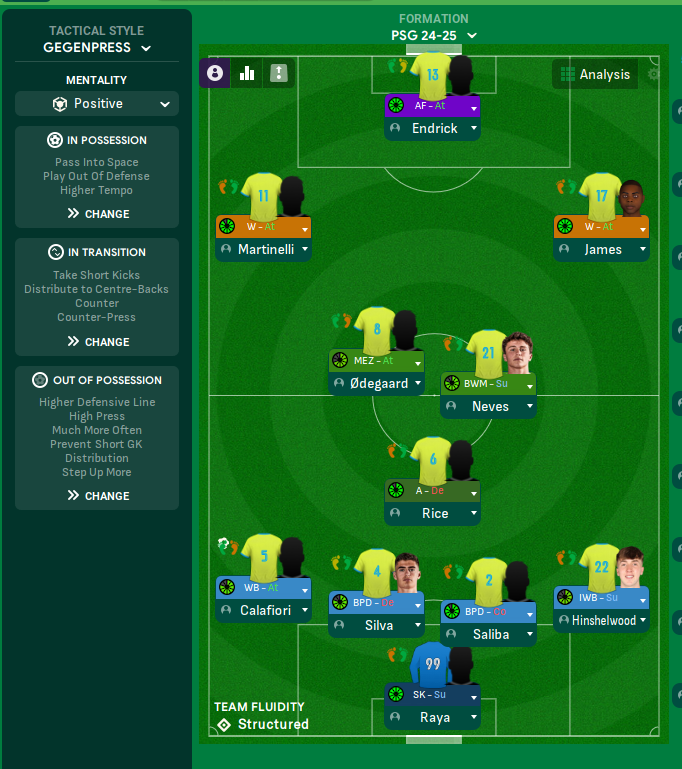
Loading tactical analysis...
Gegenpress
Positive
4-2-3-1 Wide
Structured
Pass Into Space
Play Out Of Defense
Higher Tempo
Take Short Kicks
Distribute to Centre-Backs
Counter
Counter-Press
Higher Defensive Line
High Press
Much More Often
Prevent Short GK Distribution
Step Up More
ST
Advanced Forward
Attack
LW
Winger
Attack
AM
Mezzala
Attack
CM
Ball-Winning Midfielder
Support
CM
Deep-Lying Playmaker
Defend
RB
Wing-Back
Attack
CB
Ball-Playing Defender
Defend
CB
Ball-Playing Defender
Cover
LB
Inverted Wing-Back
Support
GK
Sweeper Keeper
Support
The use of a Winger and Advanced Forward creates width and depth in the attack, making it difficult for the opposition to defend against quick movements.
The high press utilized in this setup allows the team to regain possession quickly, especially with the Counter-Press instruction in place.
While having structured fluidity promotes organization, it might contradict with the intention of a high press, potentially limiting dynamism in attacking transitions.
A higher defensive line brings risk against pacey attackers while utilizing the Counter-Press, as it may leave space behind that can be exploited.
How can the players better support each other when transitioning from defense to attack?
What adjustments can be made to fully exploit the width created by the wing-backs?
Are there any weaknesses in the current formation that could be exploited by the opposition?
How frequently are we regaining possession in the opponent's half during pressing?
Is the attacking tempo suitable for maintaining possession while maximizing quick transitions?
How can we improve set-piece effectiveness both defensively and offensively?
The tactical theory behind the 4-2-3-1 Wide: roles, instructions, and the trade-offs that decide whether the system holds up.
Klopp-style gegenpressing in FM, including squad profile, line-and-press pairing, sustainable workload, and the antipatterns to avoid.
Double pivots and flat pairs in 4-2-3-1 and 4-4-2: when each pairing works, when it collapses, and the AMC unicorn that rescues both.
How Mentality, Duty, and Role interact in FM, why duty trumps mentality every time, and the role-on-top-of-duty composition rules.











