
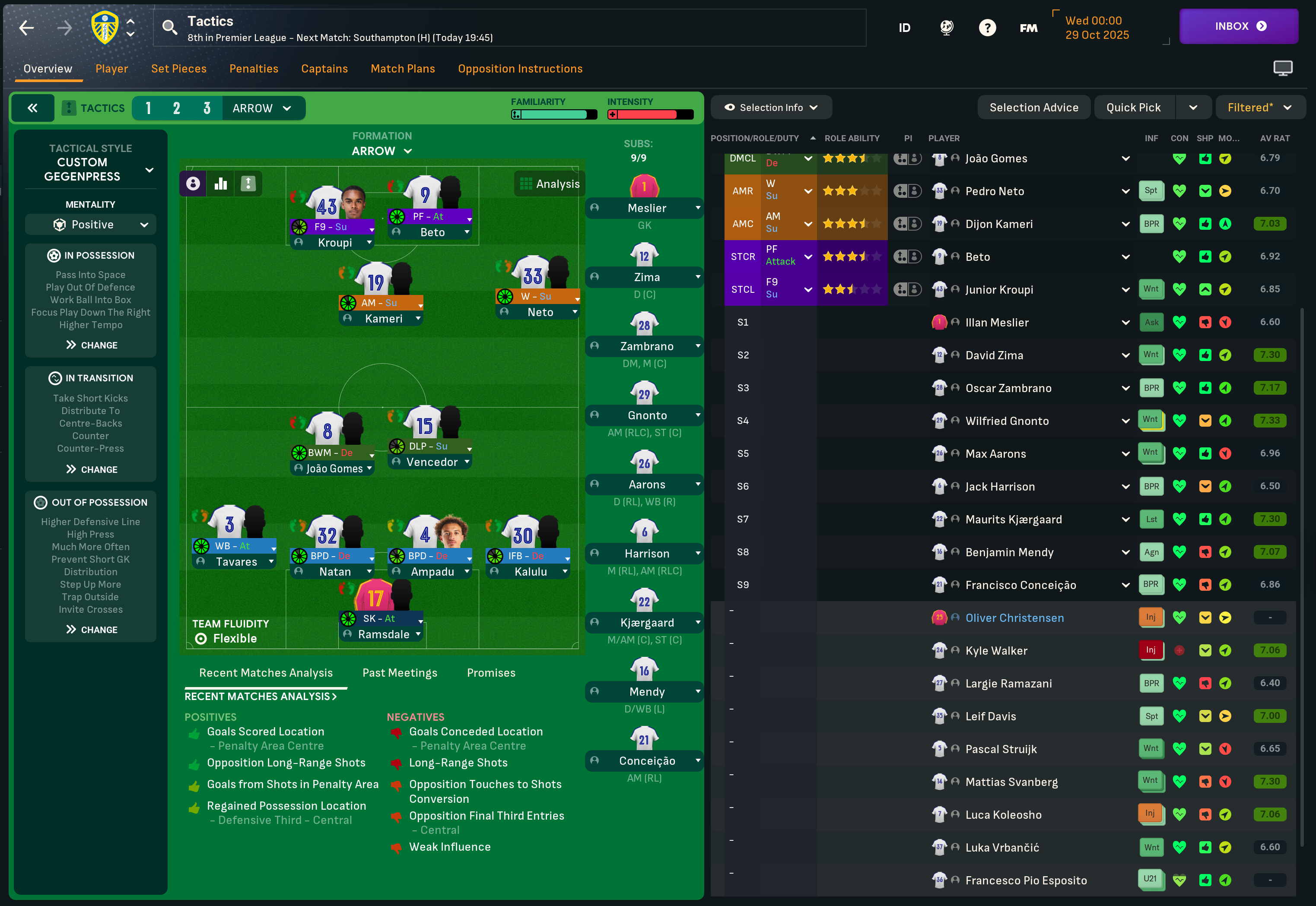
4-2-3-1 Wide
Utilizes width effectively with wingers and full-backs, creating a fluid attack that can stretch the opposition's defense.
Loading tactical analysis...
Gegenpress
Positive
4-2-3-1 Wide
Flexible
Pass Out of Space
Work Ball Into Box
Focus Play Down the Right
Take Short Kicks
Distribute to Centre-Backs
Counter-Press
Higher Defensive Line
Much More Urgent Press
Step Up More Often
Invite Crosses
GK
Goalkeeper
Defend
D (R)
Wing-Back
Attack
D (C)
Ball-Playing Defender
Defend
D (C)
Ball-Playing Defender
Defend
D (L)
Full-Back
Attack
DM
Deep-Lying Playmaker
Support
M (C)
Box-to-Box Midfielder
Support
AM (L)
Winger
Support
AM (C)
Attacking Midfielder
Support
AM (R)
Winger
Support
ST
Pressing Forward
Attack
ST
False Nine
Attack
Utilizes width effectively with wingers and full-backs, creating a fluid attack that can stretch the opposition's defense.
High pressing regains possession quickly, disrupting the opponent's buildup and allowing for quick transitions.
A higher defensive line could create space behind for counter-attacks, risking vulnerability while pressing high.
The presence of a False Nine and a Pressing Forward could lead to confusion in positioning and space occupation in the attacking third.
How can the pressing intensity be maintained without compromising defensive stability?
What is the best way to incorporate the bench players into the starting lineup during tougher matches?
Are there specific opponent tactics to consider when adjusting our formation?
Could an alternate formation better suit our strengths in certain matches?
How can we improve conversion rates from crosses and set pieces?
What tactical adjustments can be made if underperforming in midfield control?
The tactical theory behind the 4-2-3-1 Wide: roles, instructions, and the trade-offs that decide whether the system holds up.
Double pivots and flat pairs in 4-2-3-1 and 4-4-2: when each pairing works, when it collapses, and the AMC unicorn that rescues both.
Klopp-style gegenpressing in FM, including squad profile, line-and-press pairing, sustainable workload, and the antipatterns to avoid.
How Mentality, Duty, and Role interact in FM, why duty trumps mentality every time, and the role-on-top-of-duty composition rules.











