
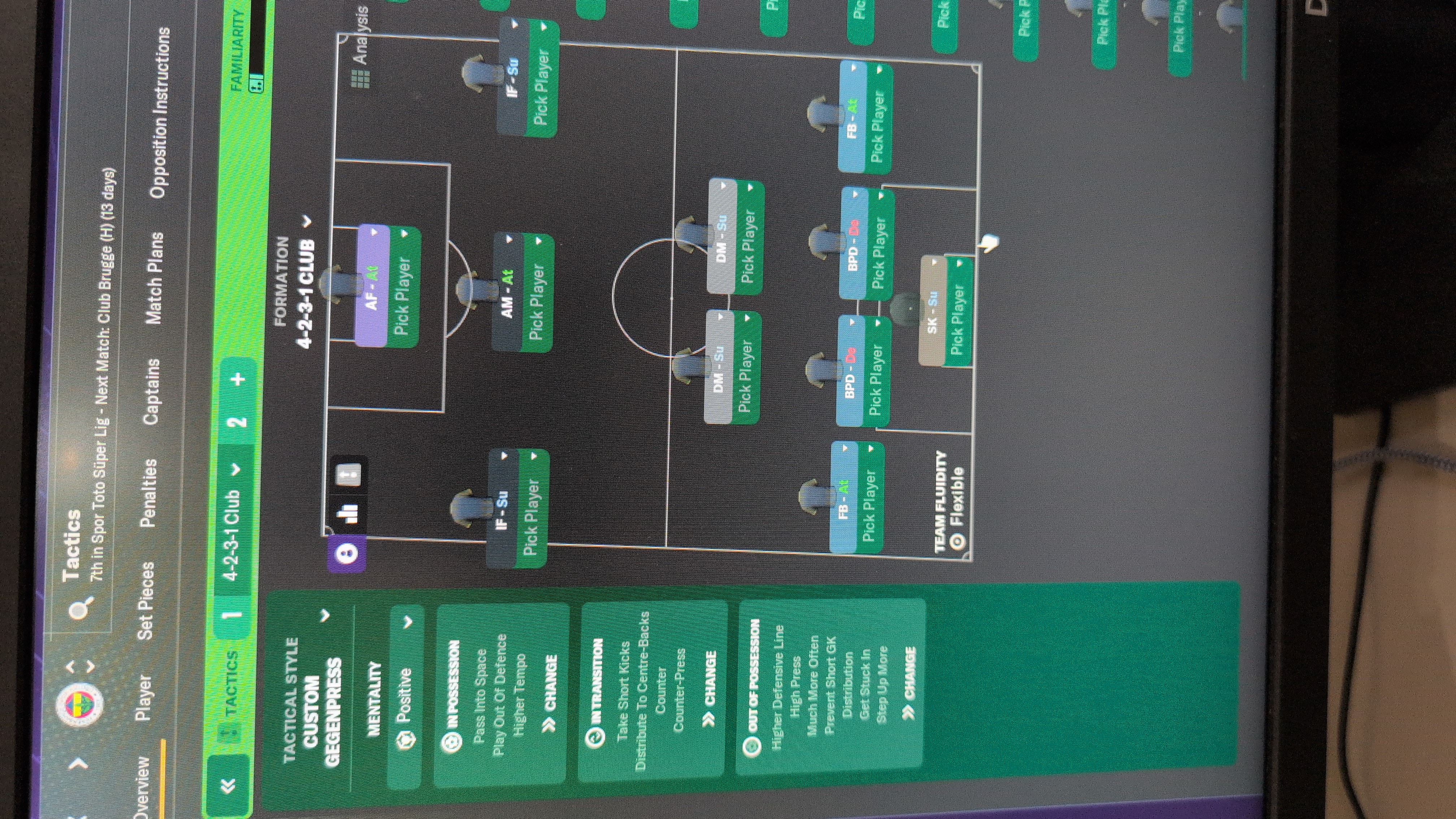
4-2-3-1 Wide
Utilizes counter-pressing to regain possession quickly, disrupting opponent's play.
Loading tactical analysis...
Gegenpress
Positive
4-2-3-1 Wide
Flexible
Pass Into Space
Play Out Of Defence
Higher Tempo
Take Short Kicks
Distribute To Centre-Backs
Counter
Counter-Press
Higher Defensive Line
Much More Often
Prevent Short GK Distribution
Step Up More
ST
Advanced Forward
Attack
AMC
Attacking Midfielder
Attack
LM
Inside Forward
Support
RM
Inside Forward
Support
DM
Central Midfielder
Support
BPD
Ball Playing Defender
Defend
FB
Full Back
Support
GK
Sweeper Keeper
Support
Utilizes counter-pressing to regain possession quickly, disrupting opponent's play.
The Inside Forwards and advanced midfielder create numerous attacking patterns, making it hard for opponents to defend.
A higher defensive line may lead to vulnerabilities against fast counter-attacks if the team is not positioned well.
While a higher tempo is beneficial, it may lead to rushed attacks and miscommunication among players, particularly in transition.
How can pressing intensity be adjusted based on the opponent's style?
Would a more compact midfield benefit possession retention?
Should the full-backs push higher or provide more defensive cover?
How can we utilize set-pieces to strengthen offensive threat?
Are player roles aligned with overall tactical goals?
Can we improve communication during transitional phases?
The tactical theory behind the 4-2-3-1 Wide: roles, instructions, and the trade-offs that decide whether the system holds up.
Klopp-style gegenpressing in FM, including squad profile, line-and-press pairing, sustainable workload, and the antipatterns to avoid.
Double pivots and flat pairs in 4-2-3-1 and 4-4-2: when each pairing works, when it collapses, and the AMC unicorn that rescues both.
Routines, takers, and target picks. How to turn corners and free-kicks into a reliable third of your goal output.











