
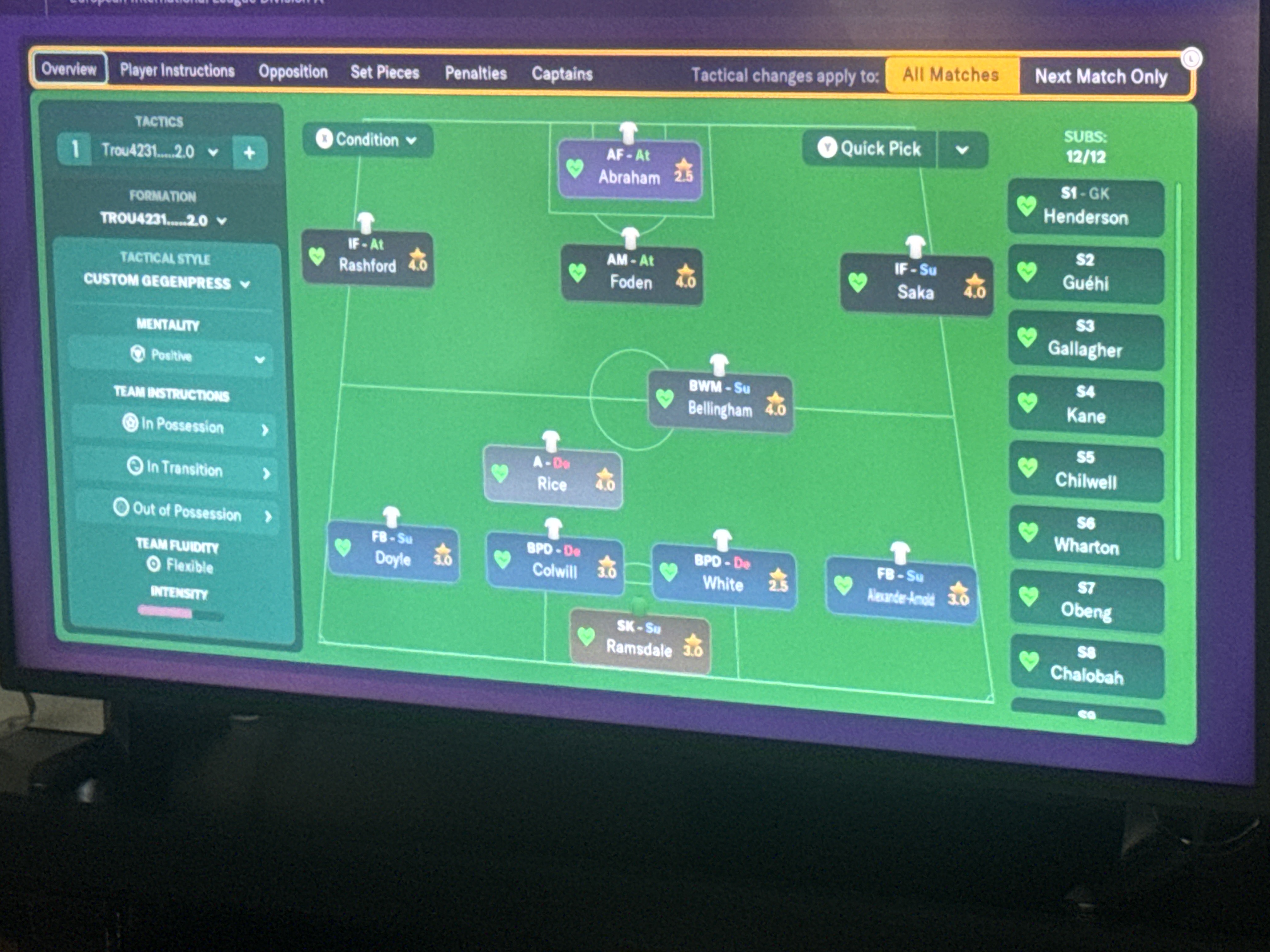
4-2-3-1 Wide
Utilizing Gegenpressing allows the team to win the ball back quickly in advanced positions, creating immediate scoring opportunities.
Loading tactical analysis...
Gegenpress
Positive
4-2-3-1 Wide
Flexible
Focus Play Down the Wings
Overlap Left
Overlap Right
Be More Expressive
Counter-Press
Counter
Higher Defensive Line
Use Offside Trap
More Urgent Pressing
ST
Advanced Forward
Attack
AM
Inside Forward
Attack
BWM
Ball Winning Midfielder
Support
BPD
Ball Playing Defender
Defend
Utilizing Gegenpressing allows the team to win the ball back quickly in advanced positions, creating immediate scoring opportunities.
With Inside Forwards and an Advanced Forward, the attack can be fluid and create multiple goal-scoring options from various angles.
A higher defensive line may leave players vulnerable to pacey counter-attacks, especially since the team presses high.
Relying heavily on a Ball Winning Midfielder and an advanced midfielder can lead to a lack of balance when transitioning back to defense.
Are the current player roles effectively utilizing their strengths?
How can midfield balance be improved to support both defense and attack?
What adjustments can be made to enhance central attacking options?
Is the team efficiently utilizing counter-attacking opportunities?
Are the wingers being instructed to track back effectively?
How can set pieces be integrated into the attacking strategy?
The tactical theory behind the 4-2-3-1 Wide: roles, instructions, and the trade-offs that decide whether the system holds up.
Klopp-style gegenpressing in FM, including squad profile, line-and-press pairing, sustainable workload, and the antipatterns to avoid.
Double pivots and flat pairs in 4-2-3-1 and 4-4-2: when each pairing works, when it collapses, and the AMC unicorn that rescues both.
What Higher Tempo, Wider, and Narrower actually do in FM, plus the dial contradictions and antipatterns players run into most often.











