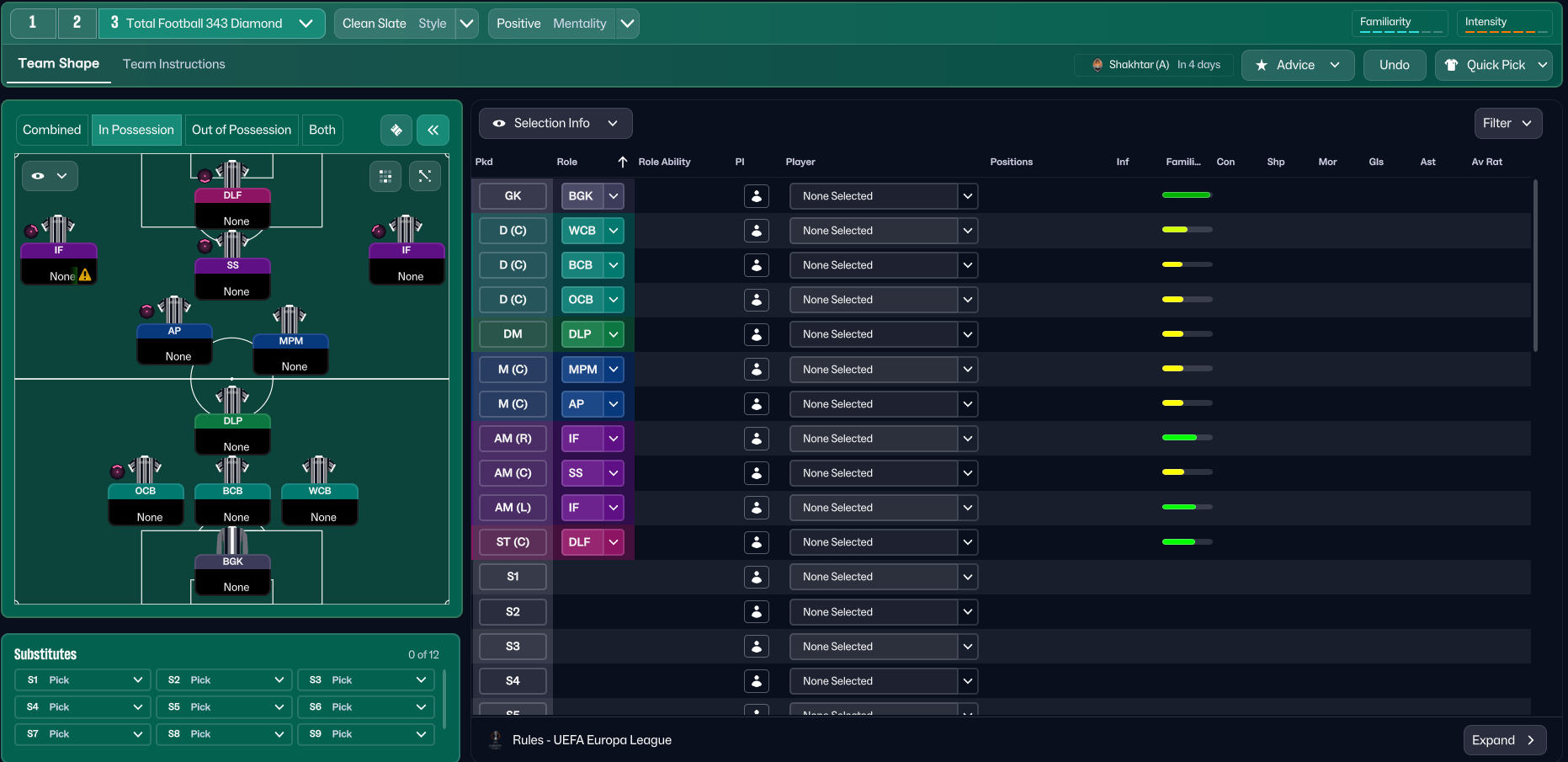
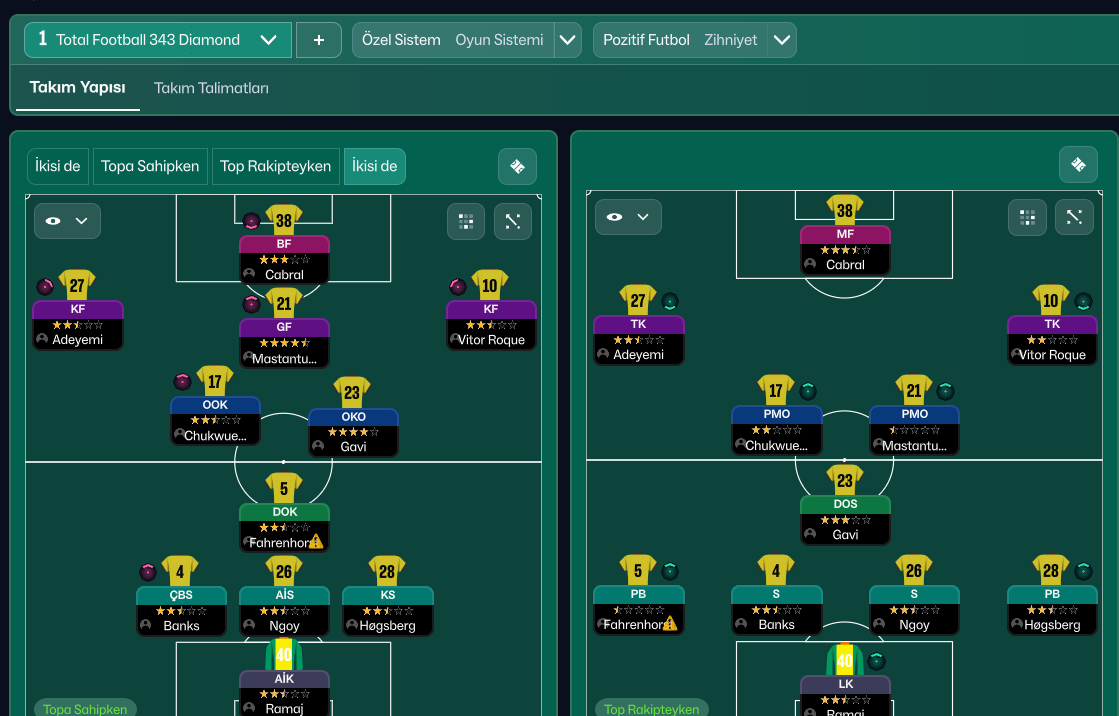
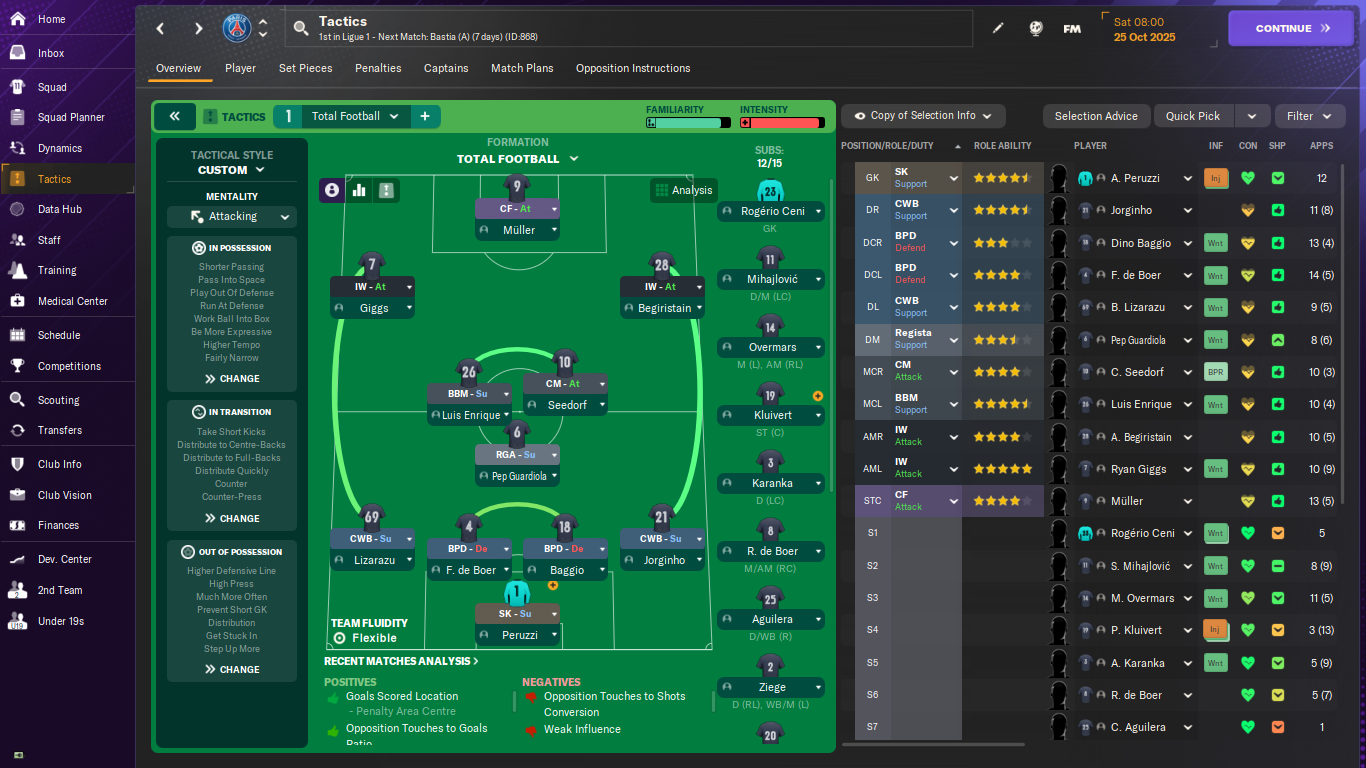
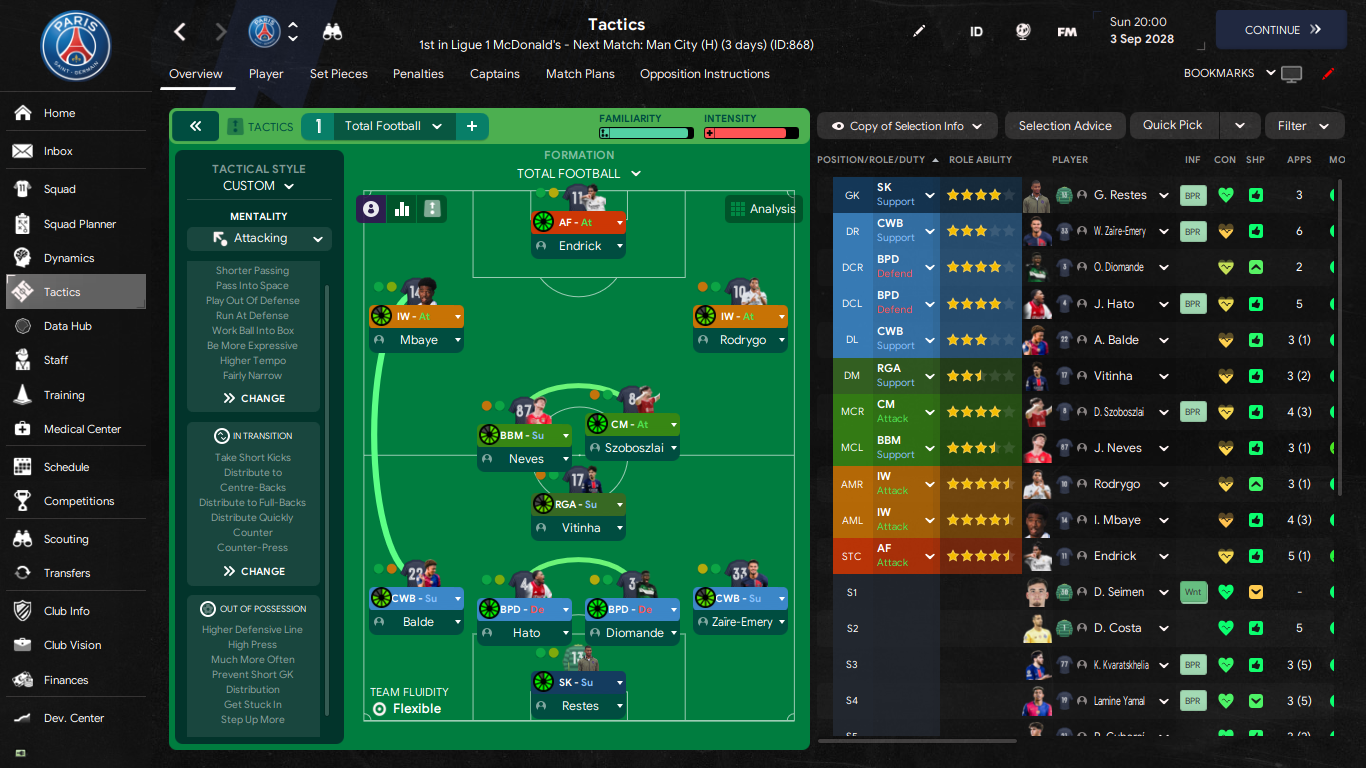
4-2-3-1 Wide
Creating space through movements in the attack. Wide play forces opposition to stretch, creating space centrally.
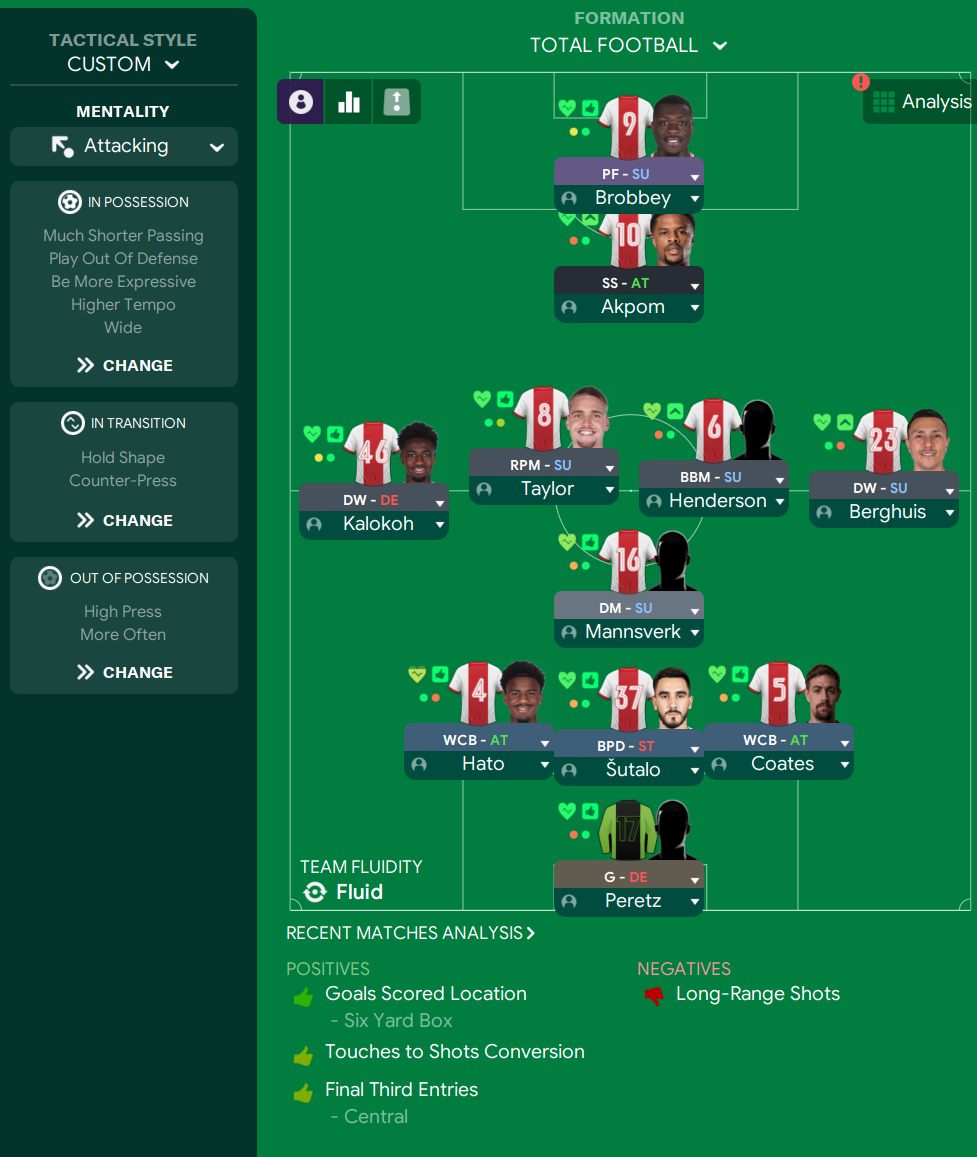
Loading tactical analysis...
Total Football
Attacking
4-2-3-1 Wide
Fluid
Much Shorter Passing
Play Out Of Defense
Be More Expressive
Higher Tempo
Wide
Hold Shape
Counter-Press
High Press
More Often
GK
G
D
Defender
BPD
S
Defender
WCB
A
Defender
WCB
A
Defender
WCB
D
Defensive Midfield
DM
S
Central Midfield
BBM
S
Right Midfield
RPM
S
Left Wing
DW
D
Shadow Striker
SS
A
Pressing Forward
PF
S
Quick transitions utilizing width and fluid movement.
Maintaining shape while pressing quickly to regain possession.
Creating space through movements in the attack.
4-2-3-1 Wide
Maintains a compact shape while allowing wing-backs to join the attack.
BPD and WCBs positioned together ensure a balanced defense at [2,3] and [2,4].
Fluid 4-2-3-1
Dynamic movements allow for quick changes in attack patterns.
High pressing and wide play create opportunities with players like Akpom and Brobbey.
Wide play forces opposition to stretch, creating space centrally.
RPM-S at [4,3] and DW-DE at [5,1] utilize the flanks efficiently.
Players interchange roles dynamically, creating confusion in opposition.
High fluidity allows players like Taylor and Henderson to switch roles from midfield to attack.
Conflicting instructions can confuse players in transition.
Hold Shape contrasts with the aggressive pressing strategy.
High pressing may leave gaps for quick counter-attacks.
While pressing, wing-backs may be caught out of position.
Counter-Attacks
High pressing can be exploited if opposition bypass midfield.
WCBs positioned far forward can be vulnerable at [2,1] and [2,5].
Defensive Transition
Rapid transitions may leave midfield exposed.
The DM-S at [3,3] must quickly recover if possession is lost.
BBM-S and RPM-S
Dynamic midfield pair enhances penetration and creativity.
BBM at [4,2] and RPM at [4,3] support each other during attacks.
WCB-A and DM-S
Allows overlapping runs while maintaining defensive structure.
WCB-A at [2,2] links play effectively with DM-S at [3,3].
How can we improve the team's defensive transitions?
What adjustments can ensure better coverage against counter-attacks?
Are the current player roles and duties effectively utilized for this tactical setup?
The tactical theory behind the 4-2-3-1 Wide: roles, instructions, and the trade-offs that decide whether the system holds up.
Double pivots and flat pairs in 4-2-3-1 and 4-4-2: when each pairing works, when it collapses, and the AMC unicorn that rescues both.
Klopp-style gegenpressing in FM, including squad profile, line-and-press pairing, sustainable workload, and the antipatterns to avoid.
How Mentality, Duty, and Role interact in FM, why duty trumps mentality every time, and the role-on-top-of-duty composition rules.