
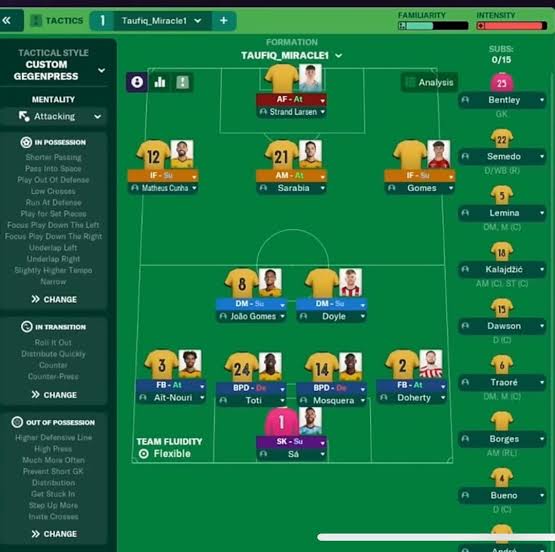
4-2-3-1 Wide
The Gegenpress style enables the team to pressure opponents high up the pitch, facilitating quick recovery of possession.
Loading tactical analysis...
Gegenpress
Attacking
4-2-3-1 Wide
Flexible
Short Passing
Focus Play Down Left
Play Out of Defence
Counter-Press
Counter
Higher Defensive Line
Tighter Marking
ST
Advanced Forward
Attack
AM
Attacking Midfielder
Attack
DM
Deep-Lying Playmaker
Support
FB
Full-Back
Attack
The Gegenpress style enables the team to pressure opponents high up the pitch, facilitating quick recovery of possession.
Flexible fluidity allows players to interchange positions, creating unpredictability in the attack.
While the tactic is attacking, some player roles like DM support could lead to a lack of defensive security if the team commits too many players forward.
Full-backs positioned on attack may leave gaps if not covered adequately by the wingers or central midfielders.
How will opponents' strengths influence your high pressing strategy?
Are the attacking roles of wingers providing enough defensive cover?
What adjustments are needed if the team struggles with quick transitions?
How can the team maintain balance between pressing and defensive solidity?
Is the current formation maximizing the strengths of your key players?
What specific player attributes should be prioritized for future signings given this setup?
The tactical theory behind the 4-2-3-1 Wide: roles, instructions, and the trade-offs that decide whether the system holds up.
Klopp-style gegenpressing in FM, including squad profile, line-and-press pairing, sustainable workload, and the antipatterns to avoid.
Double pivots and flat pairs in 4-2-3-1 and 4-4-2: when each pairing works, when it collapses, and the AMC unicorn that rescues both.
The pairing rule for Defensive Line and Line of Engagement, all 9 combinations, and the gap that costs goals.











