
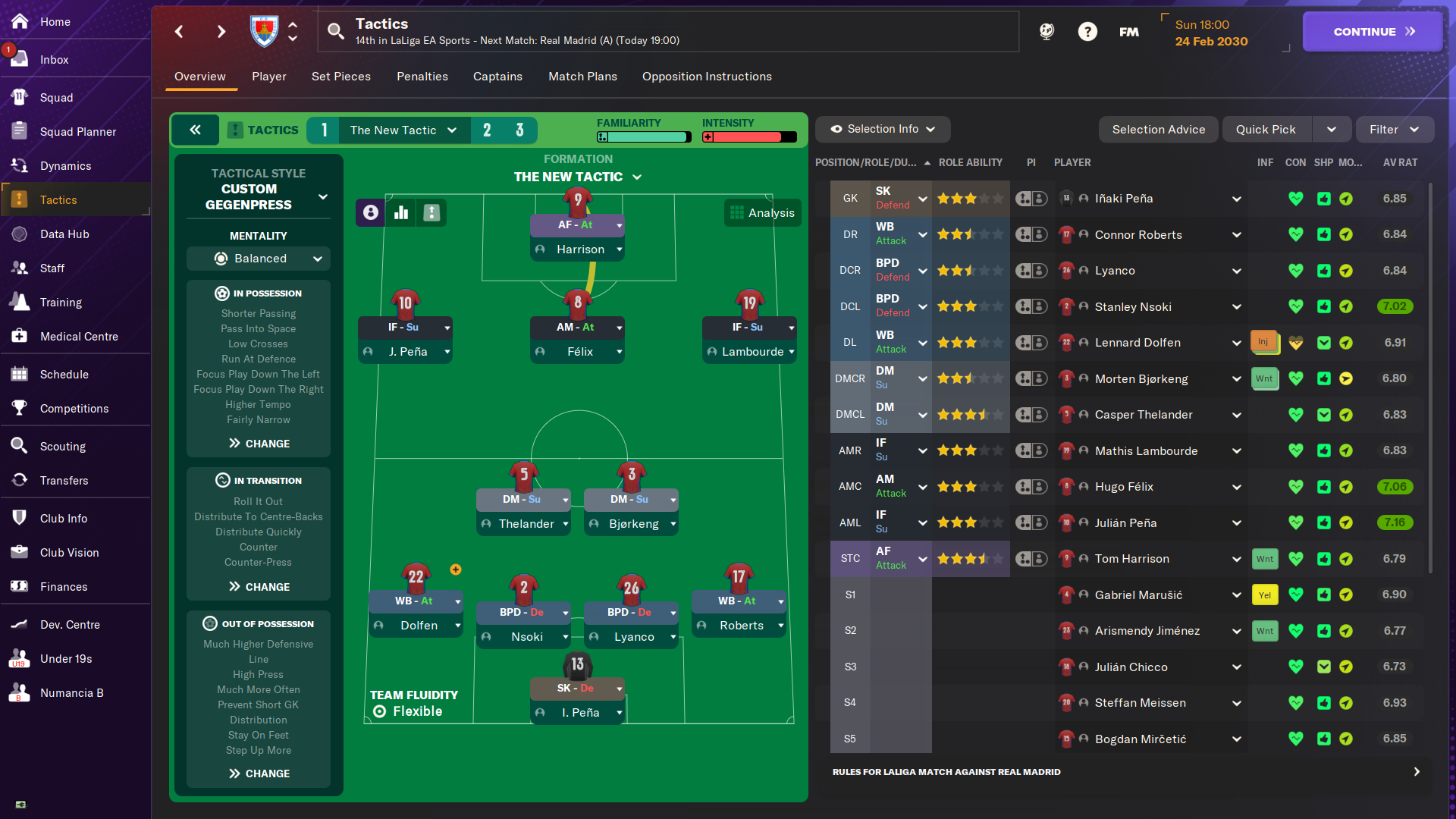
4-2-3-1 Wide
The formation allows for quick transitions and multiple attacking outlets, especially with the Inside Forwards and the Advanced Forward creating space and…
Loading tactical analysis...
Gegenpress
Balanced
4-2-3-1 Wide
Flexible
Shorter Passing
Pass Into Space
Low Crosses
Run At Defence
Focus Play Down The Left
Focus Play Down The Right
Higher Tempo
Fairly Narrow
Roll It Out
Distribute To Centre-Backs
Distribute Quickly
Counter
Counter
Much Higher Defensive Line
High Press
Much More Often
Prevent Short GK Distribution
Stay On Feet
GK
Sweeper Keeper
Defend
DL
Wing Back
Attack
DCR
Ball Playing Defender
Defend
DCL
Ball Playing Defender
Defend
DR
Wing Back
Attack
DMR
Deep Lying Playmaker
Support
DML
Deep Lying Playmaker
Support
AM
Attacking Midfielder
Attack
IF
Inside Forward
Support
IF
Inside Forward
Support
STC
Advanced Forward
Attack
The formation allows for quick transitions and multiple attacking outlets, especially with the Inside Forwards and the Advanced Forward creating space and opportunities.
The two Deep Lying Playmakers promote ball retention and distribution, allowing for better control in the midfield area.
The Wing Backs pushing forward may lead to a lack of support in midfield during transitions, potentially leaving the team exposed.
A high defensive line could be exploited by quick counter-attacking teams if the pressing fails, leaving the back four vulnerable.
Is the current defensive line suitable for upcoming matches?
How do my players perform under high pressing conditions?
Are the Wing Backs supporting enough in defence?
Should I vary the possession style based on opponents?
How well do my Inside Forwards execute their roles?
Is there balance in my midfield to facilitate smoother transitions?
The tactical theory behind the 4-2-3-1 Wide: roles, instructions, and the trade-offs that decide whether the system holds up.
Klopp-style gegenpressing in FM, including squad profile, line-and-press pairing, sustainable workload, and the antipatterns to avoid.
Double pivots and flat pairs in 4-2-3-1 and 4-4-2: when each pairing works, when it collapses, and the AMC unicorn that rescues both.
What Higher Tempo, Wider, and Narrower actually do in FM, plus the dial contradictions and antipatterns players run into most often.











