Uploaded Tactic
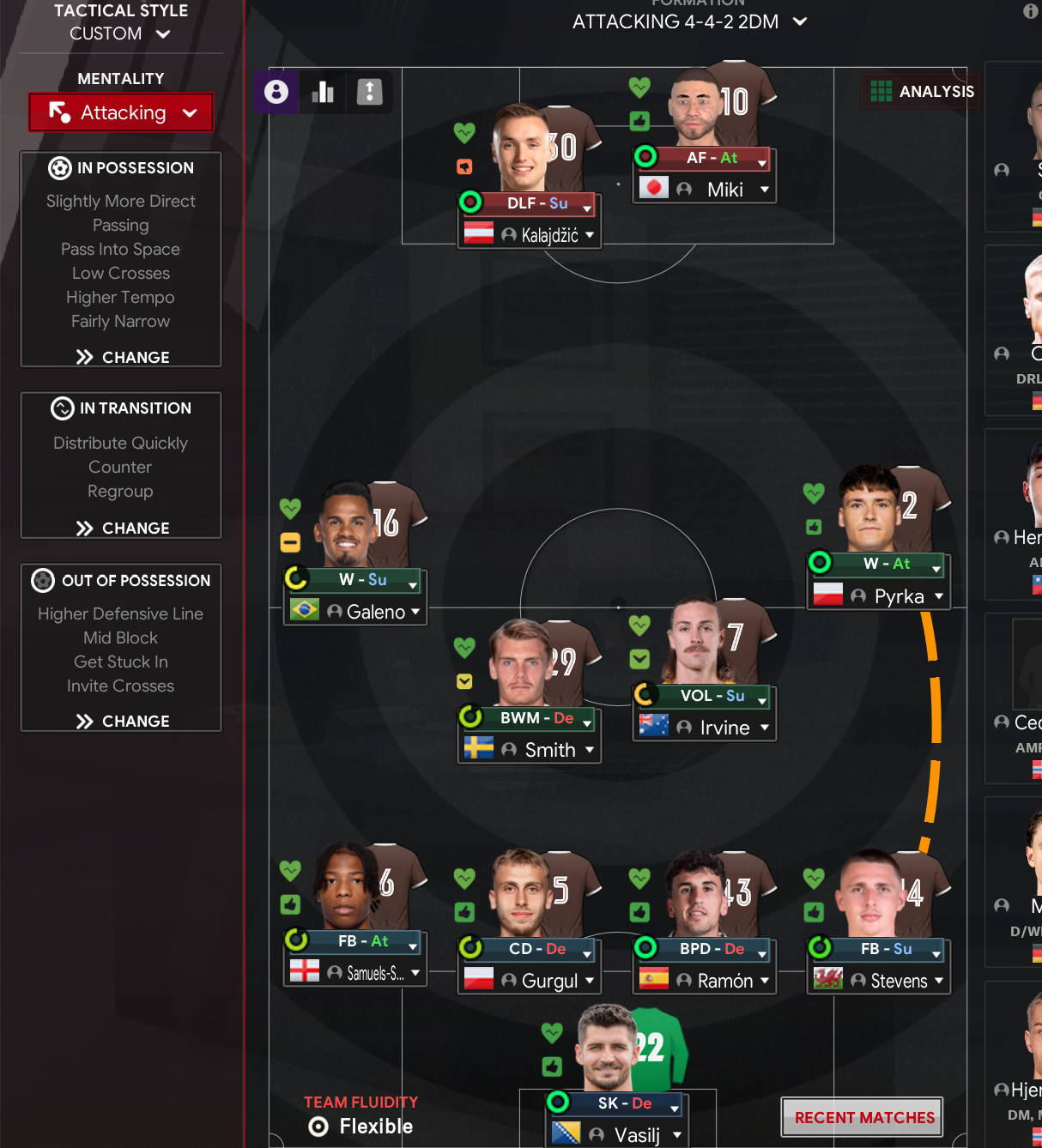
Formation & Style
Tactical Style:Attacking
Mentality:Attacking
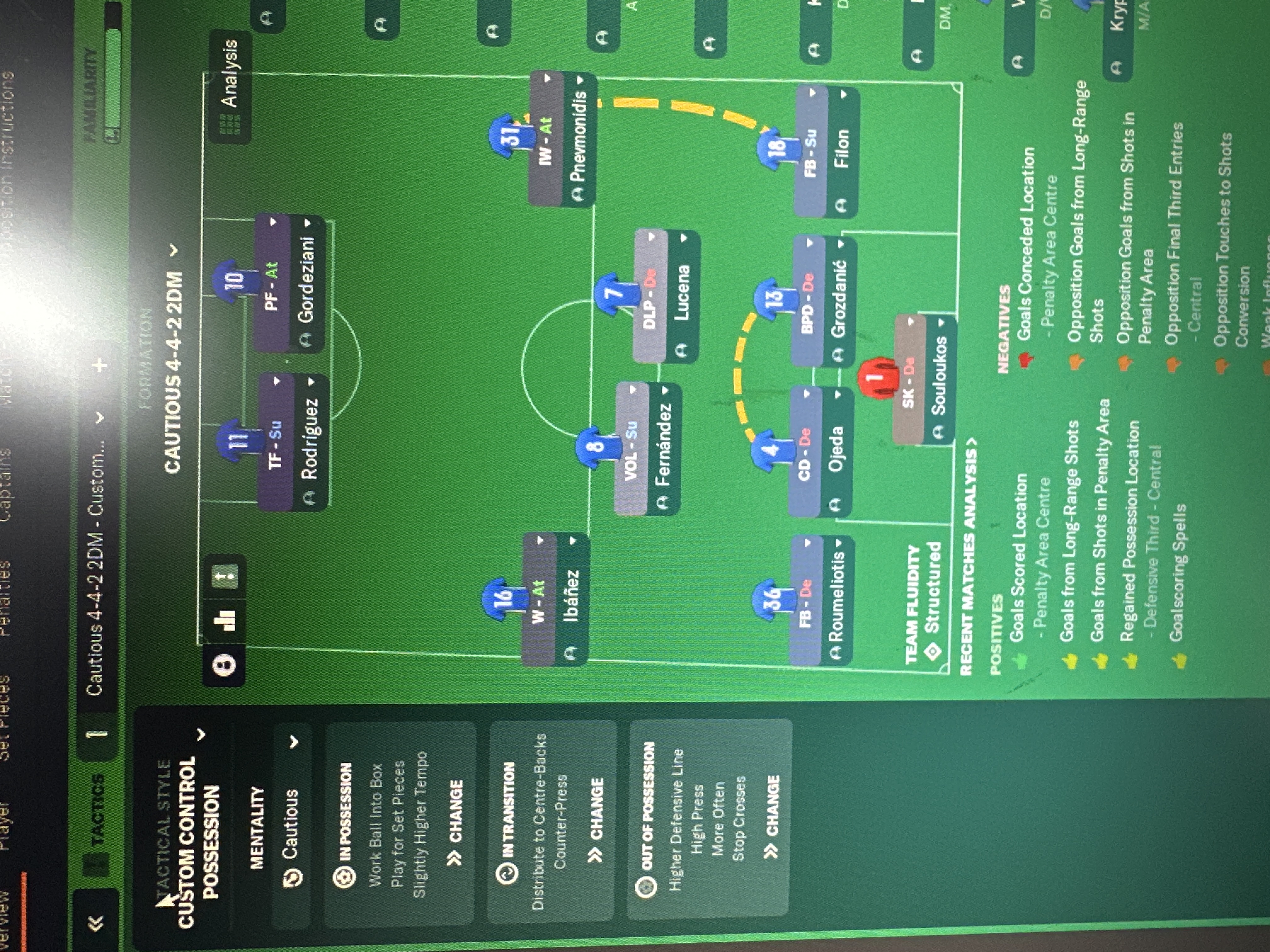
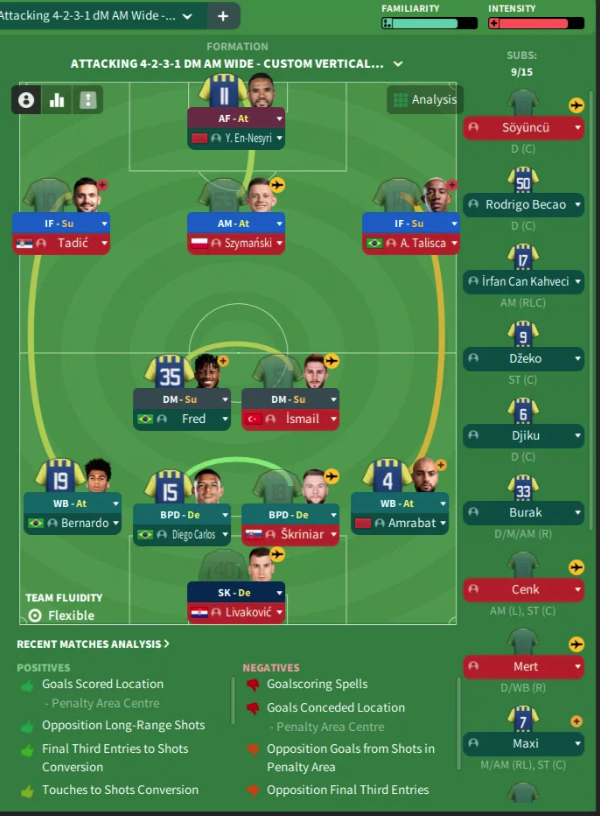
Formation:4-4-2 DM
Team Fluidity:Flexible
In Possession
Slightly More Direct Passing
Pass Into Space
Low Crosses
Higher Tempo
Fairly Narrow
In Transition
Distribute Quickly
Counter
Regroup
Out of Possession
Higher Defensive Line
Mid Block
Get Stuck In
Invite Crosses
Team Shape Without Ball
Shape:4-4-2
Description:A compact mid-block with the aim to deny central access and channel play wide.
Evidence:DM with BWM-D at [3,2] and CM with SV-S at [4,2] supporting the defensive solidity.
Team Shape With Ball
Shape:4-4-2
Description:Wide attackers with overlapping full-backs creating width, supplemented by central runs from midfield.
Evidence:Winger (W-S) at [5,1] and Winger (W-A) at [5,5] providing the width for the attack.
Phase Description
Attacking Play
Utilizes wide play with wingers, operates through quick passing to create goal-scoring chances.
Defensive Transition
Engages in quick regrouping after losing possession, aiming to regain control swiftly.
Main Focus
Maintaining a high tempo and narrow play to exploit central spaces.
Key Strengths
Strong Wide Play
The presence of wingers provides width, stretching the opposition and creating space for midfielders.
Defensive Stability
With a BWM-D and BPD-D in the midfield, the team can break down opposition attacks effectively.
Fluid Attack
The dual-striker setup allows for versatile attacking movements and space exploitation.
Conflicting Directions
High Defensive Line vs. Mid Block
Using a high defensive line may expose the team to quick counter-attacks, which counters the mid block philosophy.
Direct Passing vs. High Tempo
While higher tempo aids quick transitions, it may lead to rushed passes that jeopardize possession, countering direct passing.
Mixing Support Duties
A mix of attack and support duties among wingers could confuse spacing during transitions.
Tactical Suggestions
Adjust Defensive Line
Consider lowering the defensive line to mitigate vulnerability to counters.
Maintain Consistency in Passing Style
Limit passing variety to enhance possession stability and reduce turnovers.
Role Re-evaluation
Assess the necessity of having overlapping roles at full-back to ensure offensive support.
Ask Questions About Your Lineup
Related Tactics
More Attacking tactics


Guides for this formation
The tactical theory behind the 4-4-2 DM: roles, instructions, and the trade-offs that decide whether the system holds up.
Player pairings
Midfield Pairs in 4-2-3-1 and 4-4-2
Double pivots and flat pairs in 4-2-3-1 and 4-4-2: when each pairing works, when it collapses, and the AMC unicorn that rescues both.
Read guide
Playing styles
Direct, Vertical Football
Long-ball football done well in FM. When direct, vertical play is the right choice, and what the Direct Passing TI actually changes.
Read guide
Playing styles
Counter-Attacking Excellence
Sit deep, win the ball, and break in three passes. The roles, instructions, and squad profile that make it work.
Read guide