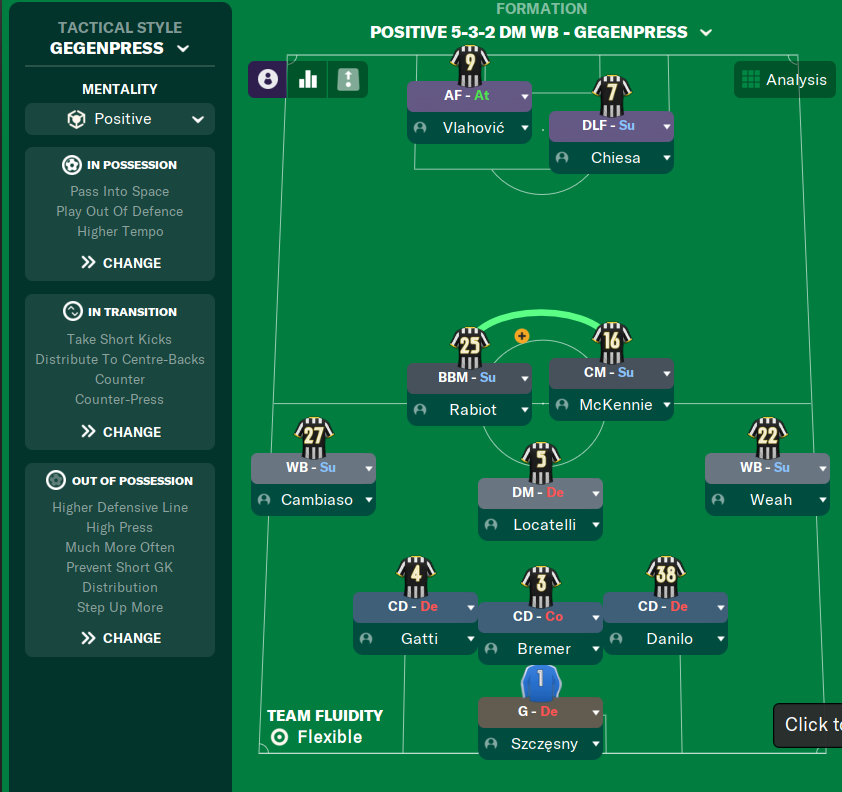
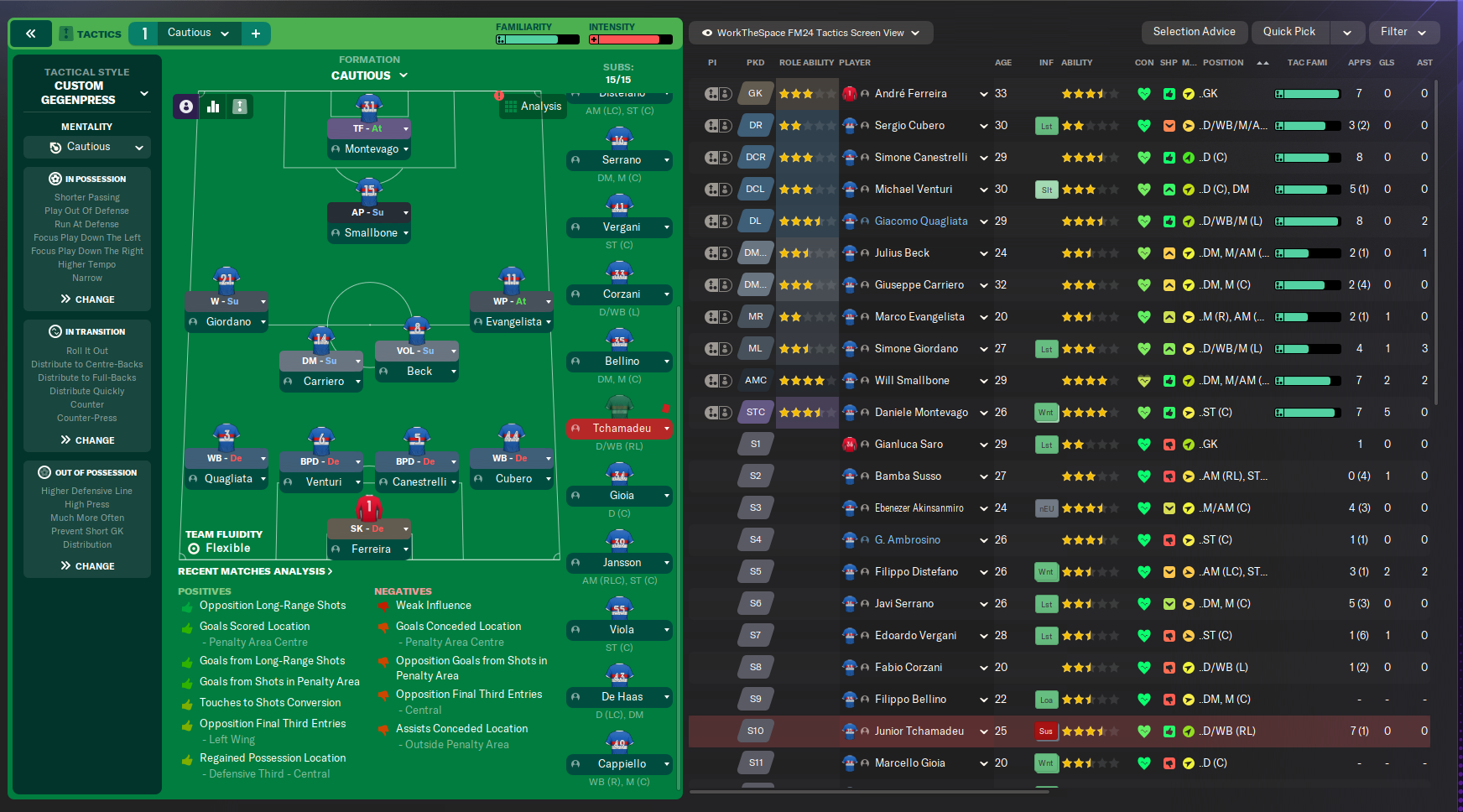
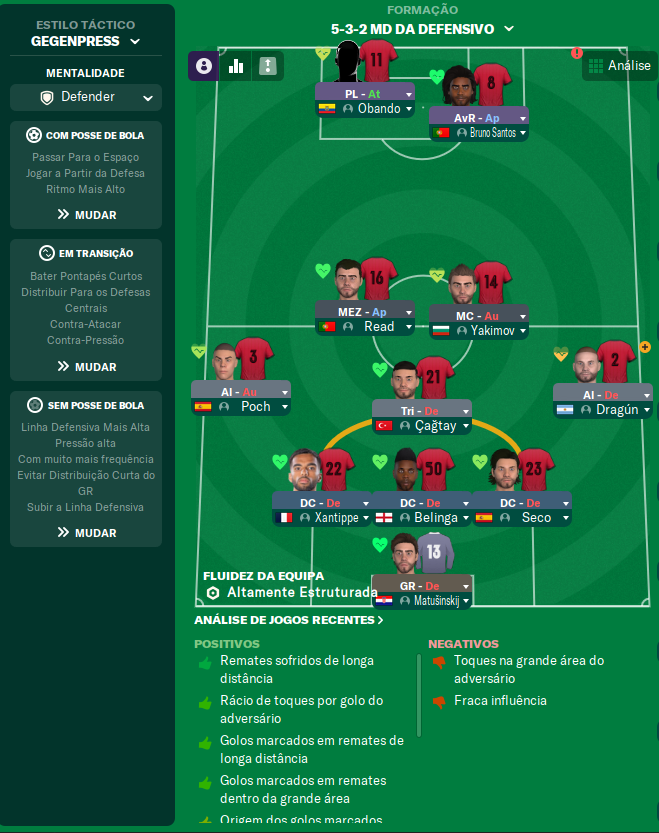
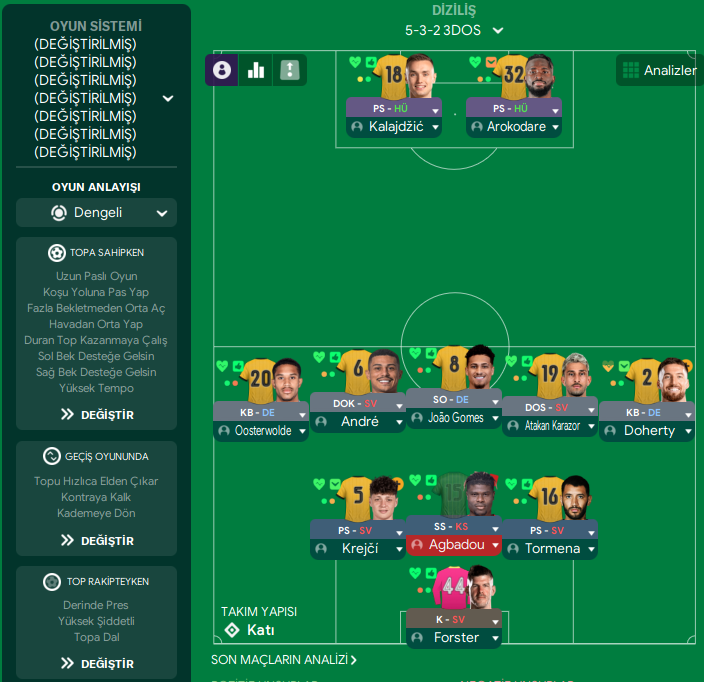
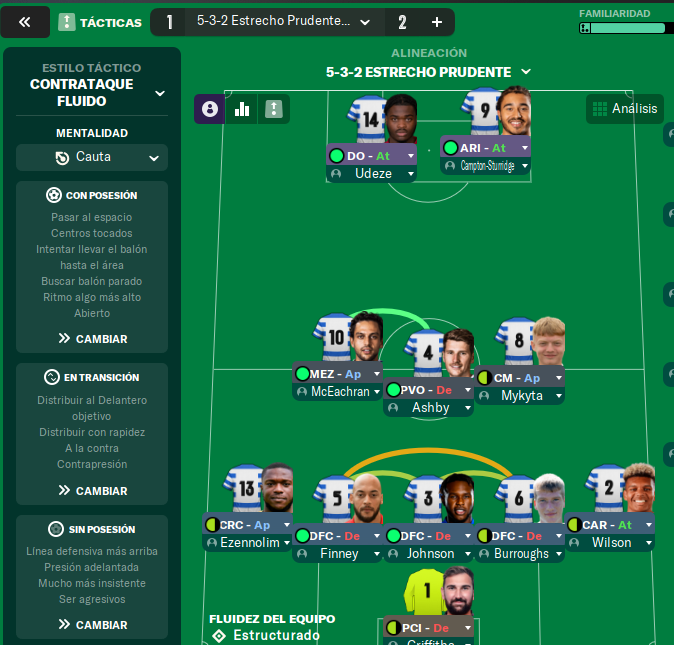
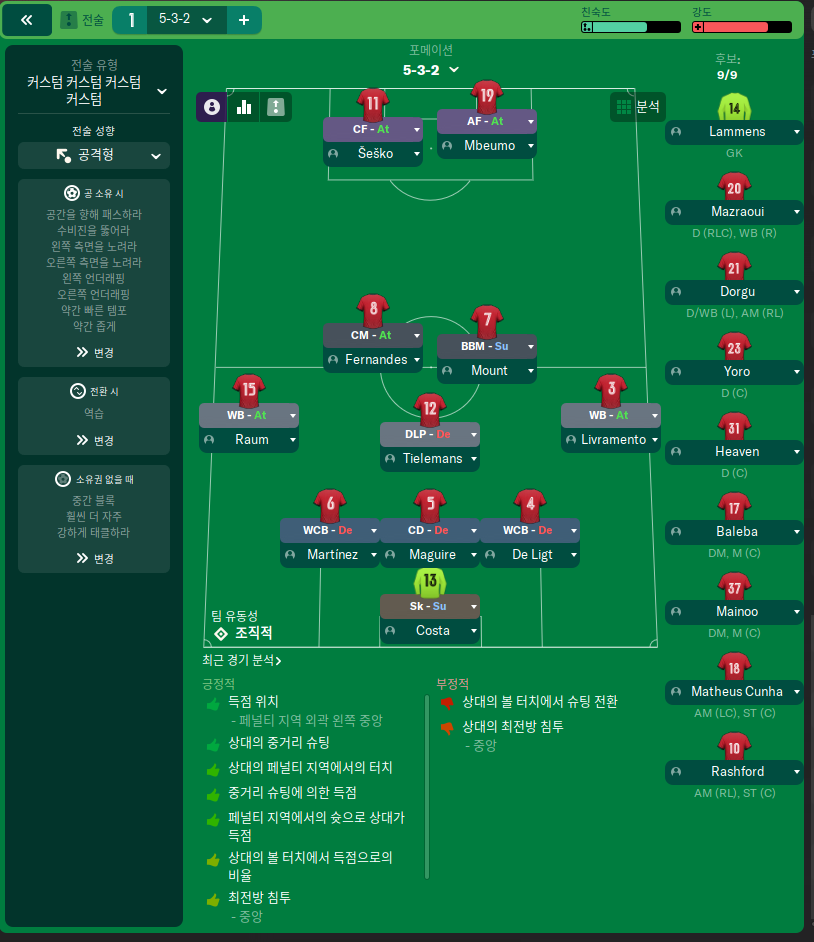
5-3-2
Use the DLP and back three to progress quickly, release the attacking wing-backs, and find the two forwards with forward passes. The two forwards can…
Loading tactical analysis...
Vertical Tiki-Taka
Attacking
5-3-2
Structured
GK
Sweeper Keeper
Support
DC
Wide Centre-Back
Defend
DC
Centre-Back
Defend
DC
Wide Centre-Back
Defend
WBL
Wing-Back
Attack
DM
Deep-Lying Playmaker
Defend
WBR
Wing-Back
Attack
MC
Central Midfielder
Attack
MC
Box-to-Box Midfielder
Support
ST
Complete Forward
Attack
ST
Advanced Forward
Attack
Pass Into Space
Distribute to Centre-Backs
Focus Play Down the Left
Focus Play Down the Right
Underlap Left
Underlap Right
Slightly Higher Tempo
Fairly Narrow Attacking Width
Counter
Standard Line of Engagement
Trigger Press Much More Often
Get Stuck In
The two forwards can offer complementary runs and link play, while Pass Into Space suits the attacking intent and can exploit gaps behind the opposition.
The CF and AF are both on Attack duty, with Pass Into Space enabled.
Both attacking wing-backs provide width and forward support, giving the narrow attacking setup an outlet on either flank.
Both wide players are WB on Attack duty at [3,1] and [3,5], alongside Fairly Narrow Attacking Width.
Attacking mentality, two attacking wing-backs and three attacking roles in midfield and attack commit many players forward. Countering quickly after winning possession can amplify the risk of losing the ball while the team is stretched.
Attacking mentality and counter are paired with WB (At) at [3,1] and [3,5], CM (At) at [4,2], CF (At), and AF (At).
The narrow attacking width and focus through both flanks do not align neatly: play is directed down the sides, but the overall attacking spacing is narrow, potentially crowding the wing-back and underlapping lanes.
Fairly Narrow Attacking Width is paired with Focus Play Down the Left, Focus Play Down the Right, Underlap Left, and Underlap Right.
Space behind the attacking wing-backs
When both wing-backs advance, opponents can target the channels outside the wide centre-backs before the back three can shift across.
WB (At) at [3,1] and [3,5] sit ahead of WCB (De) at [2,2] and [2,4].
high
Midfield protection during attacks
Only the DLP is explicitly on a defensive duty in the three-player midfield; the attacking CM and supporting BBM may leave space around the holder when possession turns over.
DLP (De) at [3,3] is alongside CM (At) at [4,2] and BBM (Su) at [4,4], with counter enabled.
medium
DLP with the back three
The DLP can receive from the three centre-backs and feed forward passes, helping connect the defensive base to the attacking pair.
DLP (De) at [3,3] is positioned ahead of WCB (De) at [2,2], CB (De) at [2,3], and WCB (De) at [2,4].
DLP with the back three
CF and AF partnership
The CF can contribute to link-up while the AF threatens space beyond, a useful pairing for a vertical approach with passes into space.
CF (At) and AF (At) occupy [6,2] and [6,4], with Pass Into Space enabled.
CF and AF partnership
How can I protect the space behind my attacking wing-backs in this 5-3-2?
What should I adjust if my narrow width and flank-focused play are crowding my underlapping runs?
How can I balance my counter-attacking instructions with the high commitment of my attacking roles?
A vertical, forward-looking attack with passes into space, a narrow starting width, flank-focused progression and underlap options on both sides.
The team is instructed to counter after winning possession; the extraction does not specify a counter-press or regroup instruction after losing it.
Use the DLP and back three to progress quickly, release the attacking wing-backs, and find the two forwards with forward passes.
5-3-2
The listed formation places three centre-backs, two wing-backs, three central midfielders and two forwards. The wing-backs' Attack duties imply they may be higher when the team has the ball, but the extraction does not specify a defensive line or line of engagement.
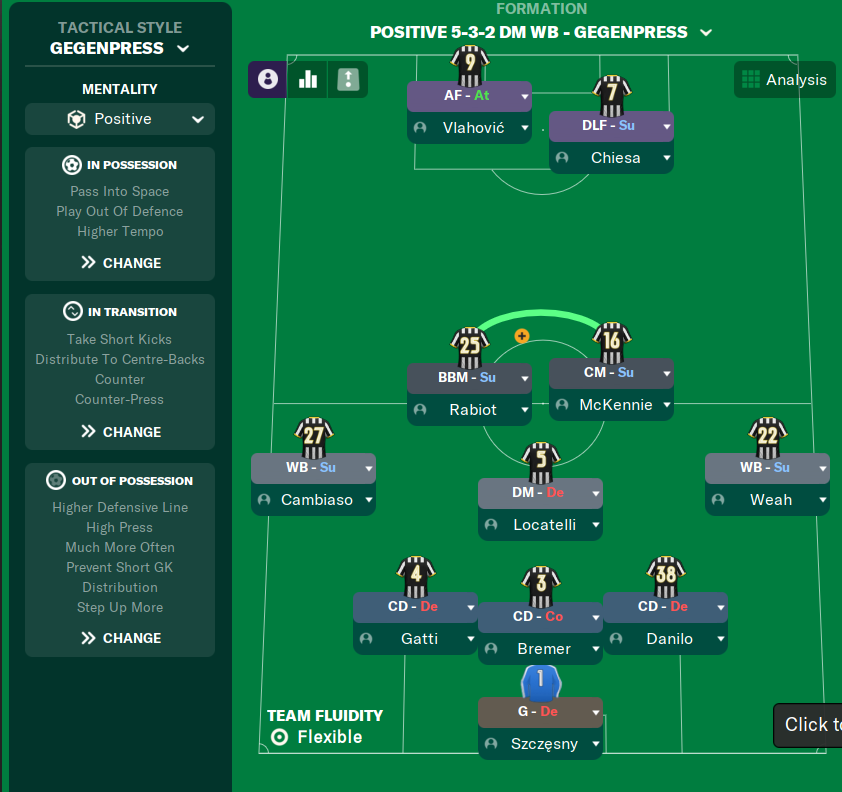
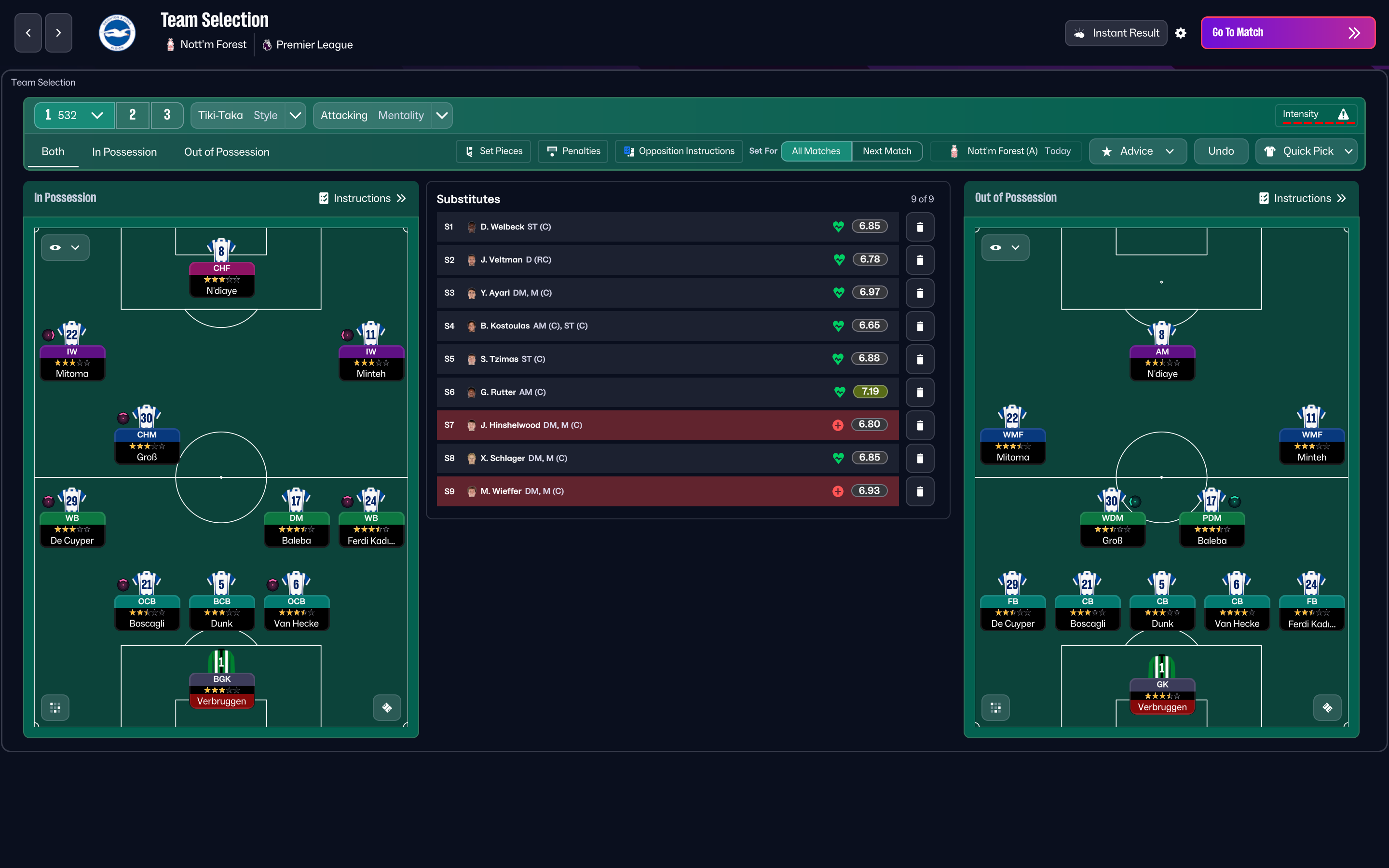
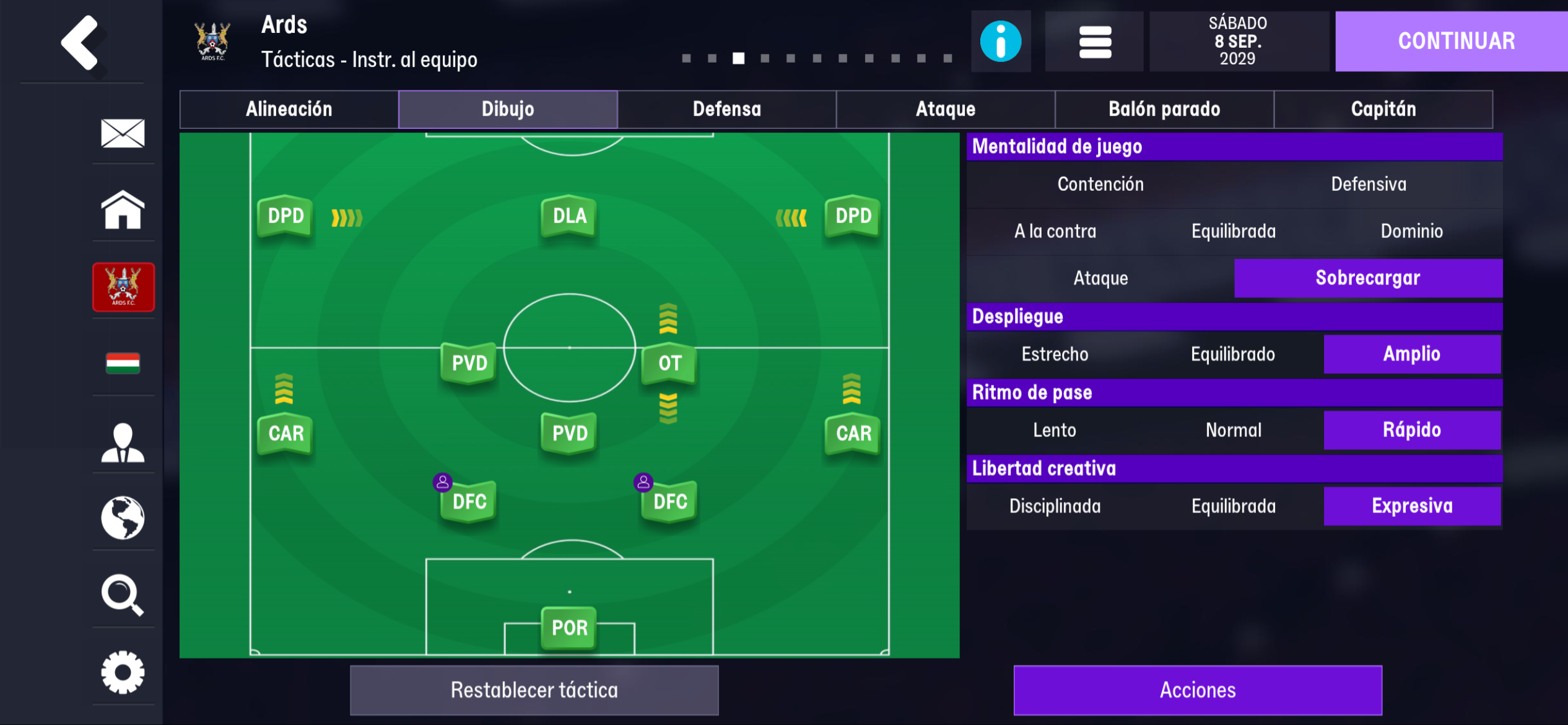
The back line includes WCB (De) at [2,2], CB (De) at [2,3], and WCB (De) at [2,4], with WB at [3,1] and [3,5] and two forwards at row 6.
5-3-2 with attacking wing-backs
The wing-backs provide the main width around a narrow central structure, while the CM, BBM and two forwards offer forward support and underlapping options.
WB (At) at [3,1] and [3,5] accompany CM (At) at [4,2], BBM (Su) at [4,4], and CF (At) plus AF (At) at row 6.
This is an ambitious vertical 5-3-2 built around a defensive playmaker, attacking wing-backs and a two-forward partnership; it should create direct runs and strong central penetration. Its main weakness is the space exposed when both wing-backs and several central players advance, especially with counter-attacking enabled. I would first moderate the mentality, give the wide attacks more room, and reduce the tackling risk; then review whether the two flank-focus instructions are helping the underlaps rather than making the attack predictable.
The tactical theory behind the 5-3-2: roles, instructions, and the trade-offs that decide whether the system holds up.
The deliberate underdog tactic in FM: formation choices, duty distribution, and why Counter-Press is exactly wrong inside a low block.
FM27 keeps FM26's tactic system. Here is what stays the same, the small changes that can catch you out, and what the new Tactical Effectiveness system asks of you.
How Mentality, Duty, and Role interact in FM, why duty trumps mentality every time, and the role-on-top-of-duty composition rules.