Uploaded Tactic
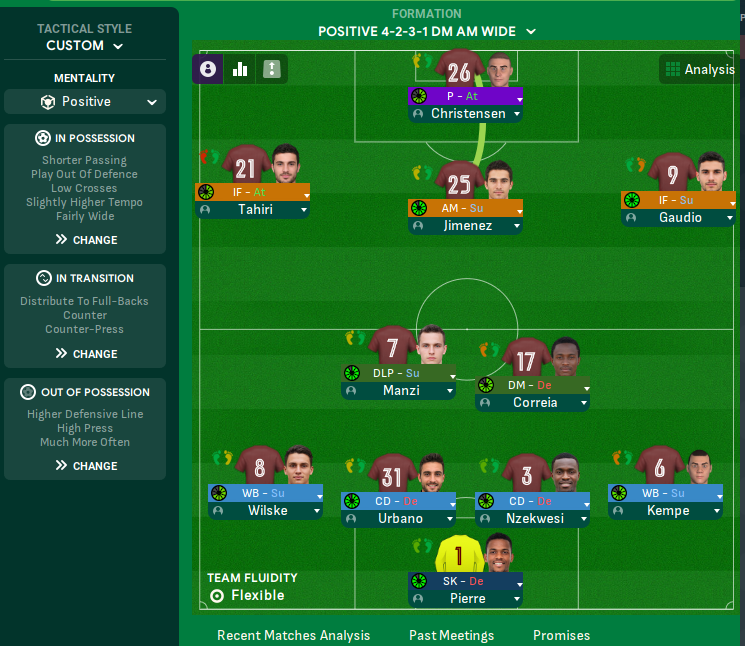
Formation & Style
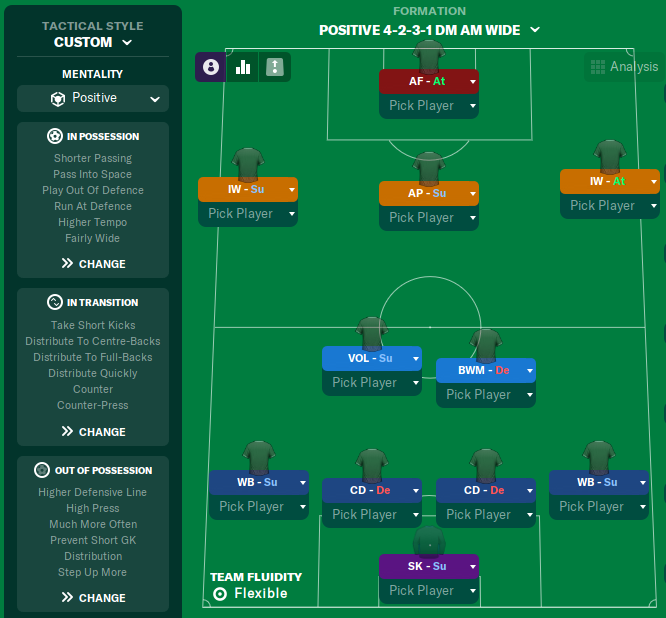
Tactical Style:Custom
Mentality:Positive
Formation:4-2-3-1 DM Wide
Team Fluidity:Flexible
In Possession
Shorter Passing
Play Out Of Defence
Low Crosses
Slightly Higher Tempo
Fairly Wide
In Transition
Distribute To Full-Backs
Counter
Counter-Press
Out of Possession
Higher Defensive Line
High Press
Much More Often
Team Shape Without Ball
Shape:4-2-3-1
Description:Compact defensive shape with an emphasis on pressing high and maintaining a strong back line.
Evidence:The two CBs at [2,2] and [2,4] combined with two WBs at [2,1] and [2,5] ensure solid coverage.
Team Shape With Ball
Shape:4-2-3-1 Fluid
Description:Attacking structure that prioritizes ball control with two IFs stretching the opposition and an AM linking up play.
Evidence:The positioning of the AM at [5,3] alongside the IFs at [6,1] and [6,5] facilitates varied attacking options.
Phase Description
Attacking Play
Utilizing shorter passing through the midfield, the team aims to build-up play gradually, relying on the creativity of the AM and movement of the IFs.
Defensive Transition
The team looks to quickly counter-press, maintaining pressure immediately after losing possession to recover the ball.
Main Focus
Building attacks through the centre while using the width provided by the WBs and IFs.
Key Strengths
Dynamic Attacking Movement
The combination of two inside forwards converging in central areas opens spaces for the attacking midfielder.
Width from Wing-Backs
The wing-backs provide necessary width, stretching the opposition and providing crossing opportunities.
Strong Midfield Partnership
The double pivot with a DM and DLP offers both defensive stability and creative playmaking.
Conflicting Directions
Counter-Press vs High Defensive Line
Counter-pressing may leave the team exposed if successful pressure is not maintained.
Limited Defensive Width
Two central defenders with WB may create spaces between the lines if not properly supported by the midfielder.
Dependence on Wide Play
Over-reliance on WBs for width could lead to predictability in attacks.
Tactical Suggestions
Adjust Defensive Block Height
Modifying the defensive block to a standard height may reduce vulnerability against swift counter-attacks.
Incorporate More Central Options
Encouraging the AM to make deeper runs could enhance penetration through the center.
Utilize Full-Back Support
Encouraging WBs to perform overlapping runs will stretch defenses and create additional space.
Ask Questions About Your Lineup
Related Tactics

Guides for this formation
The tactical theory behind the 4-2-3-1 DM Wide: roles, instructions, and the trade-offs that decide whether the system holds up.
Player pairings
Midfield Pairs in 4-2-3-1 and 4-4-2
Double pivots and flat pairs in 4-2-3-1 and 4-4-2: when each pairing works, when it collapses, and the AMC unicorn that rescues both.
Read guide
Playing styles
Gegenpressing: A Full Guide
Klopp-style gegenpressing in FM, including squad profile, line-and-press pairing, sustainable workload, and the antipatterns to avoid.
Read guide