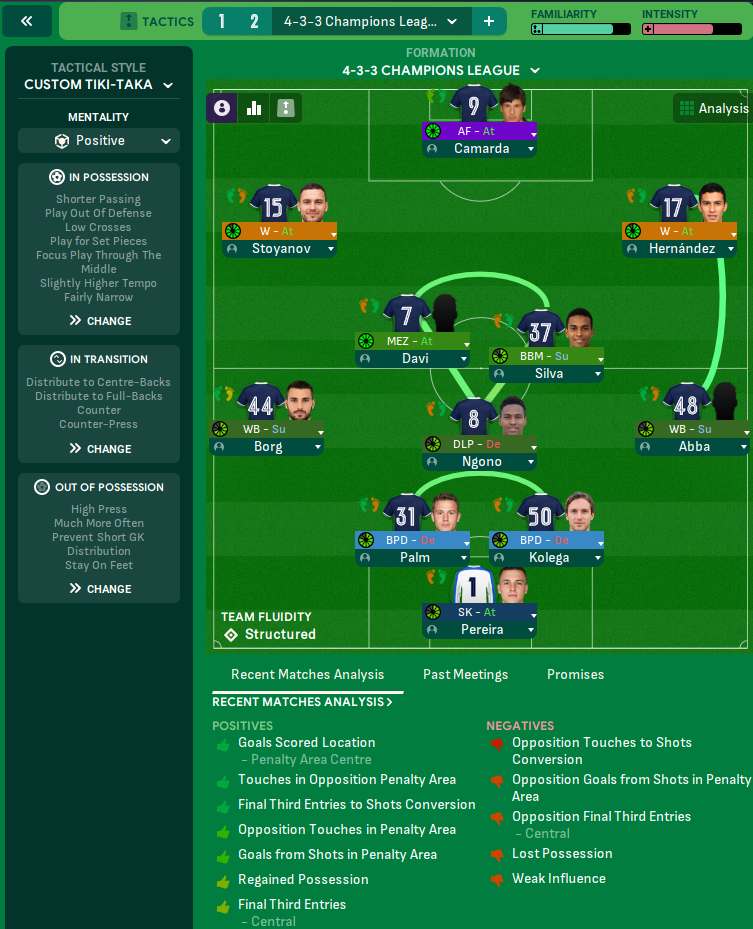
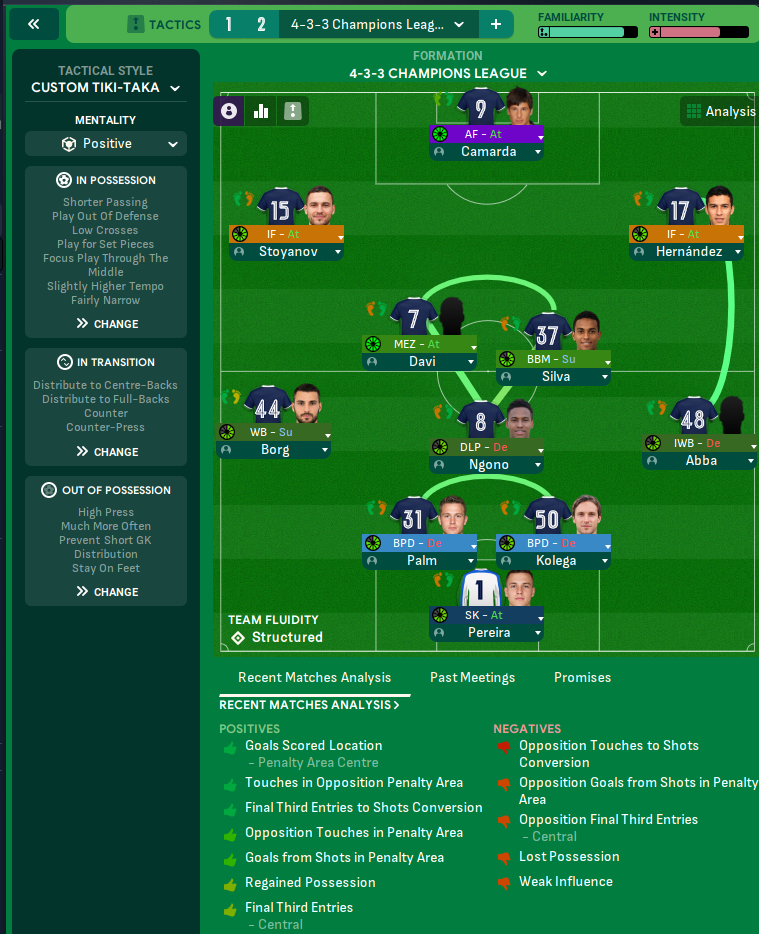
4-3-3 Champions League
The use of Mezzala and Inside Forwards creates numerous options in the final third, enhancing creativity.
Loading tactical analysis...
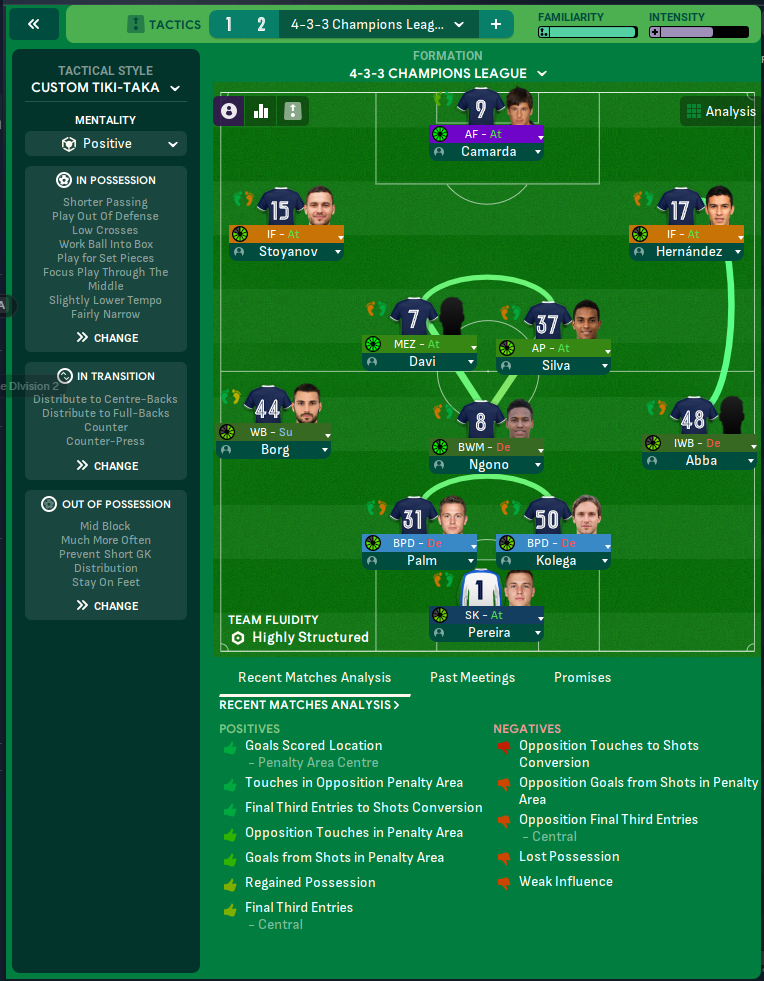
Custom Tiki-Taka
Positive
4-3-3 Champions League
Highly Structured
Shorter Passing
Low Crosses
Work Ball Into Box
Focus Play Through The Middle
Slightly Lower Tempo
Distribute to Centre-Backs
Counter
Counter-Press
Mid Block
Much More Often
Prevent Short GK Distribution
Stay On Feet
ST
Advanced Forward
Attack
IF
Inside Forward
Attack
MEZ
Mezzala
Attack
BWM
Ball Winning Midfielder
Defend
BPD
Ball Playing Defender
Defend
SK
Sweeper Keeper
Attack
The use of Mezzala and Inside Forwards creates numerous options in the final third, enhancing creativity.
The Counter-Press strategy enables quick recovery of the ball in opponent’s half, regaining possession efficiently.
The slightly lower tempo may conflict with a highly structured setup, potentially reducing fluidity in transitions.
Using a counter-press while focusing heavily on build-up could cause players to be caught out of position.
How can we improve our finishing in the final third?
Are the players comfortable with the roles they're assigned in this tactic?
Do the Inside Forwards need more support from the midfield?
Is our current counter-pressing strategy effective based on recent matches?
How can we enhance our defensive structure to prevent counterattacks?
Would adjusting the mentality to a more aggressive approach yield better results?
The tactical theory behind the 4-3-3 Champions League: roles, instructions, and the trade-offs that decide whether the system holds up.
Klopp-style gegenpressing in FM, including squad profile, line-and-press pairing, sustainable workload, and the antipatterns to avoid.
Why circulation density and zonal occupation aren't the same thing in FM, and the half-space occupation rule that decides build-up.
How Mentality, Duty, and Role interact in FM, why duty trumps mentality every time, and the role-on-top-of-duty composition rules.