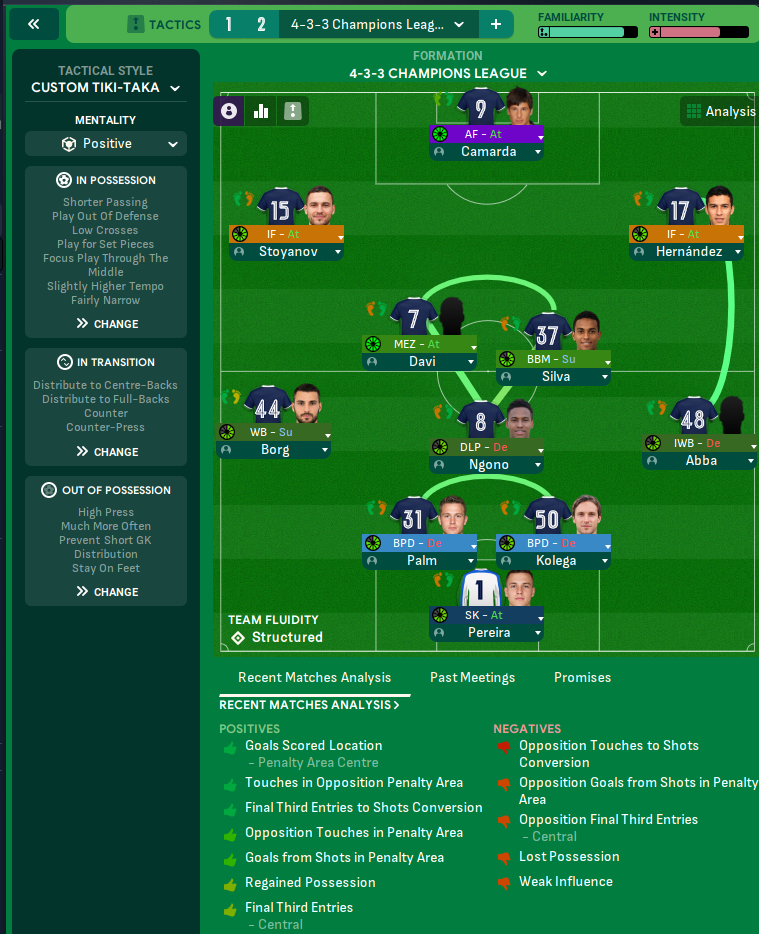
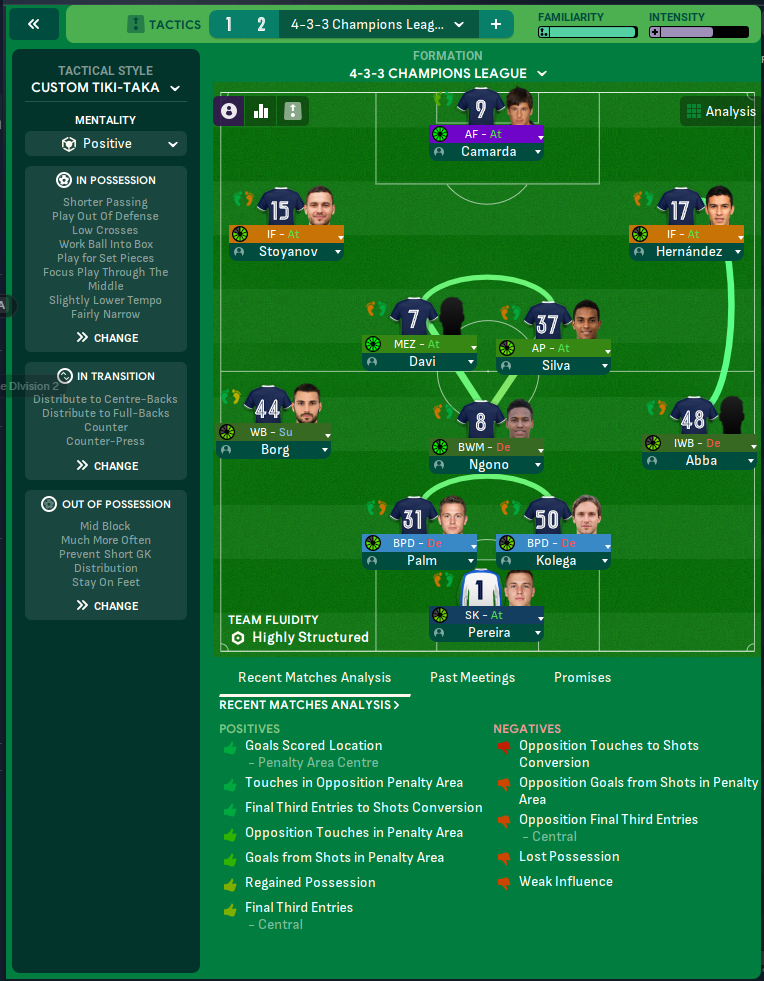
4-3-3 Champions League
The tiki-taka style promotes short passing and ball retention, allowing control of the game.
Loading tactical analysis...
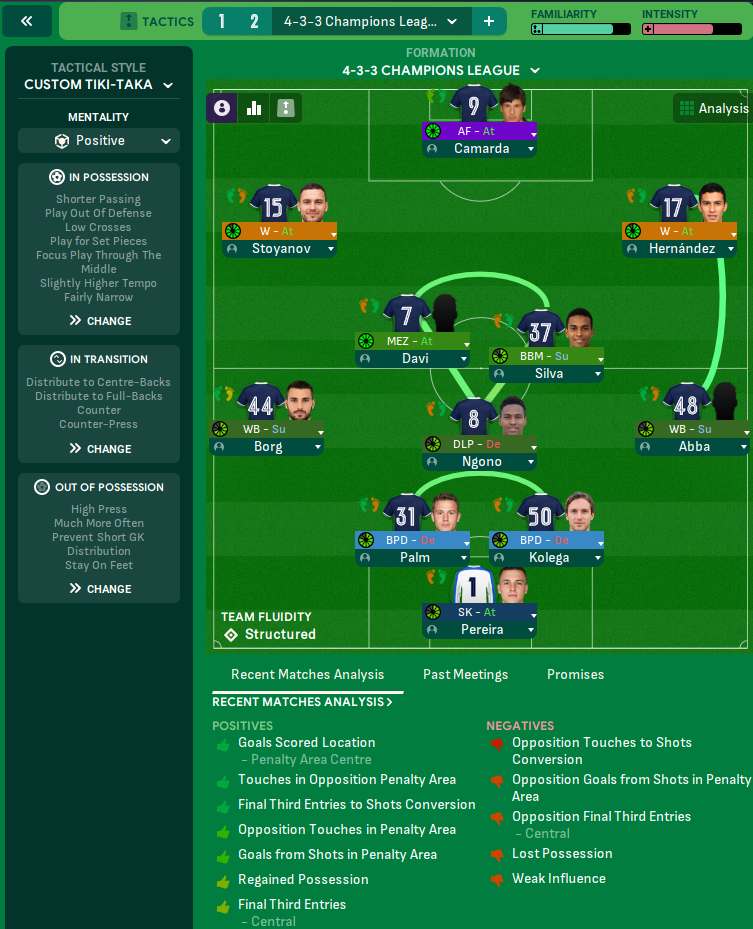
Custom Tiki-Taka
Positive
4-3-3 Champions League
Structured
Shorter Passing
Play Out Of Defense
Low Crosses
Focus Play Through The Middle
Sit Higher Tempo
Fairly Narrow
Distribute to Center-Backs
Distribute to Full-Backs
Counter-Press
High Press
Much More Often
Prevent Short GK Distribution
Stay On Feet
ST
Advanced Forward
Attack
AML
Winger
Attack
AMR
Winger
Attack
MCL
Mezzala
Support
MCR
Box-to-Box Midfielder
Support
MCD
Deep-Lying Playmaker
Defend
DL
Wing-Back
Support
DR
Wing-Back
Support
DC
Ball-Playing Defender
Defend
GK
Sweeper Keeper
Attack
The tiki-taka style promotes short passing and ball retention, allowing control of the game.
Wingers help stretch the opposition, creating spaces for midfield runs and combining with the striker.
While pressing high can disrupt opponents, it may leave defensive gaps given the focus on short passing and ball retention.
Assigning wing-backs support duties may conflict with the need for width, limiting attacking options out wide.
How effective are the wingers in creating chances?
Do the midfielders support the defense adequately?
Is the high pressing leading to turnovers or gaps in defense?
Are the wing-backs contributing enough to build-up play?
Is the team able to maintain possession against strong pressing opponents?
How often does the goalkeeper engage in sweeping duties?
The tactical theory behind the 4-3-3 Champions League: roles, instructions, and the trade-offs that decide whether the system holds up.
Master the classic 4-3-3: player roles, tactical variations, and the trade-offs that decide whether it sings or stalls.
Holder, runner, creator: the role distribution rule for three-man midfields, the AMC variants, and the antipatterns that break them.
Mentality, duty, role, instruction, sub. The change hierarchy from lightest to heaviest intervention, and 60th-minute patterns by game state.