
4-3-3 V2
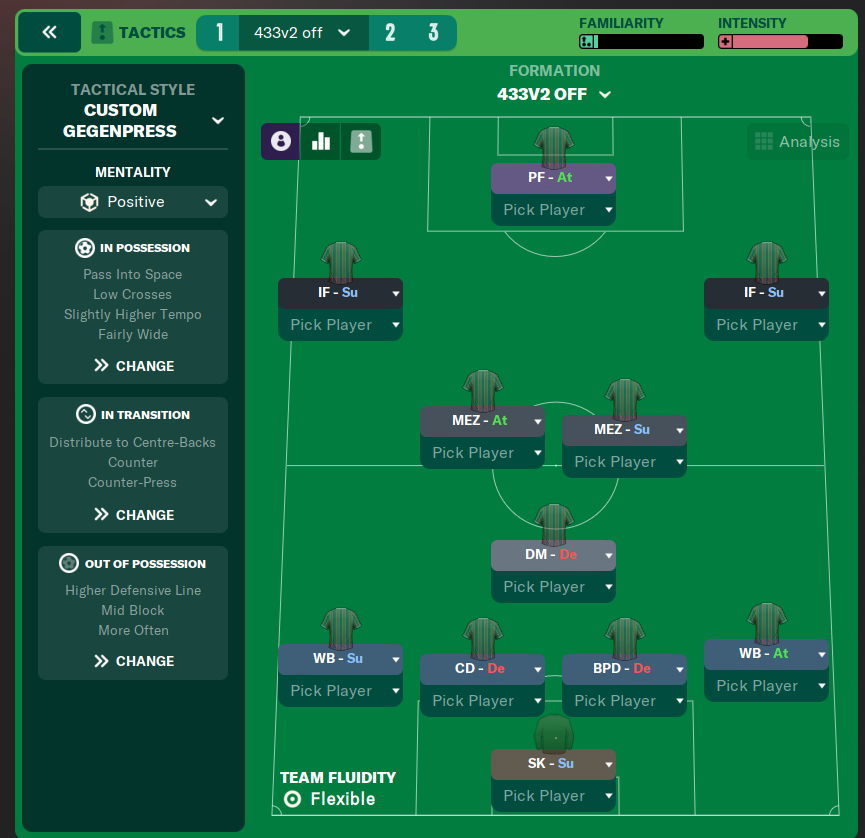
The gegenpressing style encourages players to press aggressively when possession is lost, making it difficult for opponents to build attacks.
Loading tactical analysis...
Gegenpress
Positive
4-3-3 V2
Flexible
Pass Into Space
Low Crosses
Slightly Higher Tempo
Fairly Wide
Distribute to Centre-Backs
Counter
Counter-Press
Higher Defensive Line
Mid Block
More Often
PF
Pressing Forward
Attack
IF
Inside Forward
Support
MEZ
Mezzala
Attack
DM
Defensive Midfielder
Defend
WB
Wing Back
Support
CD
Central Defender
Defend
BPD
Ball Playing Defender
Defend
SK
Sweeper Keeper
Defend
The gegenpressing style encourages players to press aggressively when possession is lost, making it difficult for opponents to build attacks.
With multiple mezzala roles and a defensive midfielder, there is flexibility in transitions and support for both attack and defense.
With multiple mezzalas occupying similar space, there is a risk of overcrowding in central areas, potentially disrupting fluidity.
The tactic relies heavily on wing-backs to provide width, which can be exploited if they are caught out of position.
How does the team perform defensively when counter-pressed?
Are the wing-backs providing enough width during offensive plays?
Is the pressing intensity sustainable over the full match duration?
How well do the mezzalas support the front line and each other?
What adjustments can be made to maintain shape during transition?
Is the team effective at regaining possession quickly?
The tactical theory behind the 4-3-3 V2: roles, instructions, and the trade-offs that decide whether the system holds up.
Master the classic 4-3-3: player roles, tactical variations, and the trade-offs that decide whether it sings or stalls.
Holder, runner, creator: the role distribution rule for three-man midfields, the AMC variants, and the antipatterns that break them.
Protect a 1-0, chase a 1-0, hold a draw away. How to manage game state in FM through duties and roles, not by lurching to Defensive.



