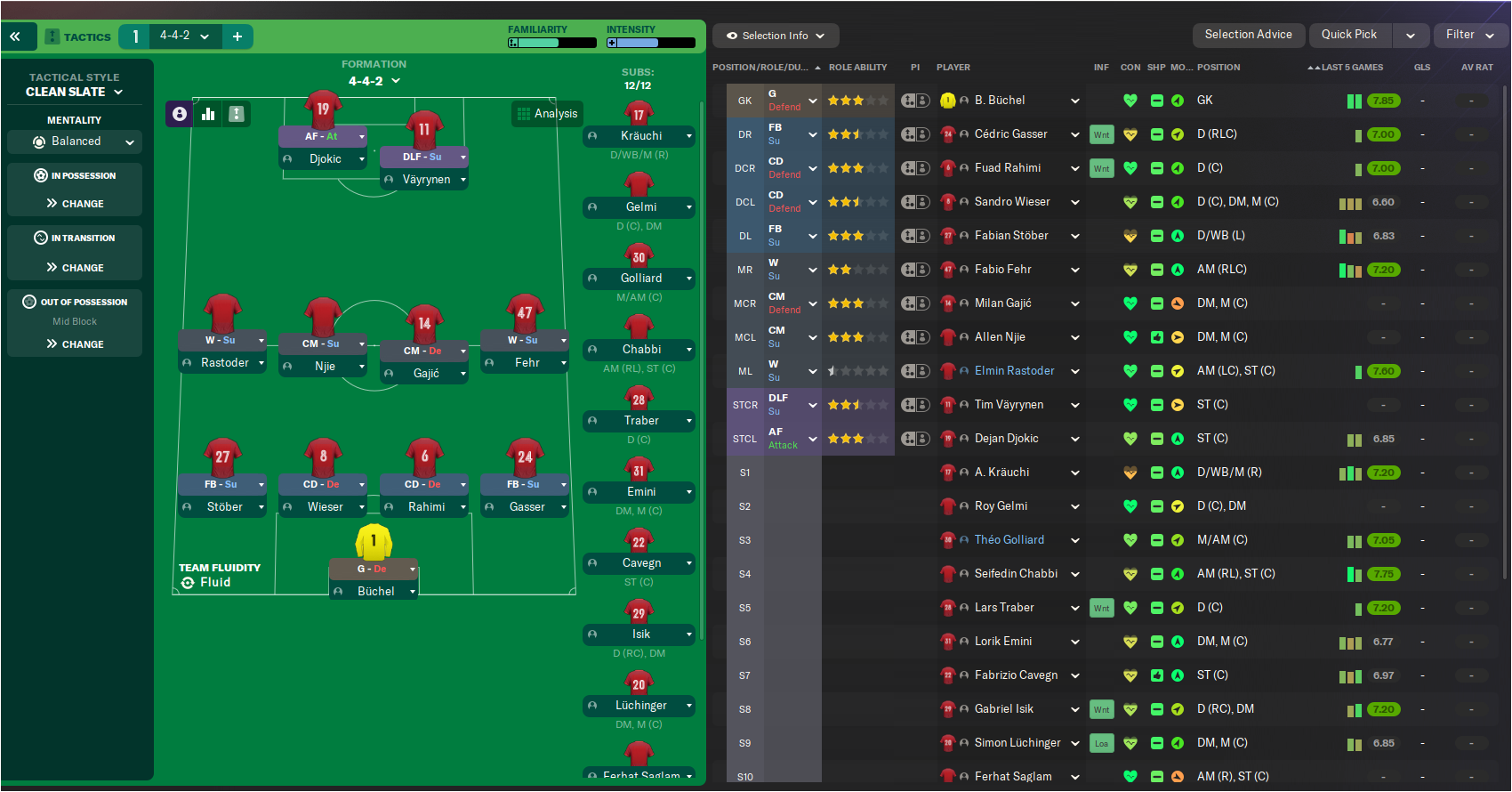
4-4-2
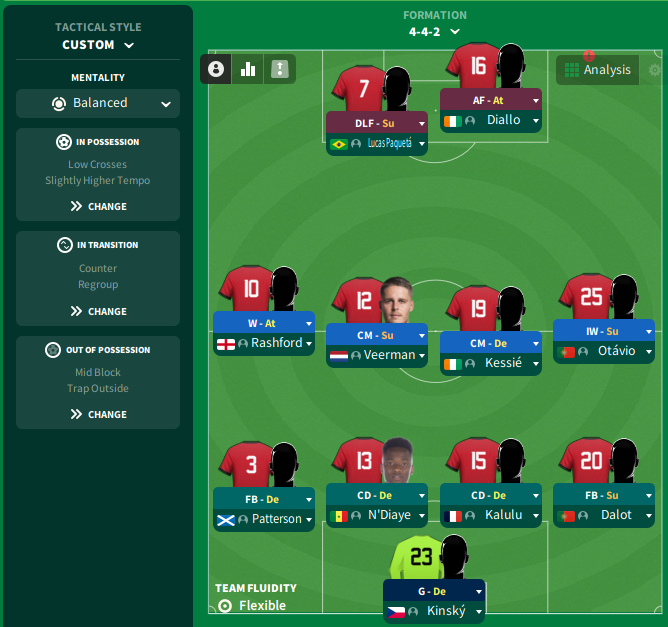
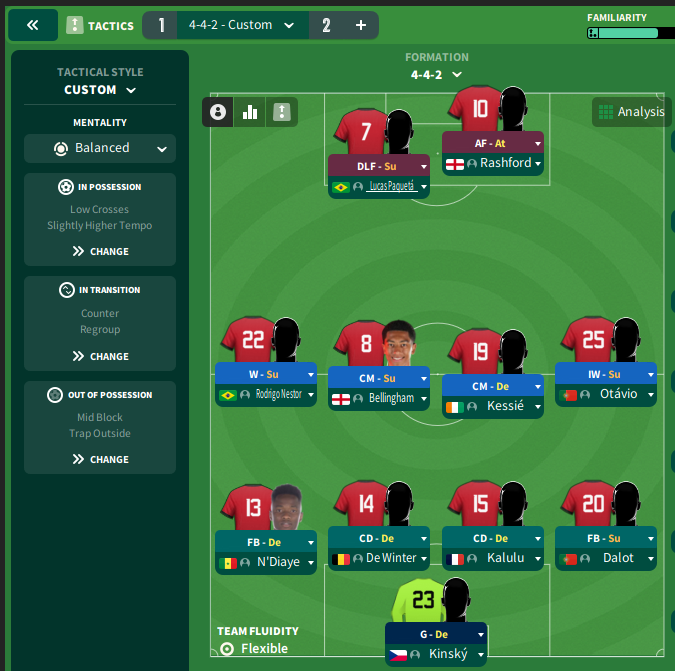
Balanced play that counters through the AF after winning the ball, with support from the wide players and the DLF. The DLF drops to link play while the AF…
Loading tactical analysis...
Balanced
4-4-2
GK
Goalkeeper
Defend
DL
Full-Back
Defend
DC
Centre-Back
Defend
DC
Centre-Back
Defend
DR
Full-Back
Support
ML
Winger
Support
MC
Central Midfielder
Support
MC
Central Midfielder
Defend
MR
Inverted Winger
Support
ST
Deep-Lying Forward
Support
ST
Advanced Forward
Attack
Low Crosses
Slightly Higher Tempo
Counter
Regroup
Standard Defensive Line
Standard Line of Engagement
Force Opposition Outside
The DLF drops to link play while the AF runs in behind, which gives the front two clear and different jobs.
DLF [6,2] and AF [6,4]
Countering on won possession and regrouping on lost possession fits a balanced side. It protects the shape and releases the forwards quickly.
AF [6,4] as the runner for the counter; CM [4,4] on De duty gives cover when regrouping
Low crosses suit a winger who goes to the byline, but the opposite flank has an IW who cuts inside. Width is therefore uneven, and with only two strikers there are few targets in the box.
W [4,1] and IW [4,5] with Low Crosses
The faster tempo can leave the DLF isolated or rushing his passes before the midfield has moved up in support.
DLF [6,2] with Slightly Higher Tempo
Right flank cover
The IW cuts inside and the right-back is on Support, so the right side is open on the break and the support behind the IW is thin.
IW [4,5] and FB [2,5]
high
Midfield pair balance
A Support CM next to a Defend CM in a flat two can be overrun by a midfield three, and neither is a dedicated ball winner.
CM [4,2] Su and CM [4,4] De
medium
DLF + AF
The DLF drops to link play and pulls a centre-back out of position, which creates space for the AF to run in behind.
DLF [6,2] and AF [6,4]
DLF + AF
W + FB (left)
A Defend full-back behind the Support winger gives balance and secure cover on that flank.
FB [2,1] De and W [4,1] Su
W + FB (left)
Which opposition and what style of play is this tactic designed to beat?
Do you have strong crossers and aerial targets, or is the strike pair better on the ground?
Is the right flank leaking goals on the counter?
Build through the DLF link-up with a slightly raised tempo, wide play down the left via the winger and low crosses, and an inverted winger cutting in from the right.
Regroup on losing the ball, so the side drops back into shape rather than pressing straight away.
Balanced play that counters through the AF after winning the ball, with support from the wide players and the DLF.
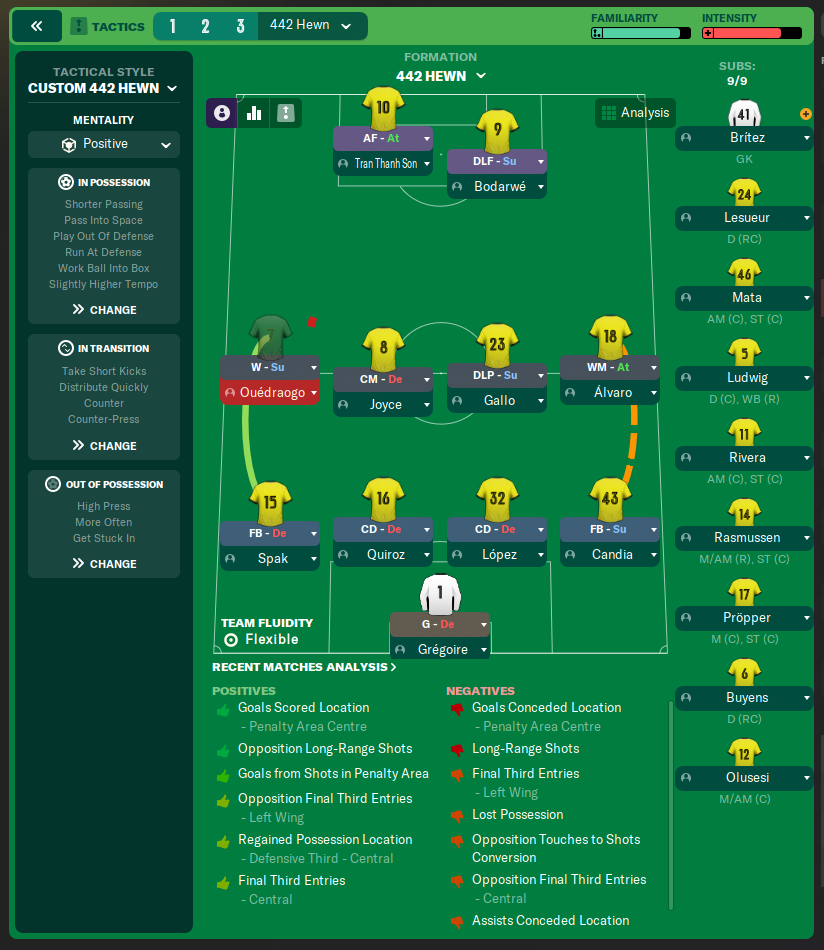
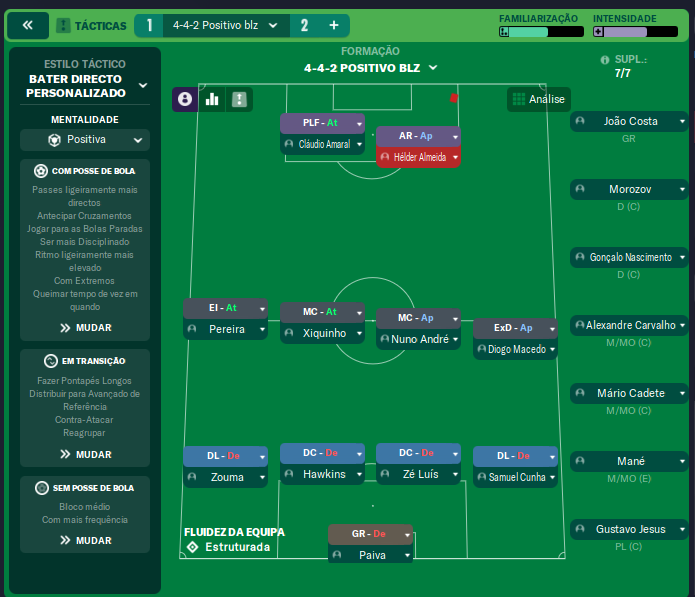
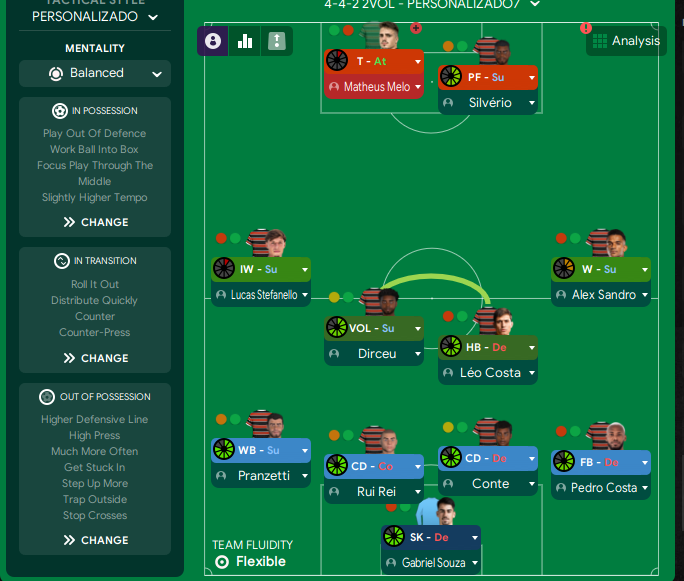
4-4-2
Two flat banks of four with the strikers up front, a standard defensive line and standard engagement, forcing the opposition wide.
CM [4,2], CM [4,4], DLF [6,2], AF [6,4] and Force Opposition Outside
4-4-2 shifting to a 4-2-4 feel
The right-back supports the attack, the IW tucks inside, the left winger stays wide, and the DLF drops short while the AF stretches the line.
FB [2,5] Su, IW [4,5], W [4,1], DLF [6,2] and AF [6,4]
This is a sensible, balanced 4-4-2 with a well-defined strike partnership of DLF and AF and a transition plan that fits its counter-attacking shape. Its weaknesses are the lack of a style or fluidity setting, the mismatch of low crosses with an IW on one flank, and the exposed right side with an IW and an attacking-minded right-back. Setting a style like fluid counter-attack, narrowing the attacking width and adding a more active press would make it more consistent.
The tactical theory behind the 4-4-2: roles, instructions, and the trade-offs that decide whether the system holds up.
Double pivots and flat pairs in 4-2-3-1 and 4-4-2: when each pairing works, when it collapses, and the AMC unicorn that rescues both.
Long-ball football done well in FM. When direct, vertical play is the right choice, and what the Direct Passing TI actually changes.
What Higher Tempo, Wider, and Narrower actually do in FM, plus the dial contradictions and antipatterns players run into most often.