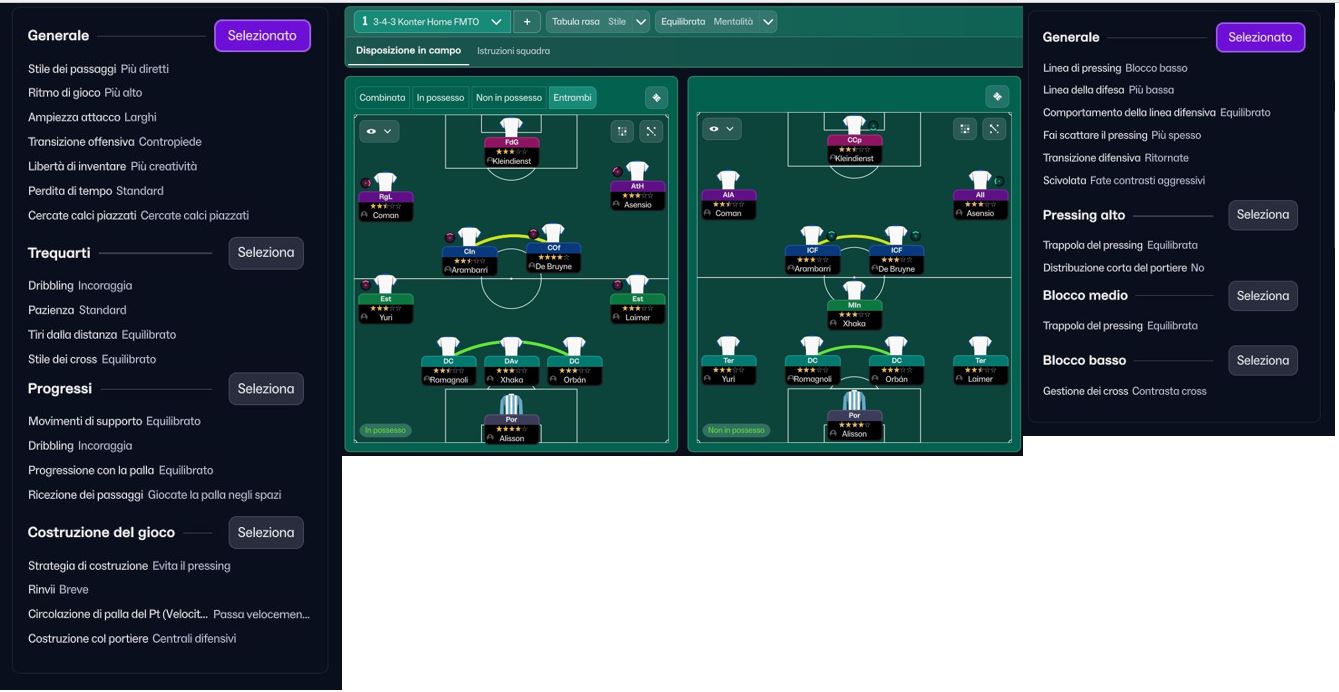
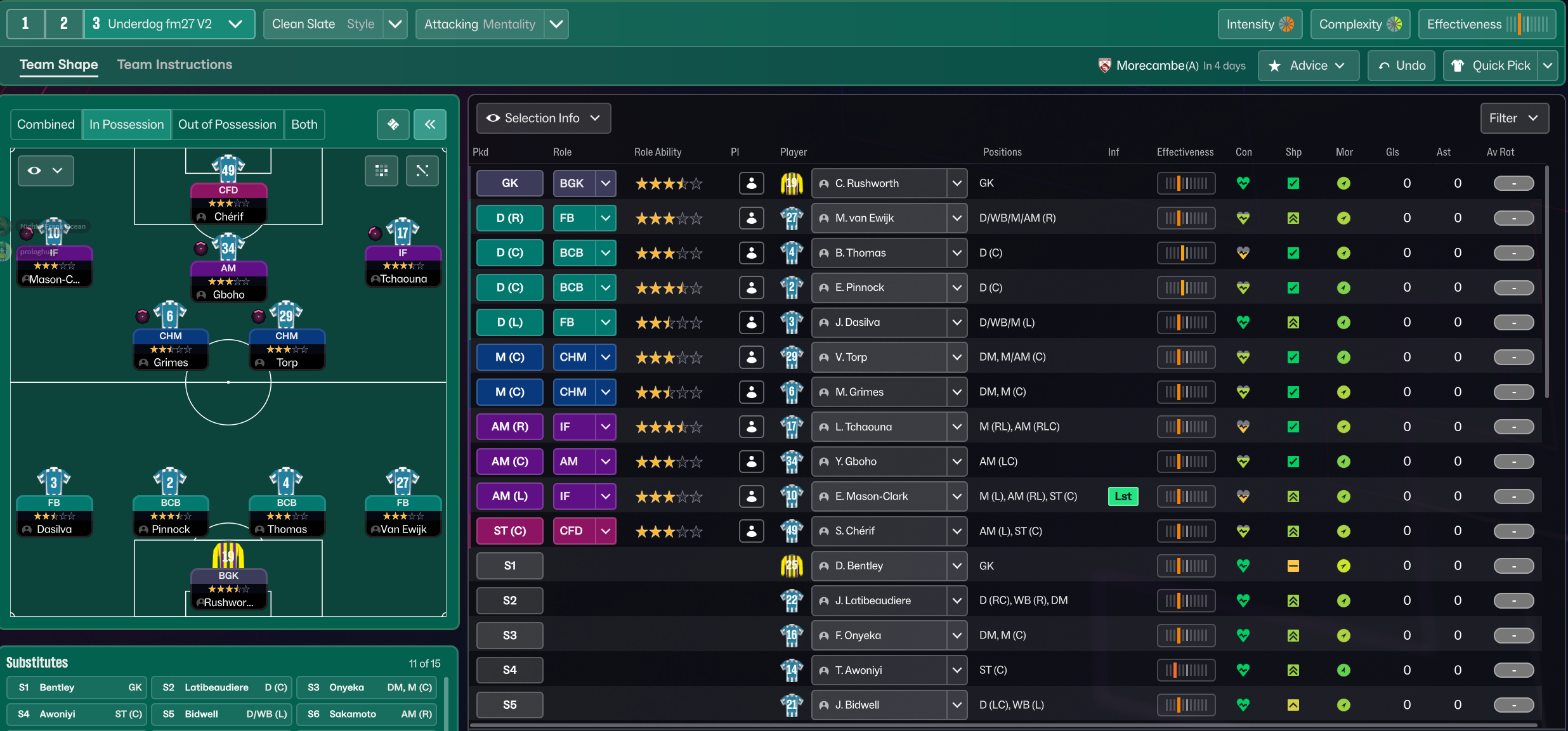
Attacking 3-4-3 (Attacking) Tactic
3-4-3
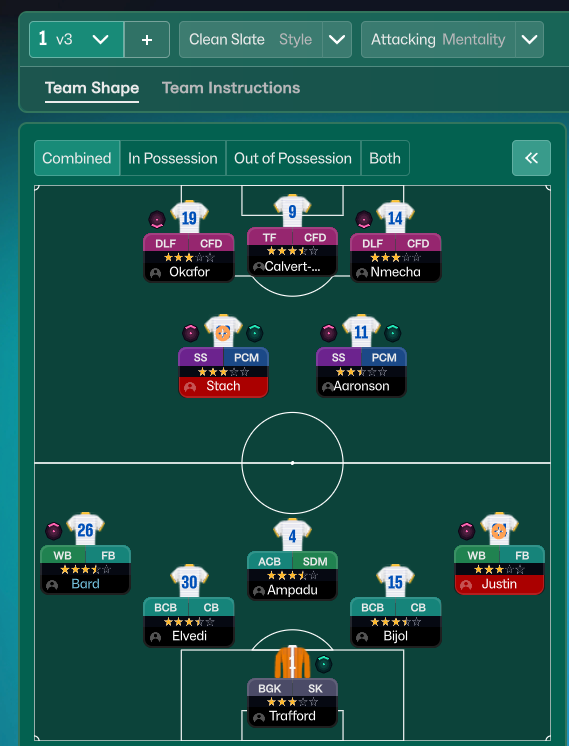
Utilizing width while keeping central players involved for combination play. The combination of a Deep-Lying Playmaker and a Central Midfielder maintains…
Loading tactical analysis...
Formation and style
Attacking
Attacking
3-4-3
In possession
Higher Tempo
Play Out of Defence
Work Ball Into Box
In transition
Counter
Counter Press
Out of possession
Higher Defensive Line
Higher Line of Engagement
Prevent Short GK Distribution
Player roles
GK
Goalkeeper
Defend
CB
Ball-Playing Defender
Defend
CB
No-Nonsense Centre-Back
Defend
CB
Ball-Playing Defender
Defend
WB
Wing-Back
Attack
WM
Wide Midfielder
Support
CM
Deep-Lying Playmaker
Support
CM
Central Midfielder
Support
FW
Target Forward
Attack
FW
Deep-Lying Forward
Support
FW
Inside Forward
Attack
Phase description
Focused on creating overloads on the wings while utilizing the central players to facilitate transitions into the final third.
Quick recovery of positions with an immediate counter-press to regain possession.
Utilizing width while keeping central players involved for combination play.
Team shape defence
Compact back three
Defensive line is tight with a higher engagement line to press opponents higher up the pitch.
3 CBs with a mixture of roles at [2,2], [2,3], and [2,4] with Higher Defensive Line.
Team shape attack
Fluid wide play
Utilizes wing-backs to stretch the opposing defense, allowing inside forwards to cut in.
Wing-Backs at [2,1] and [2,5] pushing high and wide with Inside Forwards providing depth.
Key strengths
Strong Midfield Control
The combination of a Deep-Lying Playmaker and a Central Midfielder maintains possession effectively.
DLP-S at [3,3] and CM-S at [4,3] work together to control the middle of the pitch.
Dynamic Wing Play
The use of Wing-Backs allows for fast wing progression and overloads.
WB-A at [2,1] and [2,5] work with Inside Forwards to stretch the field.
Conflicting tactics
Defensive Vulnerability on Flanks
Wing-Backs pushing high can leave spaces at the back.
WB-A at [2,1] and [2,5] may get caught out of position during transitions.
Over-Reliance on Wings
Might struggle to break down compact defenses centrally.
Limited central attacking options by reliance on wing play with emphasis on wider roles.
Risk exposures
Risk Exposures
Items
Wings
Wing-Backs often leave space when attacking, exposing the flanks.
WB-A at [2,1] and [2,5] can be caught during opposition counter-attacks.
Counter-Attacks
A higher defensive line can be vulnerable to quick transitions.
Higher line allows for direct balls to exploit gaps behind defenders.
Role synergies
Role Synergies
Items
Wing-Back & Inside Forward
Creates overloads on the flanks, stretching defenses effectively.
WB-A at [2,1] with IF-A at [6,2] enhances wing options.
Target Forward & Deep-Lying Forward
Provides dual threats, combining physicality and link-up play.
TF-A at [6,3] draws defenders while DLF-S at [6,2] exploits spaces.
Suggested questions
How can I improve the compactness of my defense during wide transitions?
What adjustments can enhance central attacking options?
Should I consider changing my defensive line strategy against faster opponents?
Related Tactics
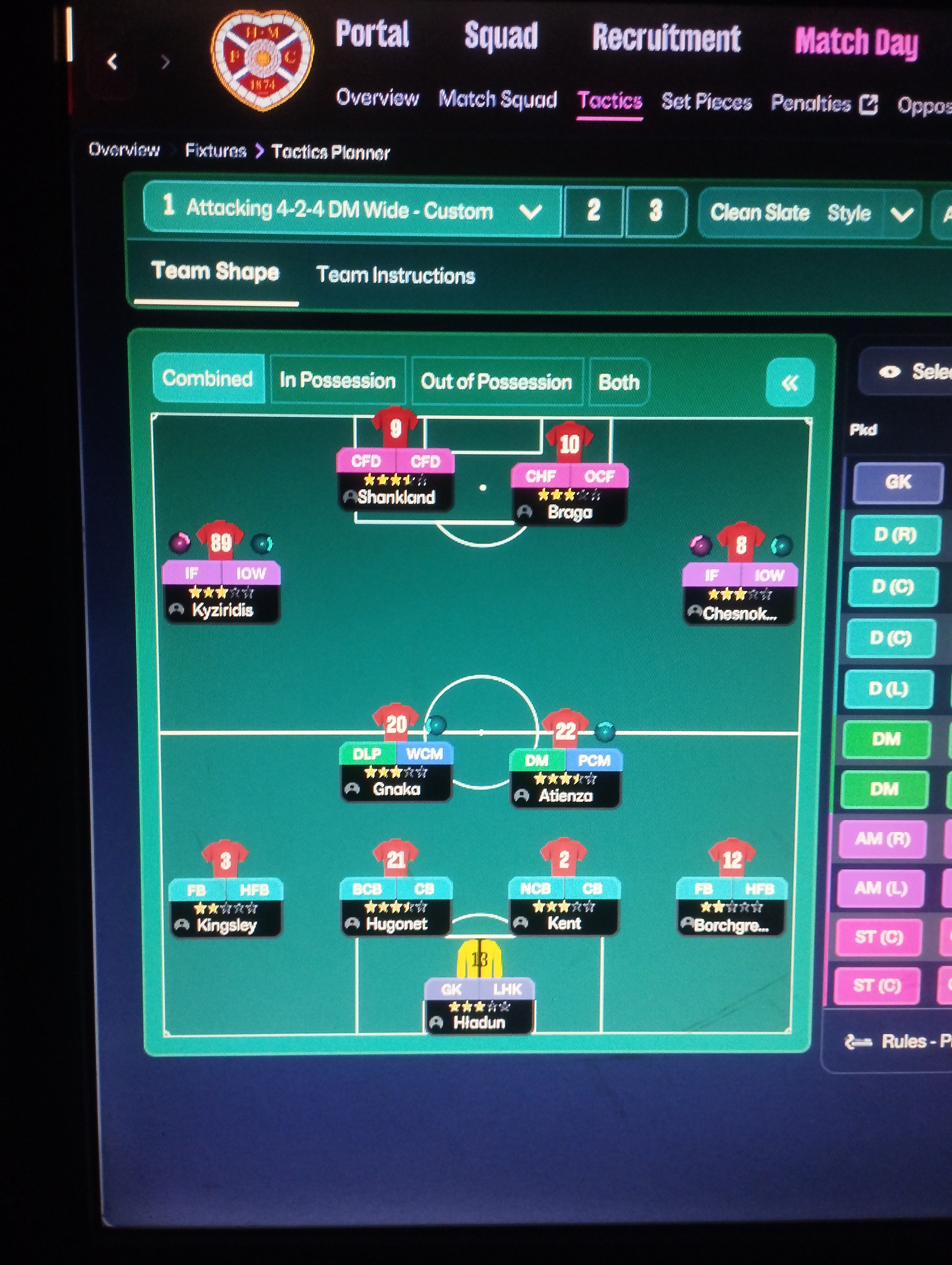
More Attacking tactics
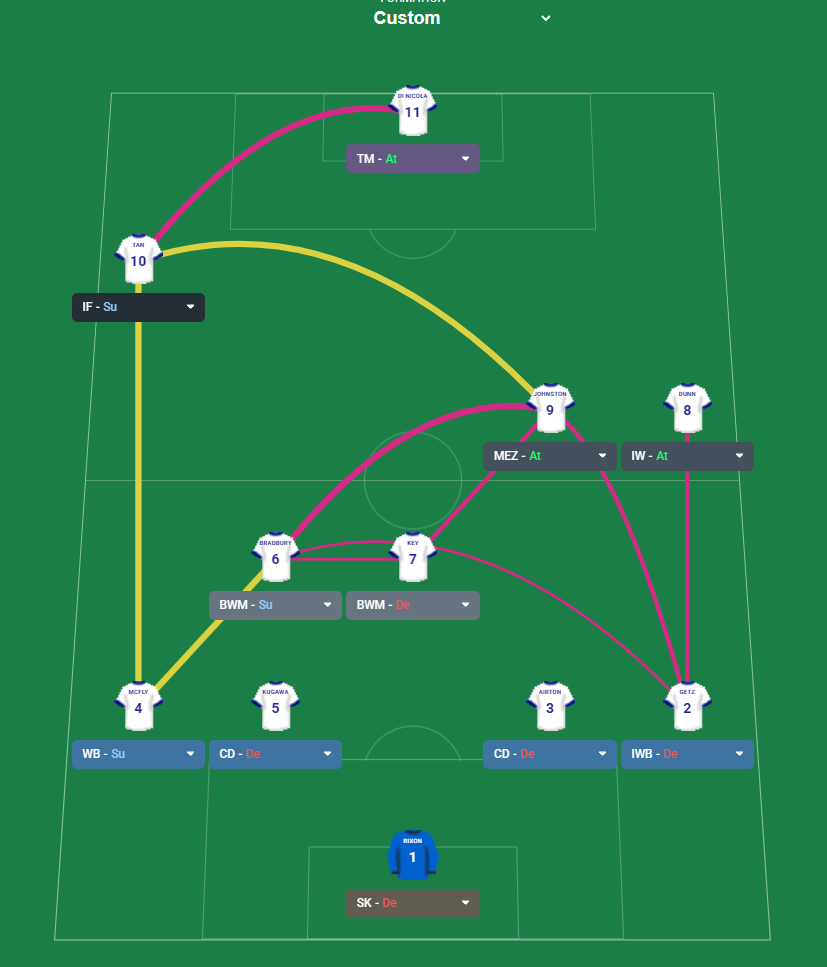
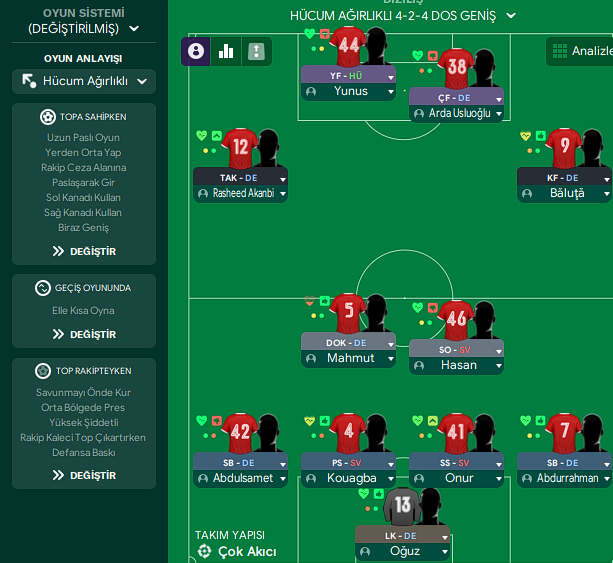
Guides for this tactic
The tactical theory behind the 3-4-3: roles, instructions, and the trade-offs that decide whether the system holds up.
Playing styles
Direct, Vertical Football
Long-ball football done well in FM. When direct, vertical play is the right choice, and what the Direct Passing TI actually changes.
Read guide
Playing styles
Possession-Based Tactics in Football Manager
Build the patient, control-the-tempo style without watching your opponents counter through the gaps you leave behind.
Read guide
Foundations
Mentality, Duty & Roles
How Mentality, Duty, and Role interact in FM, why duty trumps mentality every time, and the role-on-top-of-duty composition rules.
Read guide