Uploaded Tactic
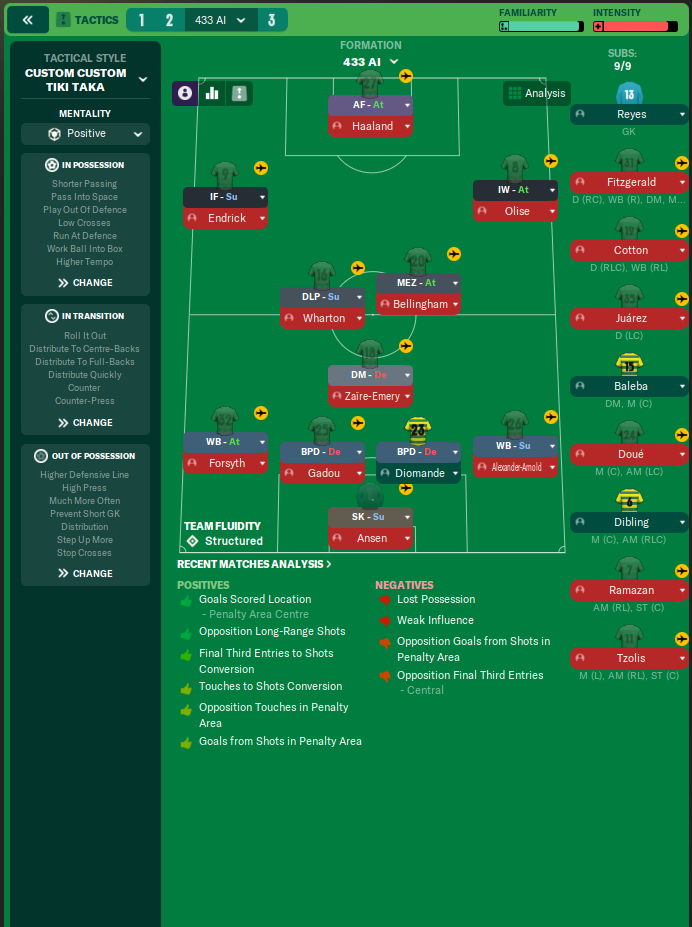
Formation & Style
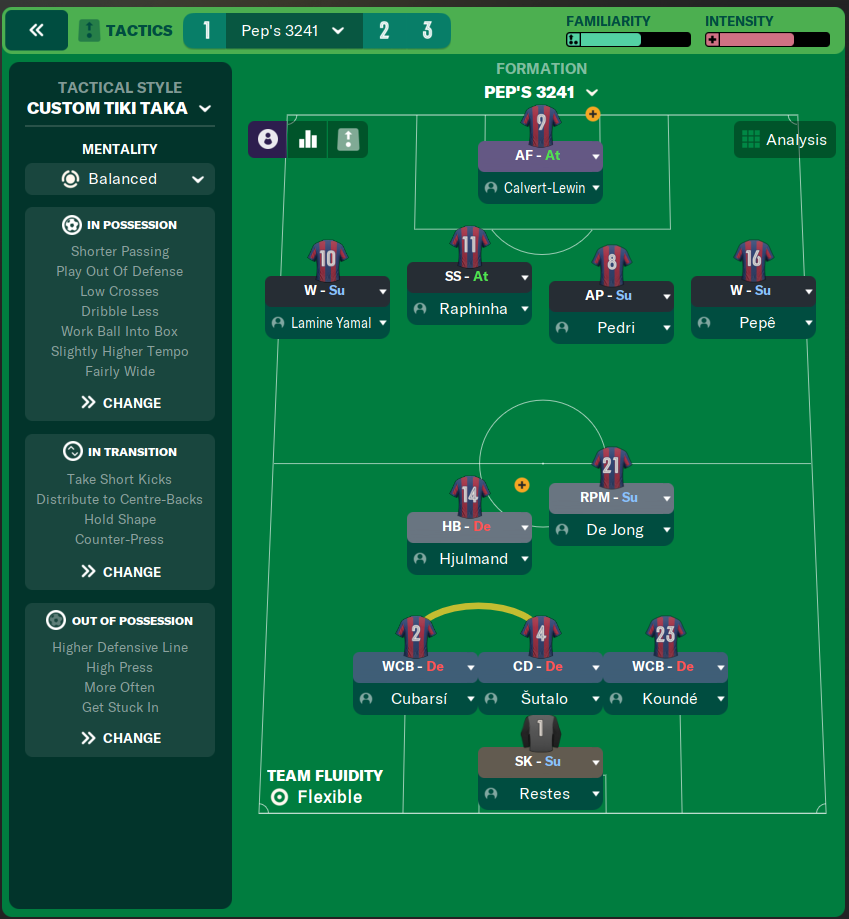
Tactical Style:Custom Tiki Taka
Mentality:Positive
Formation:4-3-3 AI
Team Fluidity:Structured
In Possession
Shorter Passing
Pass Into Space
Play Out of Defence
Run At Defence
Work Ball Into Box
Higher Tempo
In Transition
Roll It Out
Distribute To Centre-Backs
Distribute To Full-Backs
Counter
Counter-Press
Out of Possession
Higher Defensive Line
High Press
Much More Often
Prevent Short GK Distribution
Step Up More
Stop Crosses
Team Shape Without Ball
Shape:4-1-4-1
Description:Compact structure defensively, emphasizing pressure on the ball and maintaining a high line.
Evidence:DM (Zaire-Emery) at [3,3] provides cover, while CBs (Gadou, Diamonde) push up to support.
Team Shape With Ball
Shape:4-3-3
Description:Dynamic front three with width from wingers and central penetration from the striker.
Evidence:AM trio of Endrick (IF-Su), Bellingham (MEZ-At), and Olise (IW-At) provides varied attacking angles.
Phase Description
Attacking Play
Focuses on possession with a high pass completion rate, utilizing width through wing-backs and exploiting space.
Defensive Transition
Immediate counter-pressing to regain possession quickly after losing the ball.
Main Focus
Maximizing goal-scoring opportunities by controlling the midfield and creating overlaps from the wings.
Key Strengths
Possession Retention
The team's emphasis on short passing and working the ball into the box enhances possession.
Attacking Flexibility
Multiple attacking options from different positions create unpredictability.
High Defensive Engagement
High press and defensive block keeping opponents under pressure.
Conflicting Directions
Possession Loss
Frequent loss of possession can lead to vulnerability during transitions.
Counter Vulnerabilities
High line may leave spaces behind, exposing the team to counter-attacks.
Defensive Stability
Potential weaknesses in central areas when engaging in high pressing.
Tactical Suggestions
Improve Midfield Defensive Cover
Consider dropping one of the two advanced midfield roles deeper during transitions.
Balanced Pressing Intensity
Adjust pressing frequency based on match context to avoid being caught out.
Utilize Full-Backs More Effectively
Ensure wing-backs engage higher, maximizing width and stretching opponents.
Ask Questions About Your Lineup
More Custom Tiki Taka tactics
Guides for this formation
The tactical theory behind the 4-3-3 AI: roles, instructions, and the trade-offs that decide whether the system holds up.
Foundations
Understanding the 4-3-3 Formation
Master the classic 4-3-3: player roles, tactical variations, and the trade-offs that decide whether it sings or stalls.
Read guide
Player pairings
Midfield Trios
Holder, runner, creator: the role distribution rule for three-man midfields, the AMC variants, and the antipatterns that break them.
Read guide
Playing styles
Gegenpressing: A Full Guide
Klopp-style gegenpressing in FM, including squad profile, line-and-press pairing, sustainable workload, and the antipatterns to avoid.
Read guide