
4-2-3-1 DM Wide
Attack quickly into space through the Wingers and Channel Forward, while pressing aggressively to recover possession and using the two Defensive…
Loading tactical analysis...
4-2-3-1 DM Wide
Positive
Clean Slate
6
3
Channel Forward
Central Outlet Centre Forward
5
1
Winger
Central Outlet Centre Forward
5
3
Attacking Midfielder
Screening Central Midfielder
5
5
Winger
Tracking Wide Midfielder
3
2
Defensive Midfielder
Tracking Wide Midfielder
2
1
Full Back
Holding Full-Back
2
2
Centre-Back
Centre-Back
2
4
Centre-Back
Centre-Back
2
5
Full Back
Holding Full-Back
1
3
Goalkeeper
Line-Holding Keeper
3
4
Defensive Midfielder
Central Midfielder
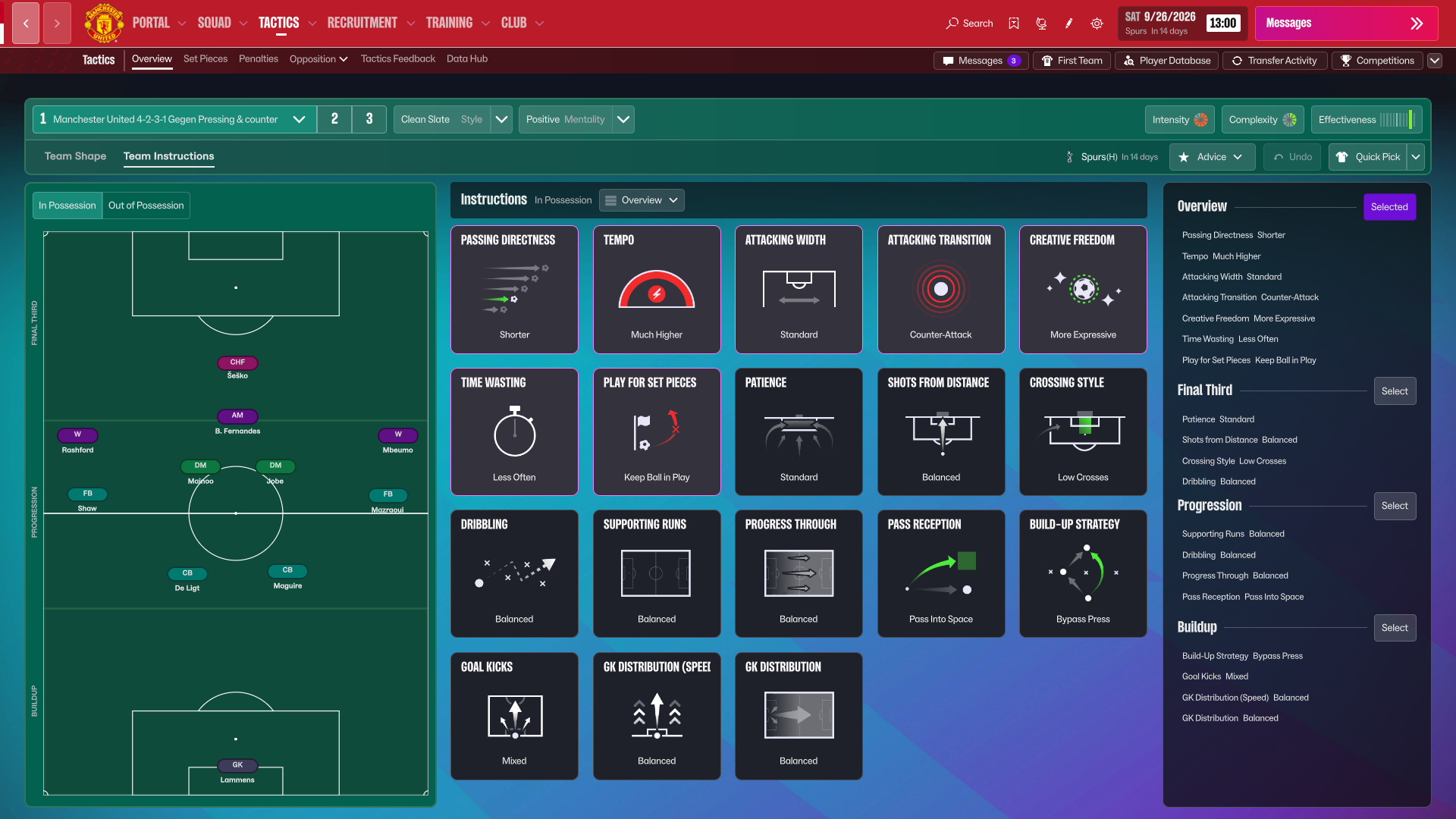
Shorter
Much Higher
Standard
Counter-Attack
More Expressive
Less Often
Keep Ball in Play
Standard
Balanced
Low Crosses
Balanced
Overlap Balanced
Balanced
Balanced
Pass Into Space
Bypass Press
Mixed
Balanced
Balanced
High Press
Higher
Balanced
Much More Often
Counter-Press
Stay On Feet
No
Trap Outside
Trap Outside
Balanced
High Press, Much More Often pressing and Counter-Press aim to win the ball back quickly, with Trap Outside directing pressure towards the touchlines.
High Press and Much More Often combine with Trap Outside; [5,5] Tracking Wide Midfielder and [3,2] Tracking Wide Midfielder provide wide defensive coverage.
Pass Into Space and Counter-Attack can exploit openings after turnovers, while the Channel Forward offers a forward outlet and both Wingers can provide width.
Pass Into Space and Counter-Attack support [6,3] Channel Forward, [5,1] Winger and [5,5] Winger.
Shorter passing and Pass Into Space favour ball retention and forward runs into space, but Bypass Press and very high tempo favour rapid, more direct progression. The combination can make possession and pass selection inconsistent.
Shorter and Much Higher sit alongside Pass Into Space and Bypass Press, with [5,3] Attacking Midfielder as a central link.
Counter-Press relies on nearby players to challenge immediately after losing possession, while Bypass Press can reduce possession and send play past the first line. If the bypassed ball is lost, the press may lack close support.
Counter-Press and Bypass Press are combined with [3,2] Defensive Midfielder and [3,4] Defensive Midfielder.
Space behind the high defensive line
A Higher defensive line paired with High Press can leave the team vulnerable to direct balls in behind, especially if the press is bypassed.
Higher and High Press are paired with [2,2] Centre-Back, [2,4] Centre-Back and [1,3] Goalkeeper.
high
Pressing intensity and transition coverage
Much More Often pressing and Counter-Press demand substantial work and can expose the defence if the first press is beaten. The Stay On Feet tackling instruction avoids adding extra tackling aggression, but does not remove the space behind the press.
Much More Often and Counter-Press combine with [5,5] Tracking Wide Midfielder and [3,4] Central Midfielder.
medium
Wide pressure and touchline traps
The wide tracking roles can support Trap Outside by pressuring opponents towards the sideline and helping cover wide areas when possession is regained or lost.
Trap Outside works alongside [5,5] Tracking Wide Midfielder and [3,2] Tracking Wide Midfielder.
Central midfield screen and forward outlet
The two Defensive Midfielders provide a central platform, while the Channel Forward can serve as a forward outlet for counter-attacks and passes into space.
[3,2] Defensive Midfielder, [3,4] Defensive Midfielder and [6,3] Channel Forward.
How can I protect the space behind my Higher defensive line when I use High Press and Counter-Press?
What should I look for in my Channel Forward and Wingers to make Pass Into Space and Counter-Attack effective?
How can I keep my Bypass Press build-up connected to my Counter-Press after losing the ball?
This is an ambitious, attack-minded 4-2-3-1 that combines an aggressive High Press and Counter-Press with wide tracking cover, two holding midfield roles and several forward outlets. Its main concern is the combination of a Higher defensive line with a very intense press, which can be punished by direct balls over the top. In possession, Shorter passing conflicts somewhat with Much Higher tempo, Pass Into Space and Bypass Press; I would first lower the defensive line to Standard, then make passing and tempo more coherent with the transition-focused approach.
Shorter passing and very high tempo combine with Pass Into Space, Bypass Press and Counter-Attack to move quickly towards the front four. Wingers provide width, and the Channel Forward offers an advanced outlet; Low Crosses are selected in the final third.
Counter-Press is intended to regain possession immediately after a turnover, supported by Much More Often pressing. If that pressure is beaten, the Higher defensive line leaves space behind to defend.
Attack quickly into space through the Wingers and Channel Forward, while pressing aggressively to recover possession and using the two Defensive Midfielders as central cover.
clean slate
clean slate
clean slate
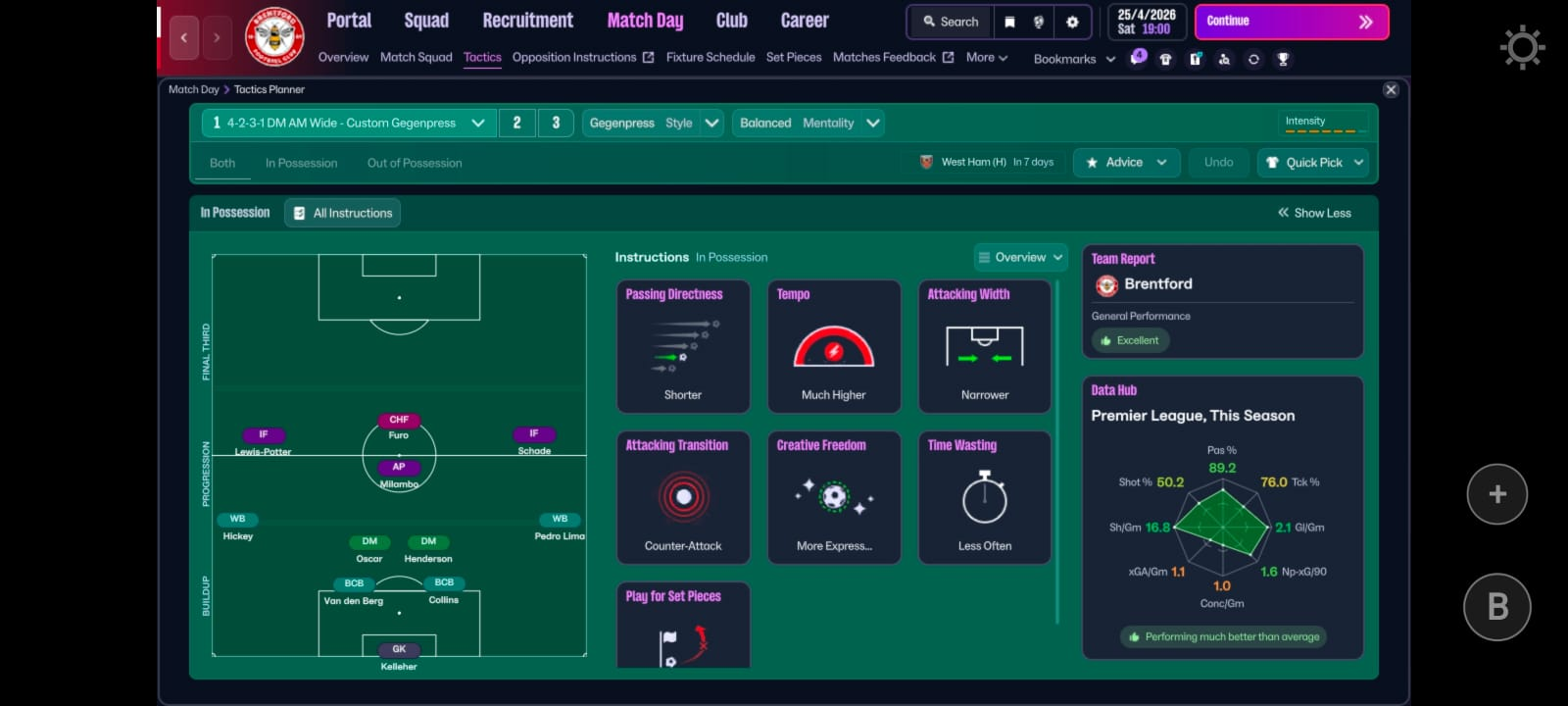
gegenpress
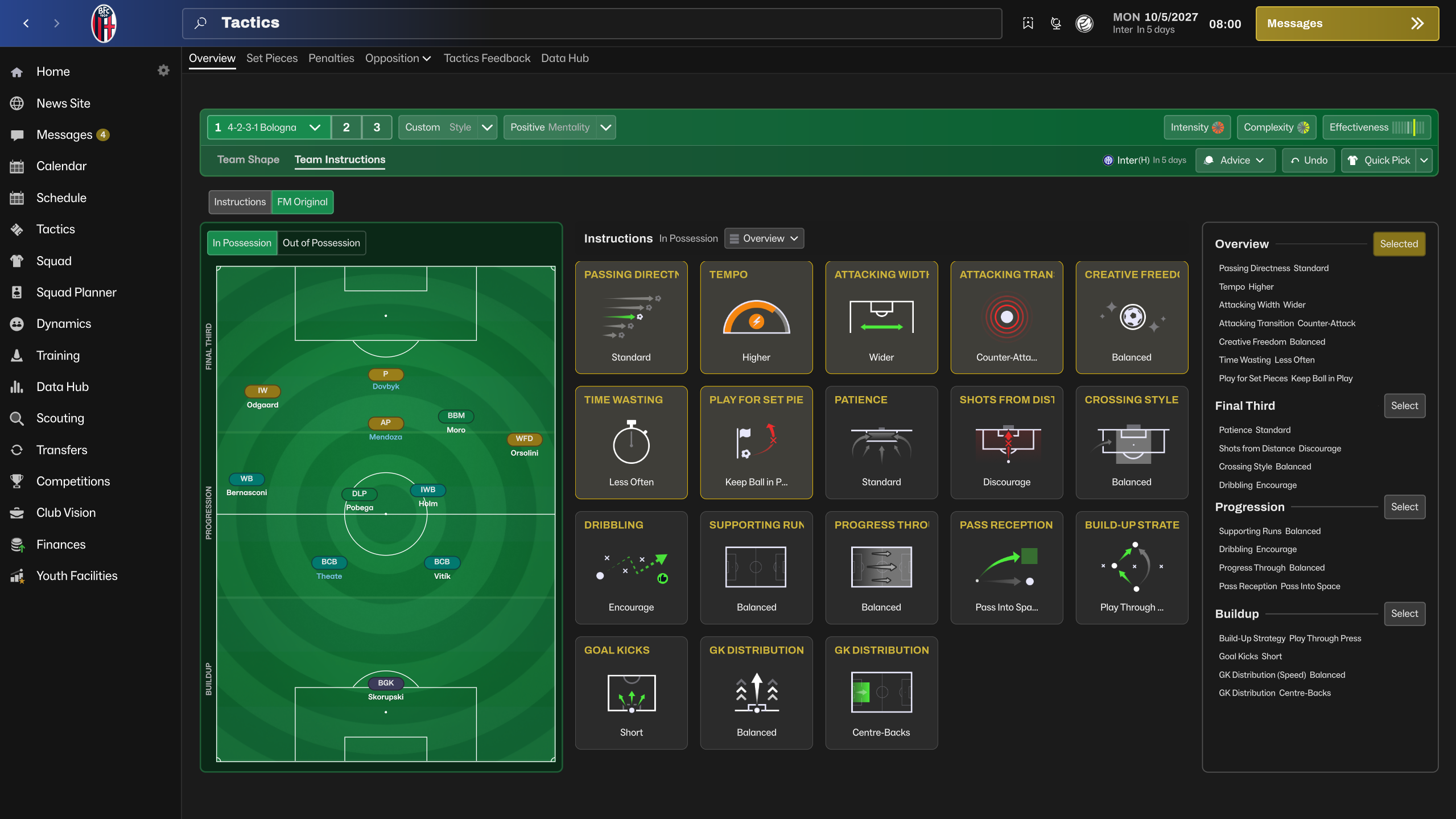
clean slate
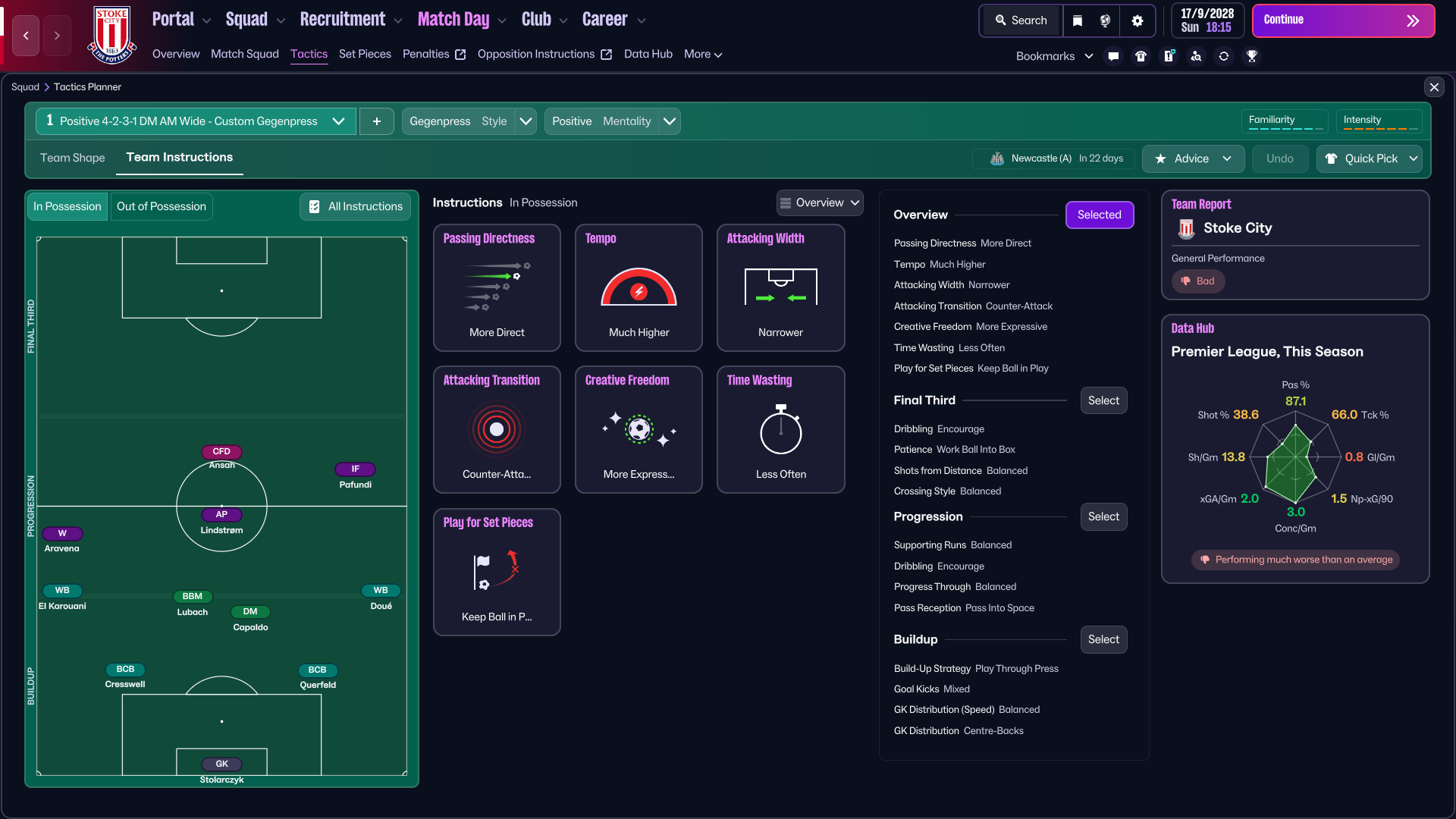
gegenpress
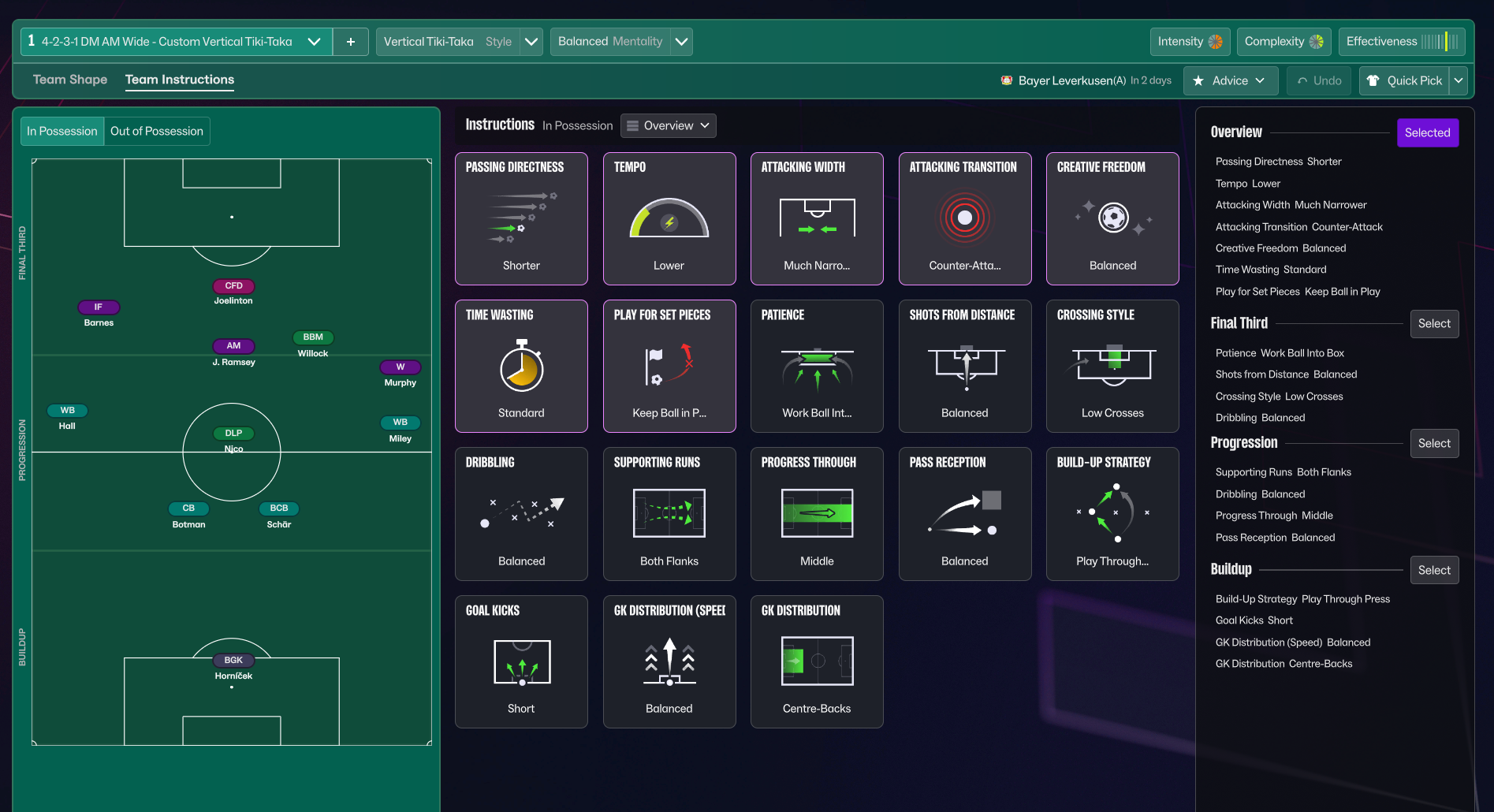
vertical tiki taka
control possession
The tactical theory behind the 4-2-3-1 DM Wide: roles, instructions, and the trade-offs that decide whether the system holds up.
Double pivots and flat pairs in 4-2-3-1 and 4-4-2: when each pairing works, when it collapses, and the AMC unicorn that rescues both.
Klopp-style gegenpressing in FM, including squad profile, line-and-press pairing, sustainable workload, and the antipatterns to avoid.
Counter-Press, Regroup, Stand Off, Trigger Press: what each pressing instruction does in FM and how to pair them without contradicting.