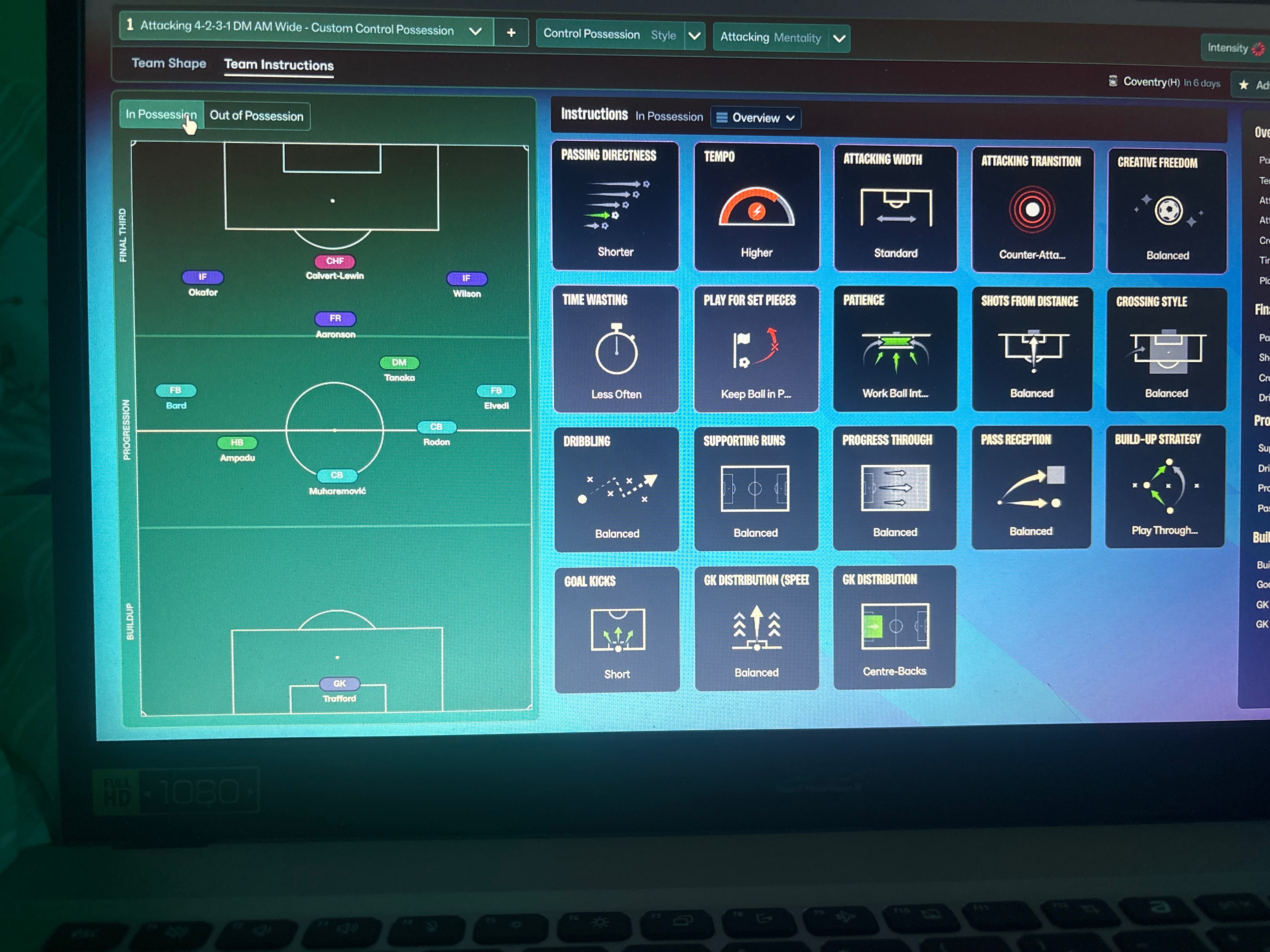
4-2-3-1 DM Wide
Controlling possession and building through the centre. Shorter passing, Lower tempo, Pass to Feet and Play Through Press all point to a patient…
Loading tactical analysis...
4-2-3-1 DM Wide
4-4-1-1 2 DM
Balanced
Control Possession
6
3
Channel Forward
Center Forward
5
3
Advanced Playmaker
Attacking Midfielder
5
1
Wide Forward
Wide Midfielder
5
5
Wide Forward
Wide Midfielder
4
4
Central Midfielder
Defensive Midfielder
4
1
Wing Back
Full Back
4
5
Wing Back
Full Back
3
2
Deep-Lying Playmaker
Screening Defensive Midfielder
2
2
Centre-Back
Centre-Back
2
4
Ball-Playing Center-Back
Centre-Back
1
3
Ball-Playing Goalkeeper
Sweeper Keeper
Shorter
Lower
Standard
Standard
Balanced
Less Often
Keep Ball in Play
Work Ball Into Box
Balanced
Whipped Crosses
Balanced
Overlap Balanced
Balanced
Balanced
Pass to Feet
Play Through Press
Mixed
Balanced
Balanced
Underlap Balanced
Mid Block
Standard
Drop Off More
More Often
Regroup
Standard
Yes
Balanced
Balanced
Stop Crosses
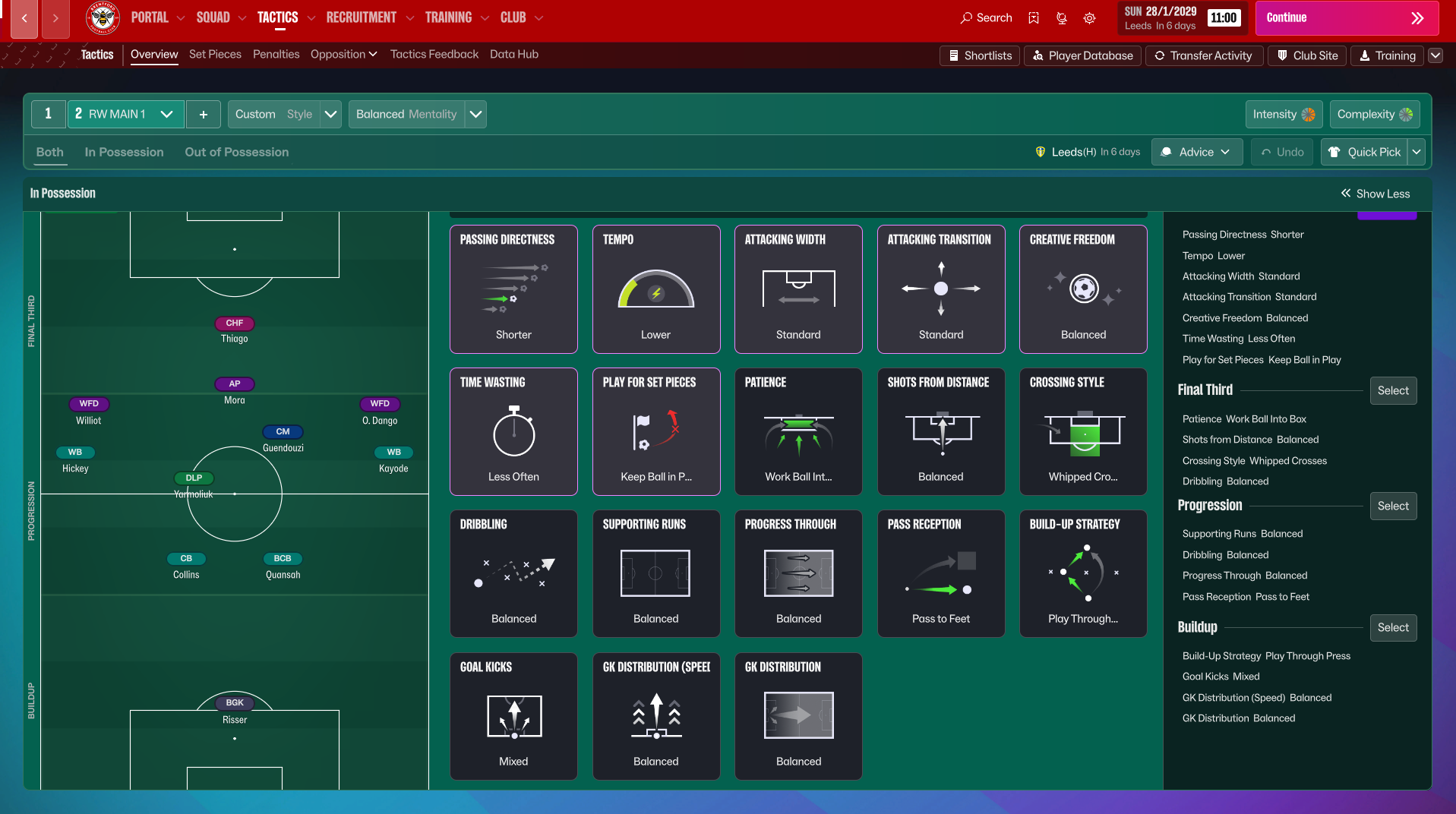
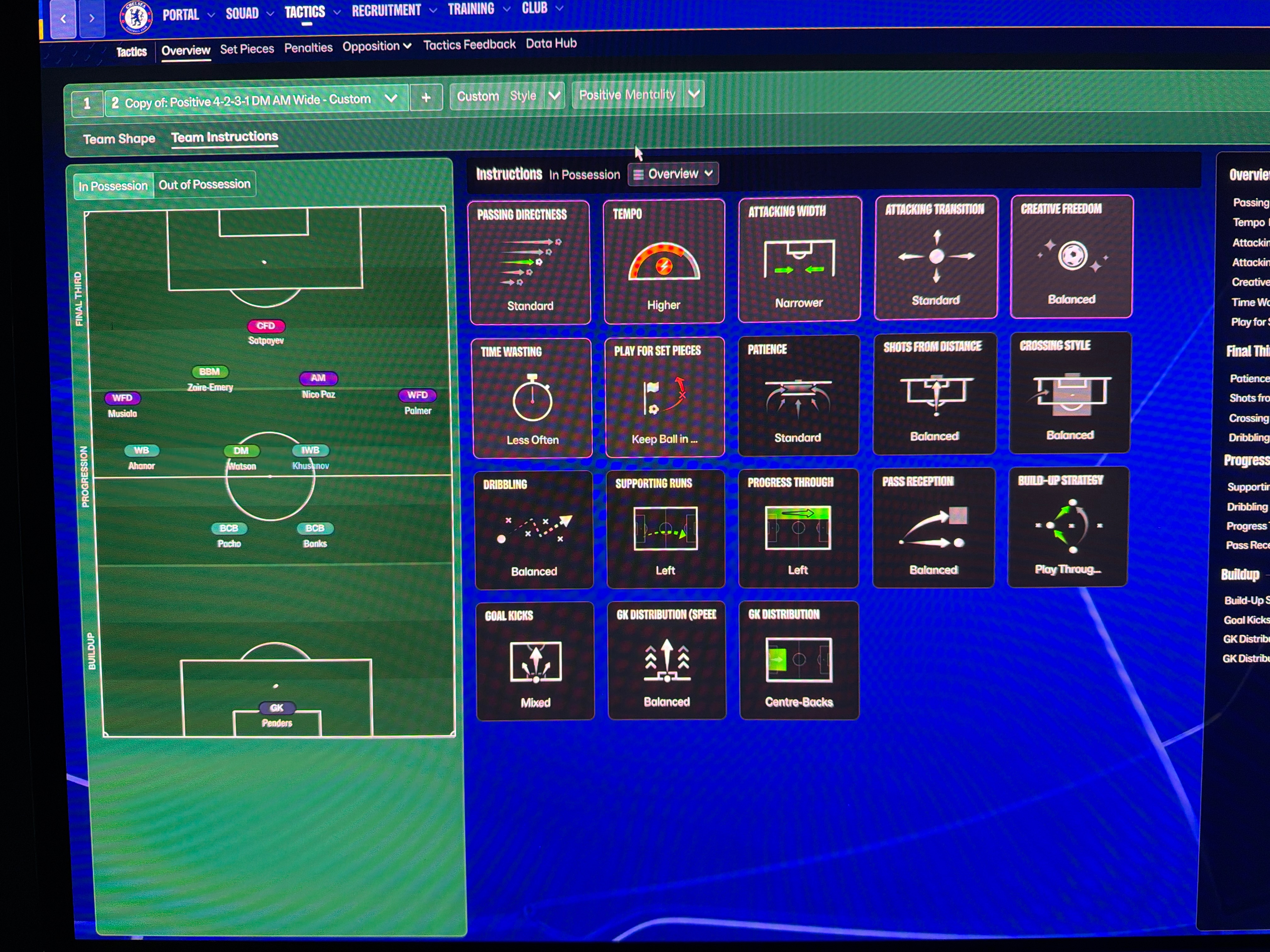
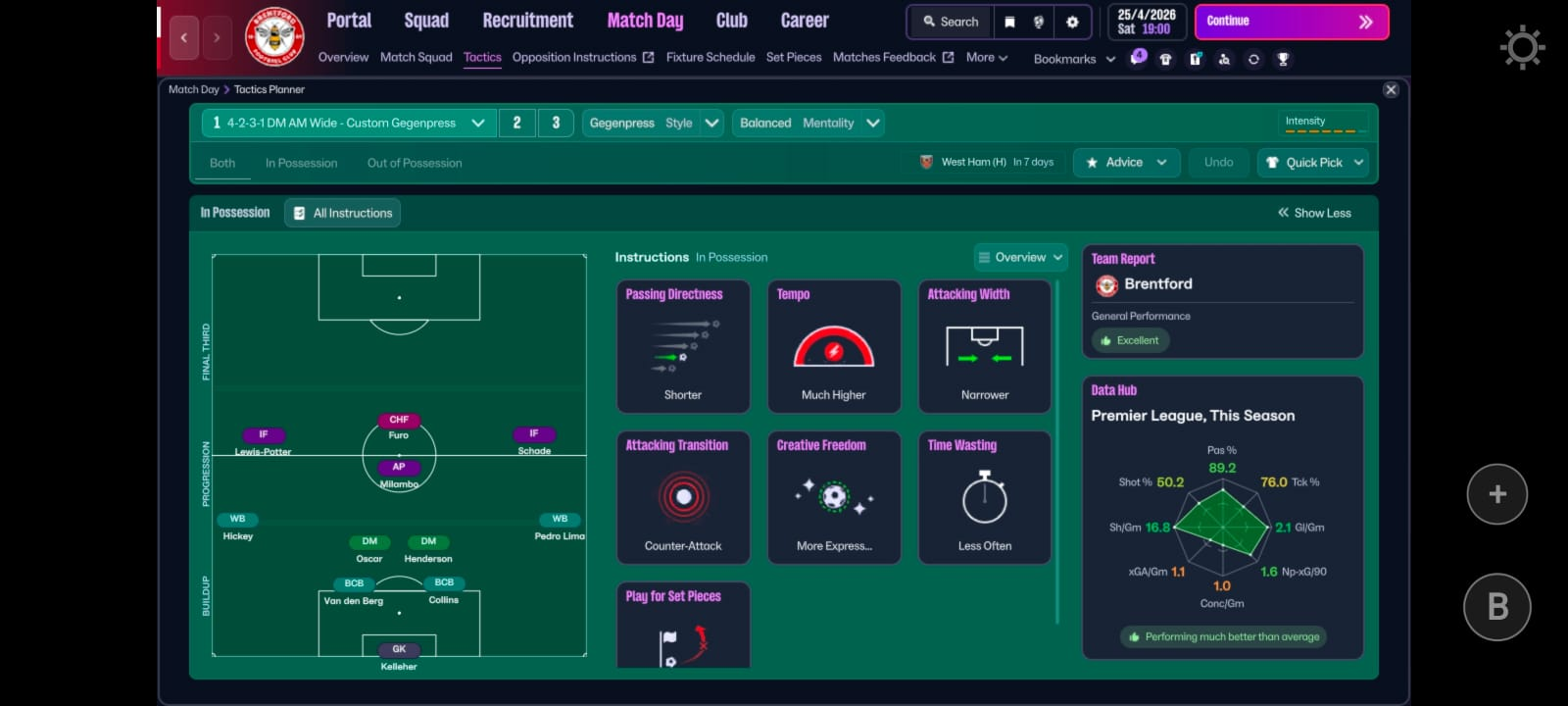
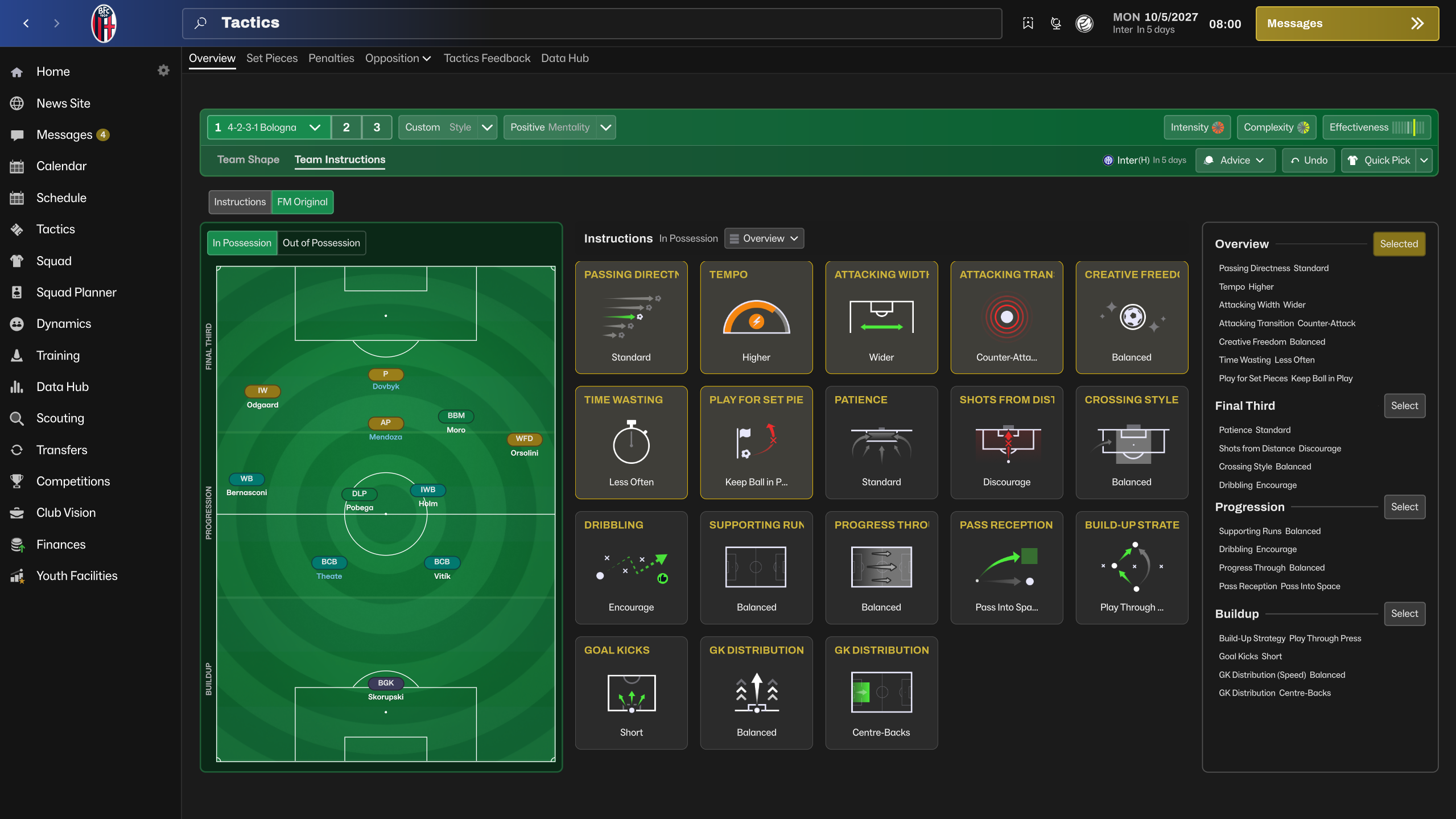
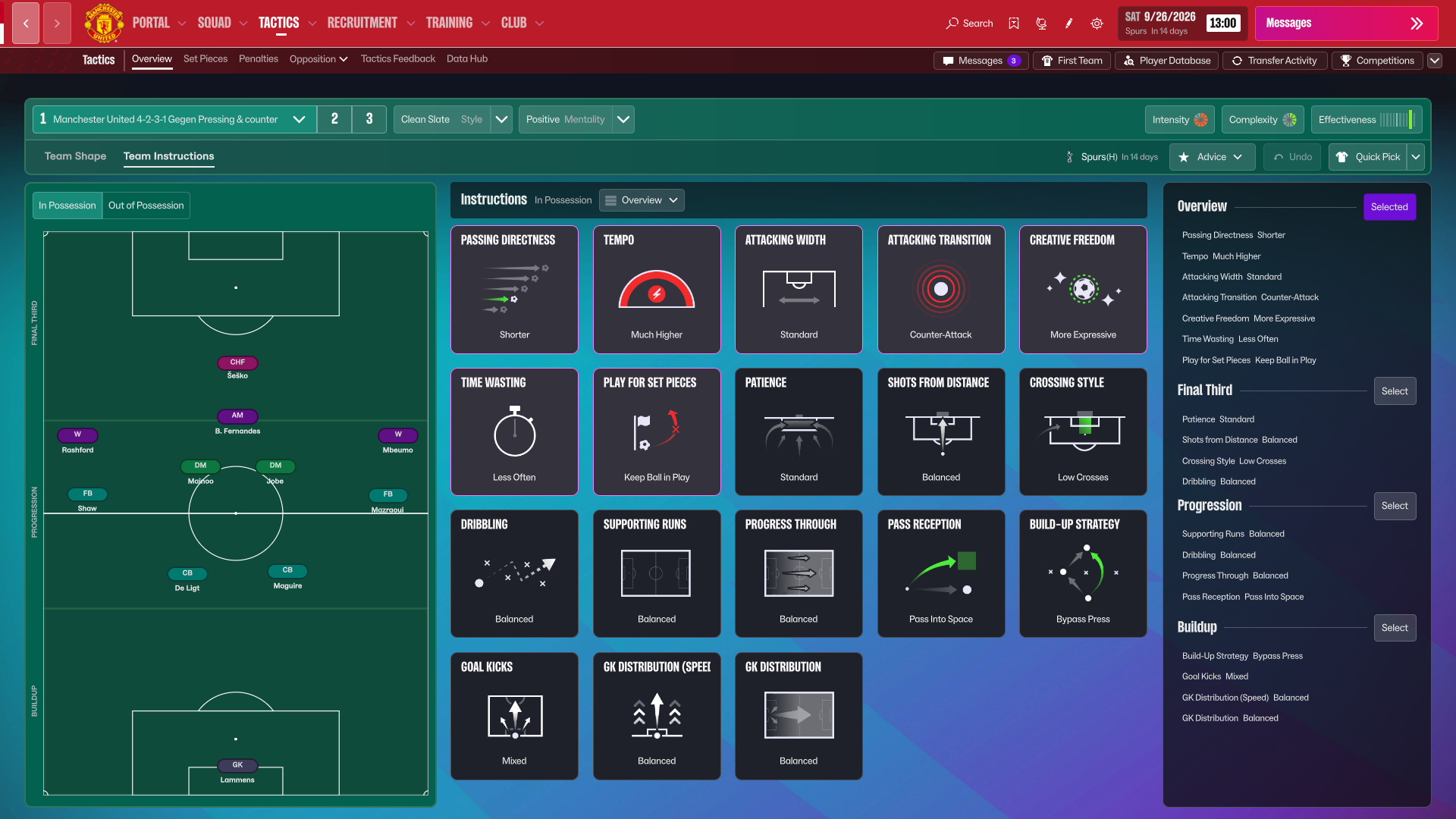
Shorter passing, Lower tempo, Pass to Feet and Play Through Press all point to a patient possession game, with passing outlets from the back.
Ball-Playing Goalkeeper at [1,3], Ball-Playing Centre-Back at [2,4] and Deep-Lying Playmaker at [3,2] give a controlled route out of defence.
The Advanced Playmaker sits behind the Channel Forward, which supports Work Ball Into Box and a high-quality chance approach.
Advanced Playmaker at [5,3] linking with Channel Forward at [6,3].
Work Ball Into Box asks for patient central combinations, yet Whipped Crosses is set as the crossing style. Both Wide Forwards are likely to cut inside, and the Channel Forward is not a crossing target, so crosses have little purpose.
Wide Forward at [5,1] and [5,5], Channel Forward at [6,3].
A mid block that presses more often but drops its line off more sends mixed signals. Pressers get drawn out of shape while the back line retreats, leaving gaps in front of it.
Screening Defensive Midfielder at [3,2] and Centre-Back at [2,2] sit behind pressing midfielders such as Defensive Midfielder at [4,4].
Counter-attacks down the flanks
Wing-Backs push high in possession while the Wide Forwards sit high, and Regroup is the only safeguard. The back four can be stretched when possession is lost.
Wing-Back at [4,1] and [4,5].
high
Deep-Lying Playmaker + Ball-Playing Centre-Back
Both circulate the ball from deep and give the Ball-Playing Goalkeeper short passing options.
Deep-Lying Playmaker at [3,2], Ball-Playing Centre-Back at [2,4].
Do your Wide Forwards have the finishing and off-the-ball movement to justify playing inside rather than crossing?
A coherent possession tactic with a strong build-up spine, but its defensive settings contradict each other and the crossing style does not match the patient central attack. Fix the defensive line behaviour first, then the crossing style.
Patient short passing through the Deep-Lying Playmaker and Advanced Playmaker into a Channel Forward.
Regroup into a mid block, pressing moderately often.
Controlling possession and building through the centre.
clean slate
clean slate
clean slate
gegenpress
clean slate
clean slate
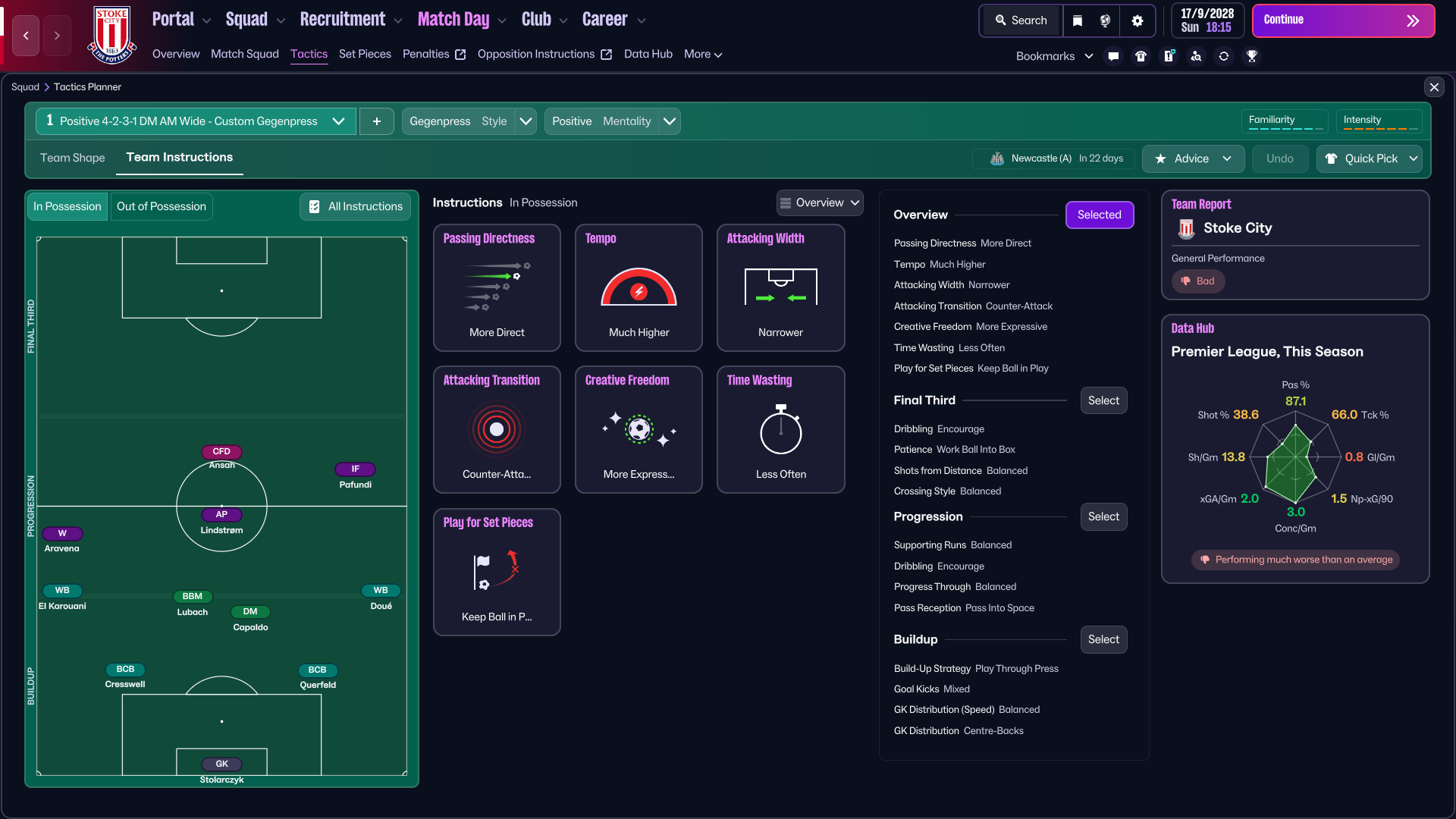
gegenpress
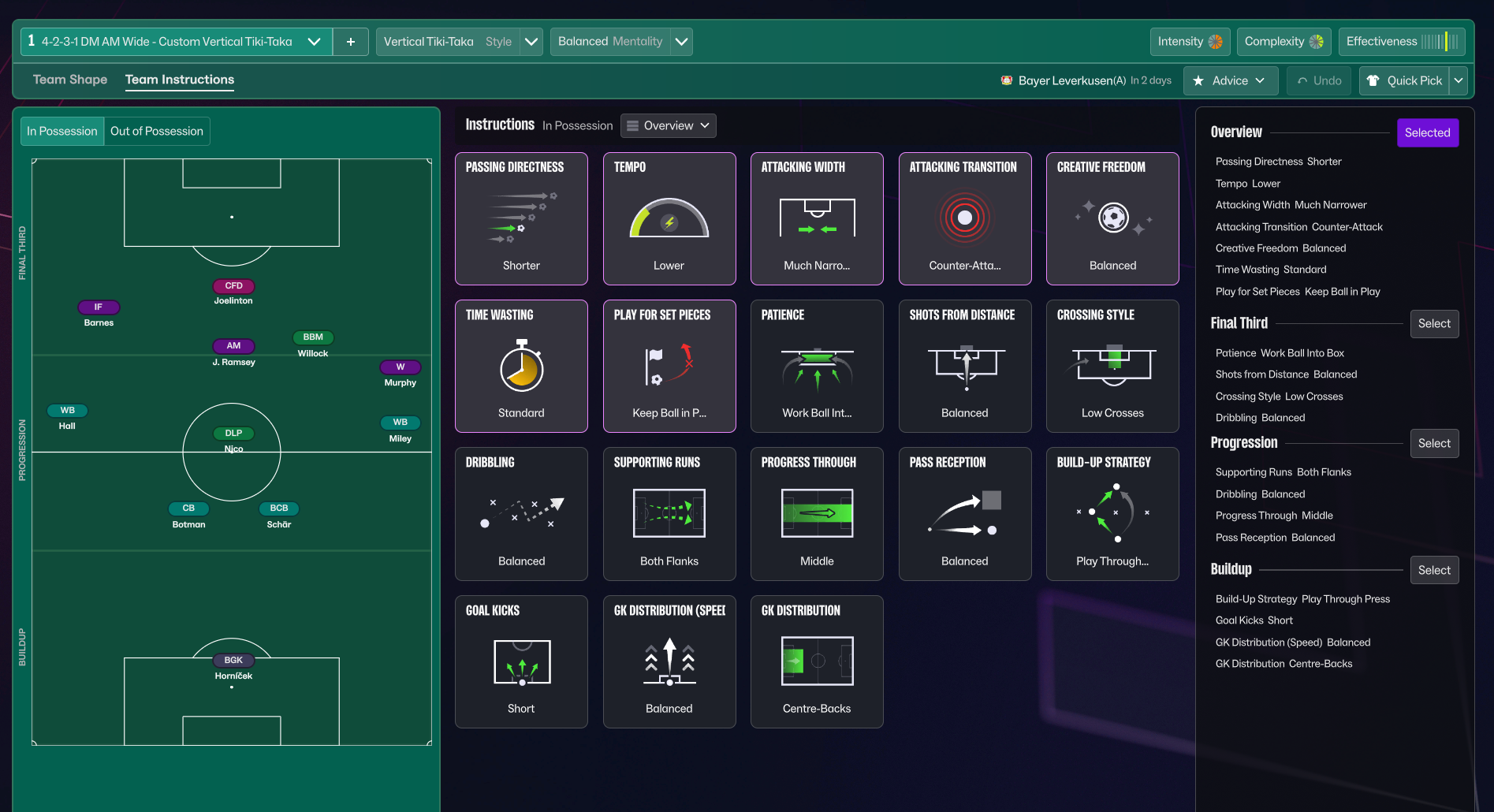
vertical tiki taka
The tactical theory behind the 4-2-3-1 DM Wide: roles, instructions, and the trade-offs that decide whether the system holds up.
Klopp-style gegenpressing in FM, including squad profile, line-and-press pairing, sustainable workload, and the antipatterns to avoid.
Double pivots and flat pairs in 4-2-3-1 and 4-4-2: when each pairing works, when it collapses, and the AMC unicorn that rescues both.
Mentality, duty, role, instruction, sub. The change hierarchy from lightest to heaviest intervention, and 60th-minute patterns by game state.