4-3-3 DM Wide
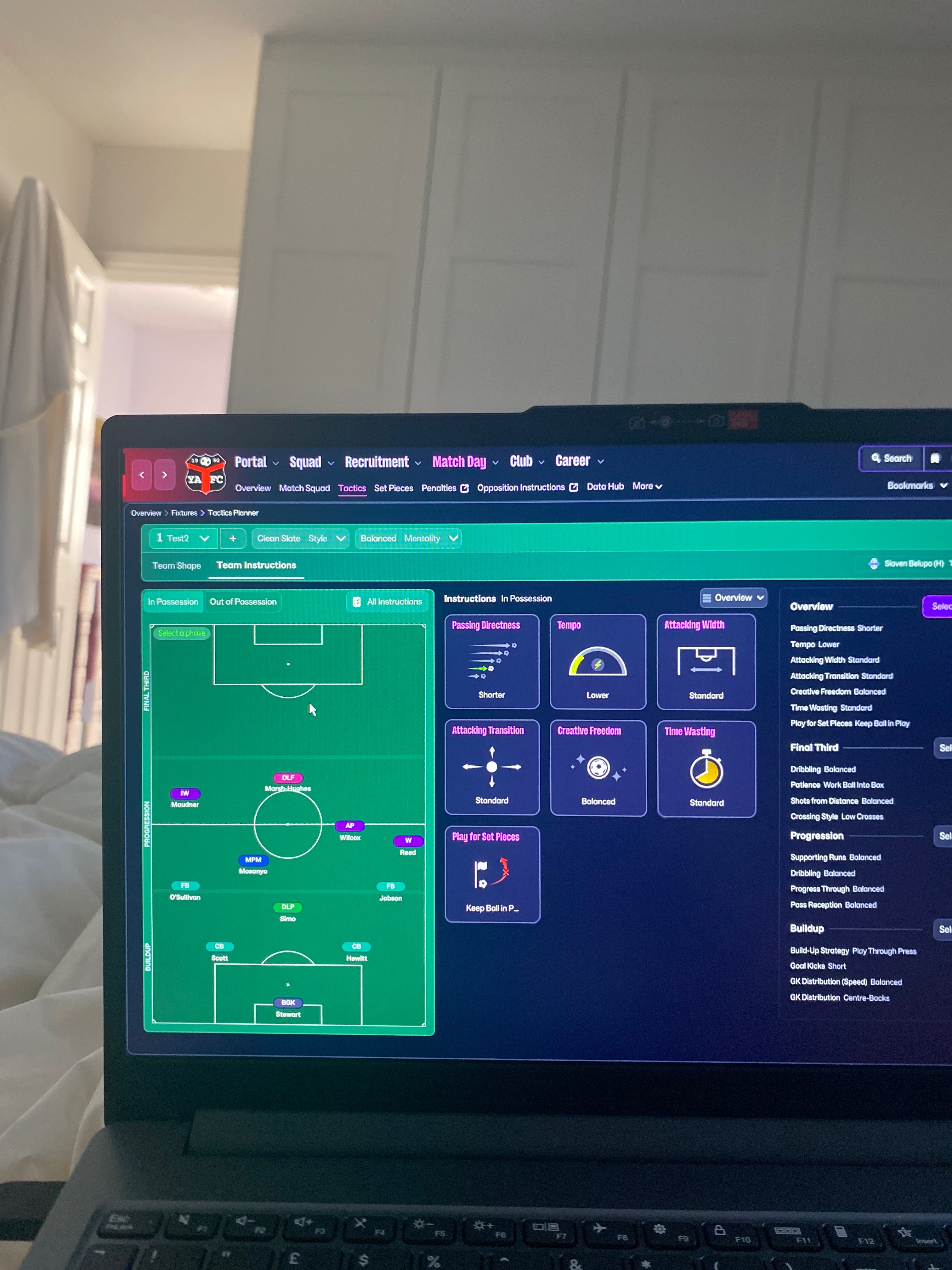
Controlling the game through short passing and a high press. Shorter passing, lower tempo, short goal kicks and play-through-press support a patient…
Loading tactical analysis...
4-3-3 DM Wide
4-1-4-1 DM
Balanced
Clean Slate
1
3
Ball-Playing Goalkeeper
Goalkeeper
2
2
Centre-Back
Centre-Back
2
4
Centre-Back
Centre-Back
2
1
Full-Back
Full-Back
2
5
Full-Back
Full-Back
4
2
Midfield Playmaker
Central Midfielder
4
4
Advanced Playmaker
Central Midfielder
5
1
Inside Winger
Wide Midfielder
6
3
Deep-Lying Forward
Centre Forward
5
5
Winger
Wide Midfielder
3
3
Deep-Lying Playmaker
Defensive Midfielder
Shorter
Lower
Standard
Standard
Balanced
Standard
Keep Ball in Play
Balanced
Work Ball Into Box
Balanced
Low Crosses
Balanced
Balanced
Balanced
Balanced
Play Through Press
Short
Balanced
Centre-Backs
Balanced
High Press
Higher
Balanced
More Often
Counter-Press
Standard
Balanced
No
Balanced
Balanced
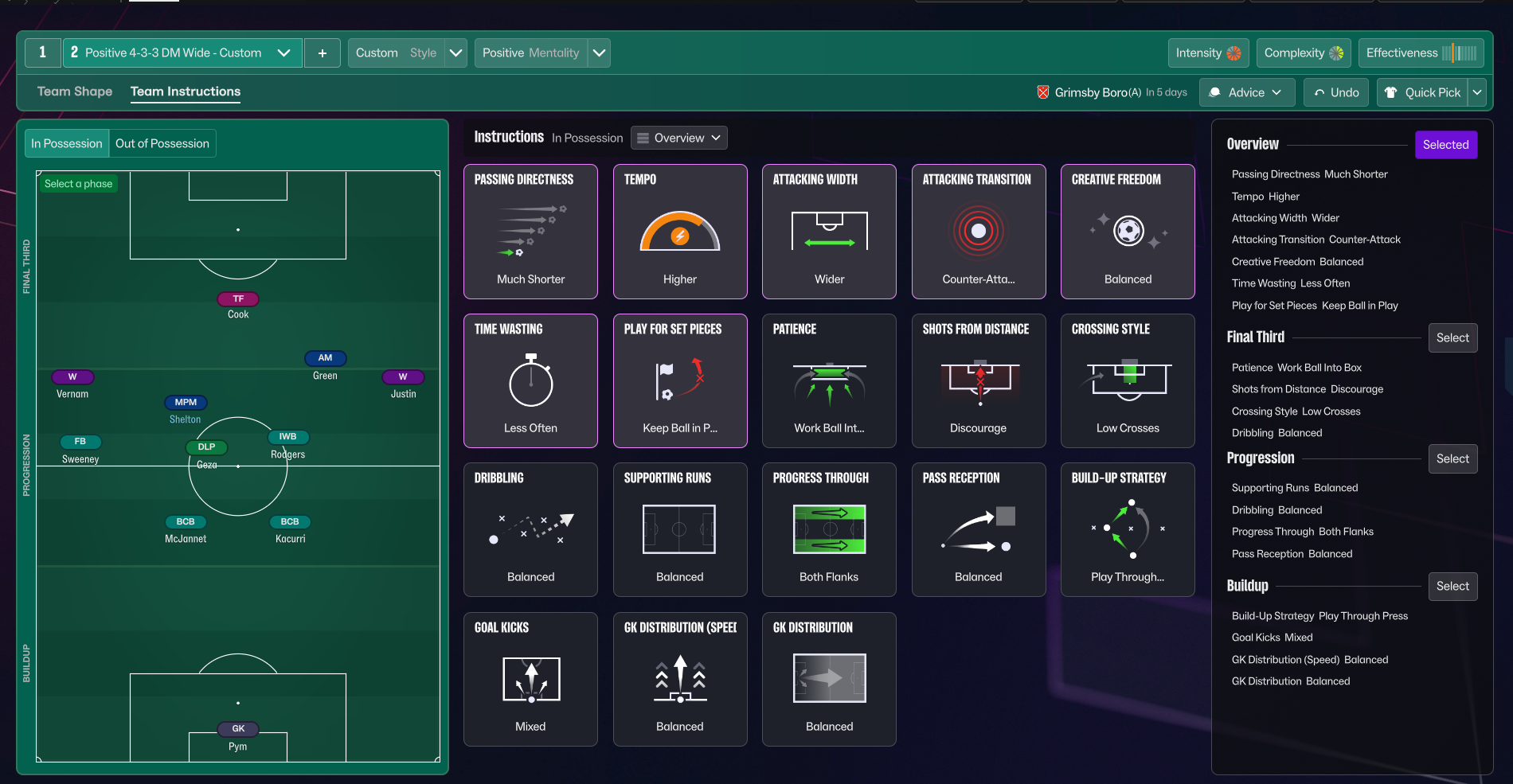
Shorter passing, lower tempo, short goal kicks and play-through-press support a patient build-up from the back, with a ball-playing keeper and a deep playmaker as outlets.
Ball-Playing Goalkeeper at [1,3] and Deep-Lying Playmaker at [3,3] anchor the build-up.
Two playmaking midfielders give multiple passing options and chance creation through the middle.
Midfield Playmaker at [4,2] and Advanced Playmaker at [4,4].
Lower tempo and patient work into the box sit awkwardly with a high-energy pressing game. Lost possession is more likely in slow build-up, and fatigue builds up quickly.
Deep-Lying Forward at [6,3] and Deep-Lying Playmaker at [3,3] are low-tempo roles.
Low crosses and a deep-lying forward give little aerial or box presence to finish wide deliveries.
Deep-Lying Forward at [6,3] and Winger at [5,5].
Space behind the high line
A higher line with balanced behaviour and only a lone defensive midfielder leaves space behind for quick balls over the top.
Centre-Back at [2,2] and [2,4] with Defensive Midfielder at [3,3] in the 4-1-4-1 shape.
high
Wide cover
Wide midfielders in the 4-1-4-1 and full-backs on standard roles can be stretched when the press is bypassed.
Full-Back at [2,1] and [2,5] with Wide Midfielder at [5,1] and [5,5].
medium
Deep-Lying Playmaker with Midfield Playmaker
The deep playmaker recycles possession while the midfield playmaker links play forward.
Deep-Lying Playmaker [3,3] and Midfield Playmaker [4,2].
Deep-Lying Forward with Advanced Playmaker
The forward drops to link up and the advanced playmaker arrives into the space left behind.
Deep-Lying Forward [6,3] and Advanced Playmaker [4,4].
Do the squad's centre-backs have the pace to cope with a higher defensive line?
Do your players have the stamina for a high press and counter-press?
Which opponents are playing direct balls over your line?
This is a patient, possession-based system with a high press and strong central playmaking, but it is poorly balanced. Slow tempo clashes with the pressing intensity and the high line leaves the defence exposed behind. Lowering the line and lifting the tempo slightly would make it more coherent and safer.
Patient short passing from the back through playmakers, working the ball into the box with low crosses.
Counter-press immediately to win the ball back high, then reset into a 4-1-4-1 high press.
Controlling the game through short passing and a high press.
The tactical theory behind the 4-3-3 DM Wide: roles, instructions, and the trade-offs that decide whether the system holds up.
Klopp-style gegenpressing in FM, including squad profile, line-and-press pairing, sustainable workload, and the antipatterns to avoid.
Why circulation density and zonal occupation aren't the same thing in FM, and the half-space occupation rule that decides build-up.
How Mentality, Duty, and Role interact in FM, why duty trumps mentality every time, and the role-on-top-of-duty composition rules.