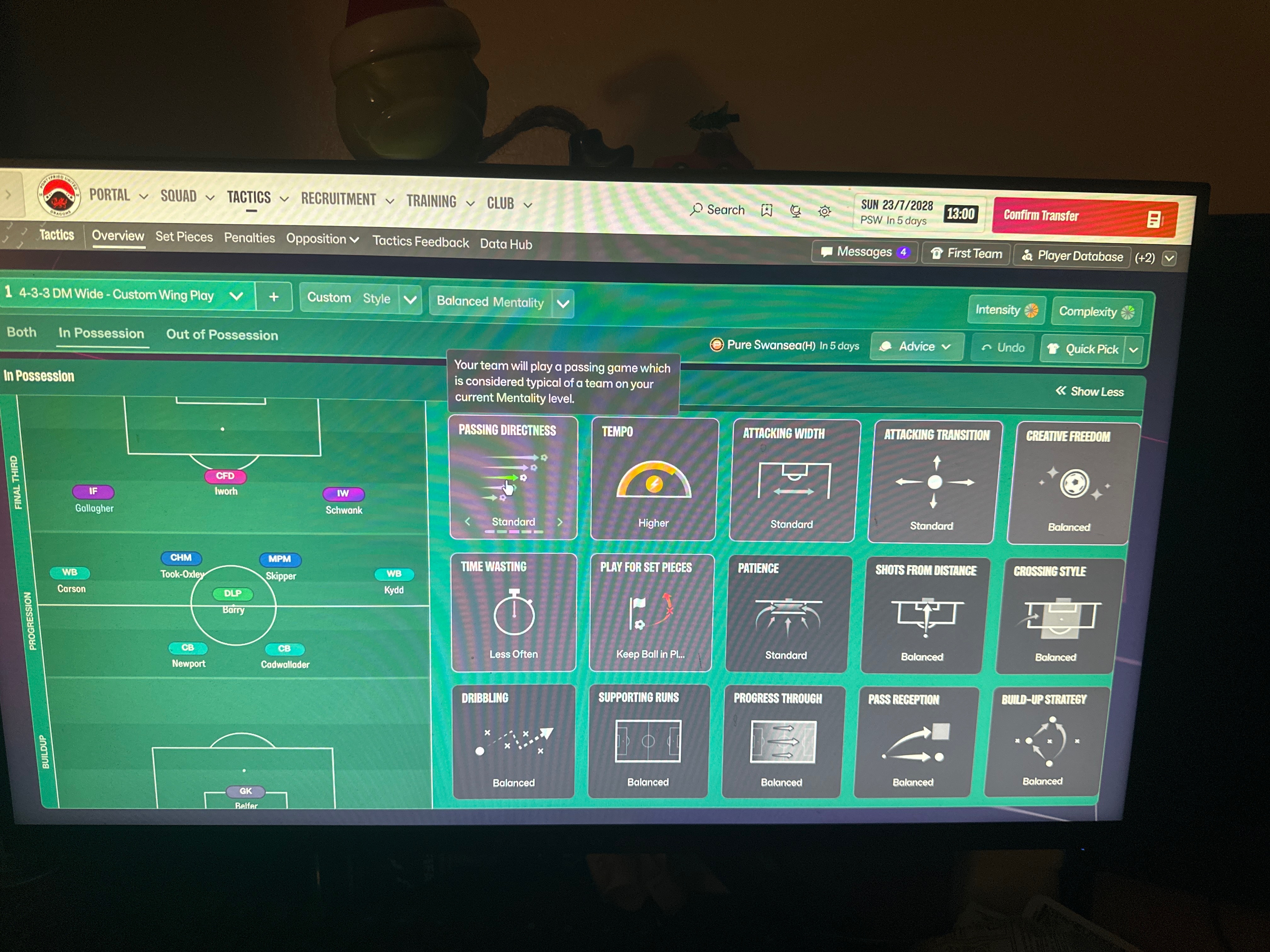
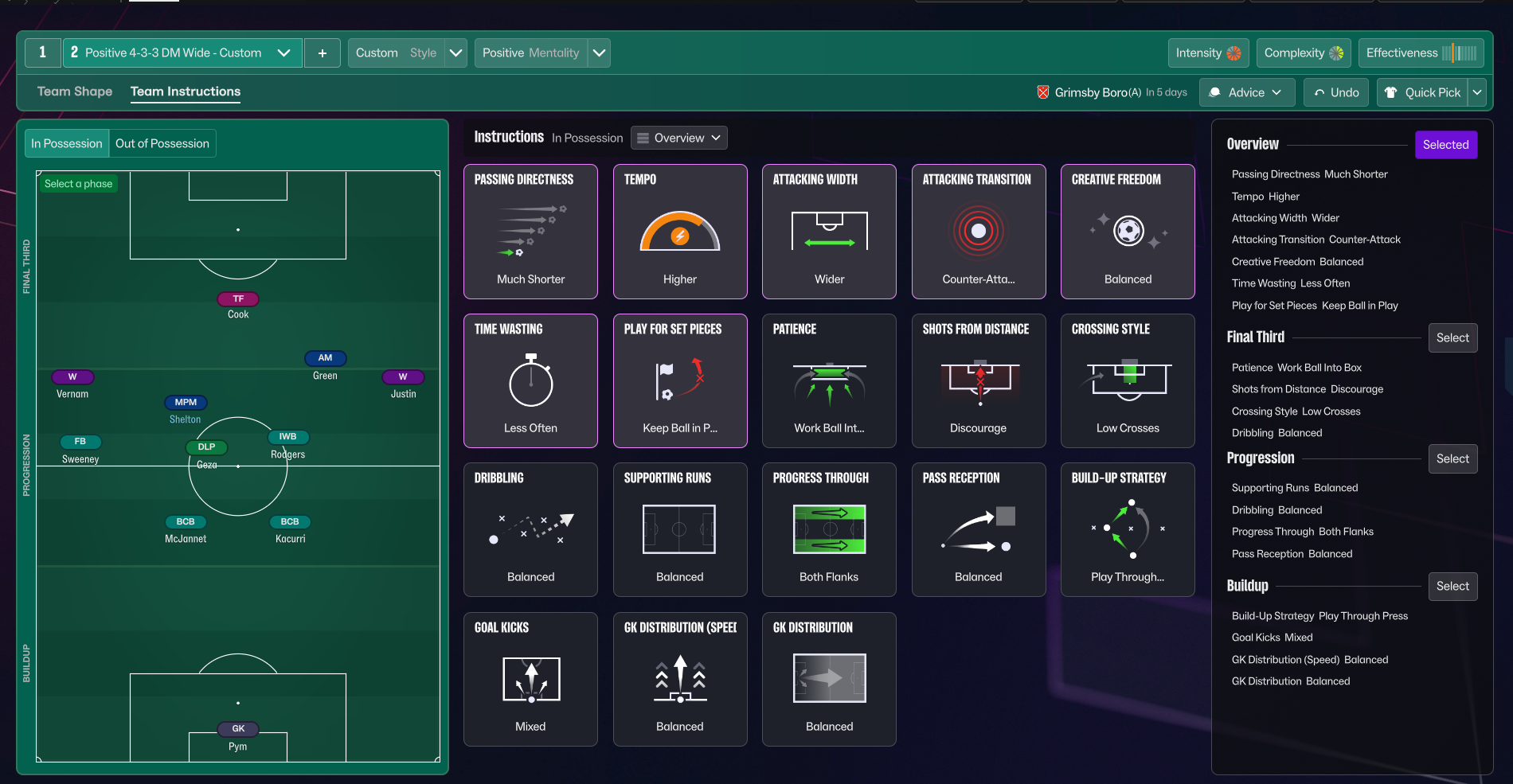
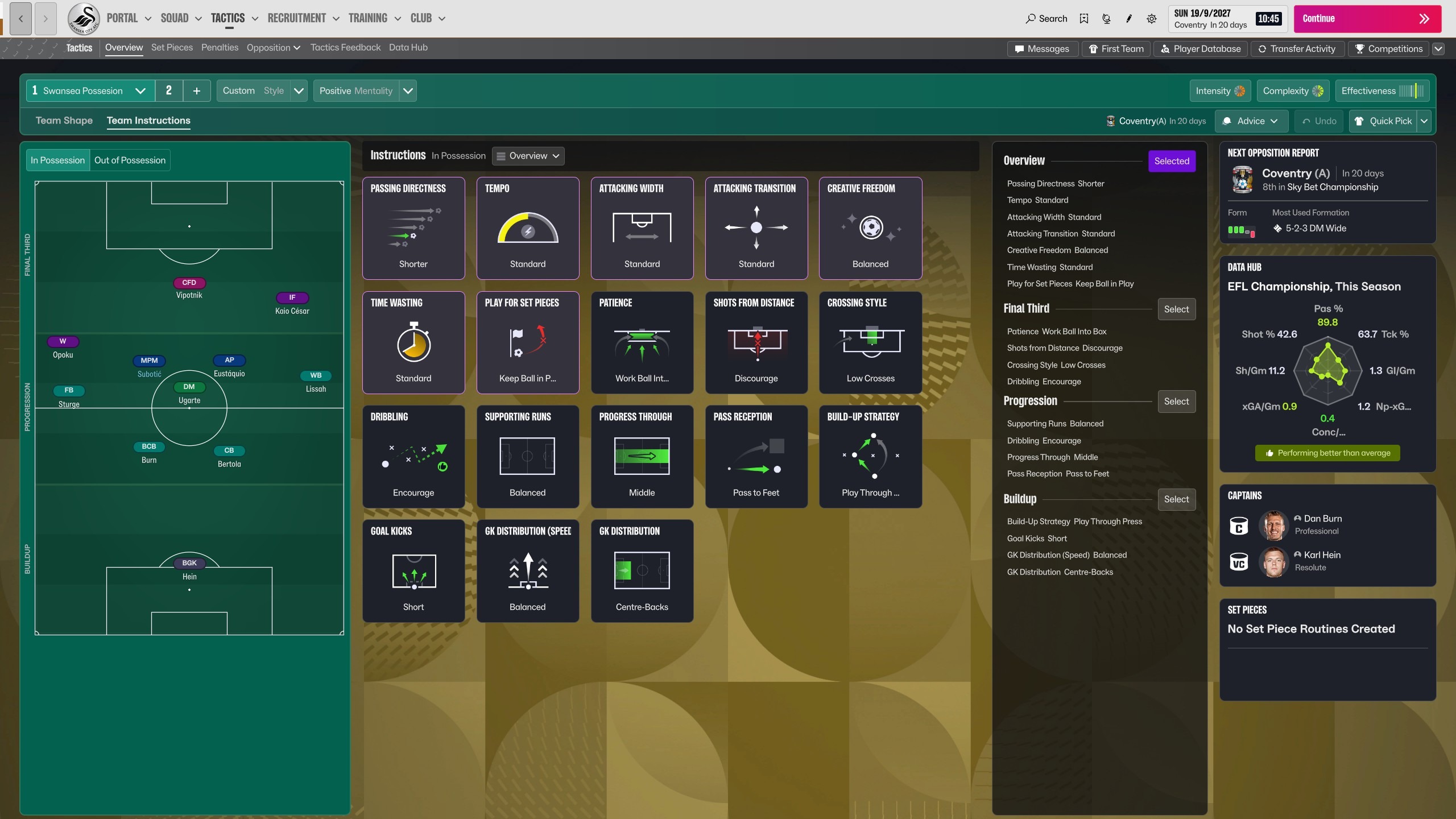
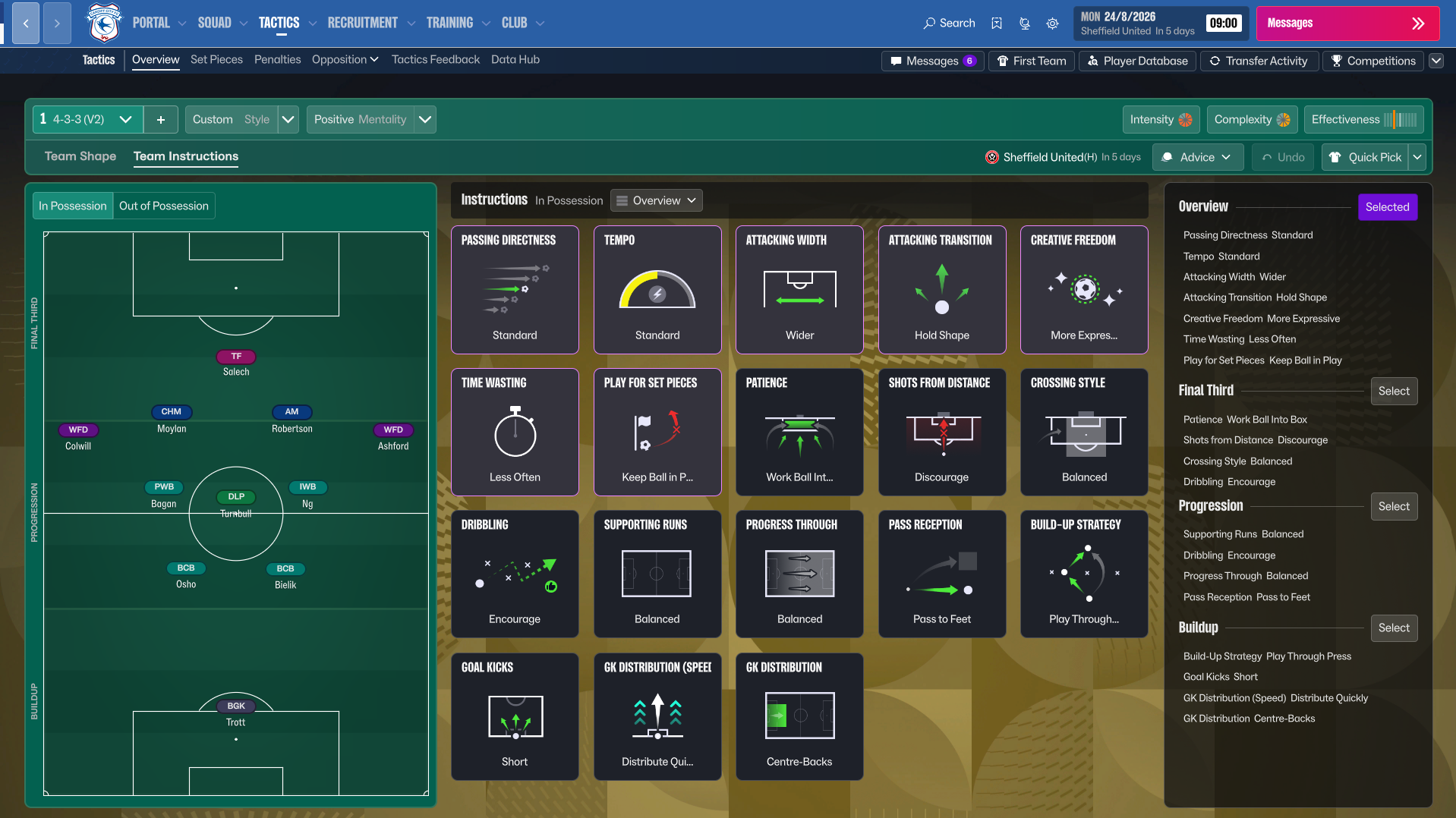
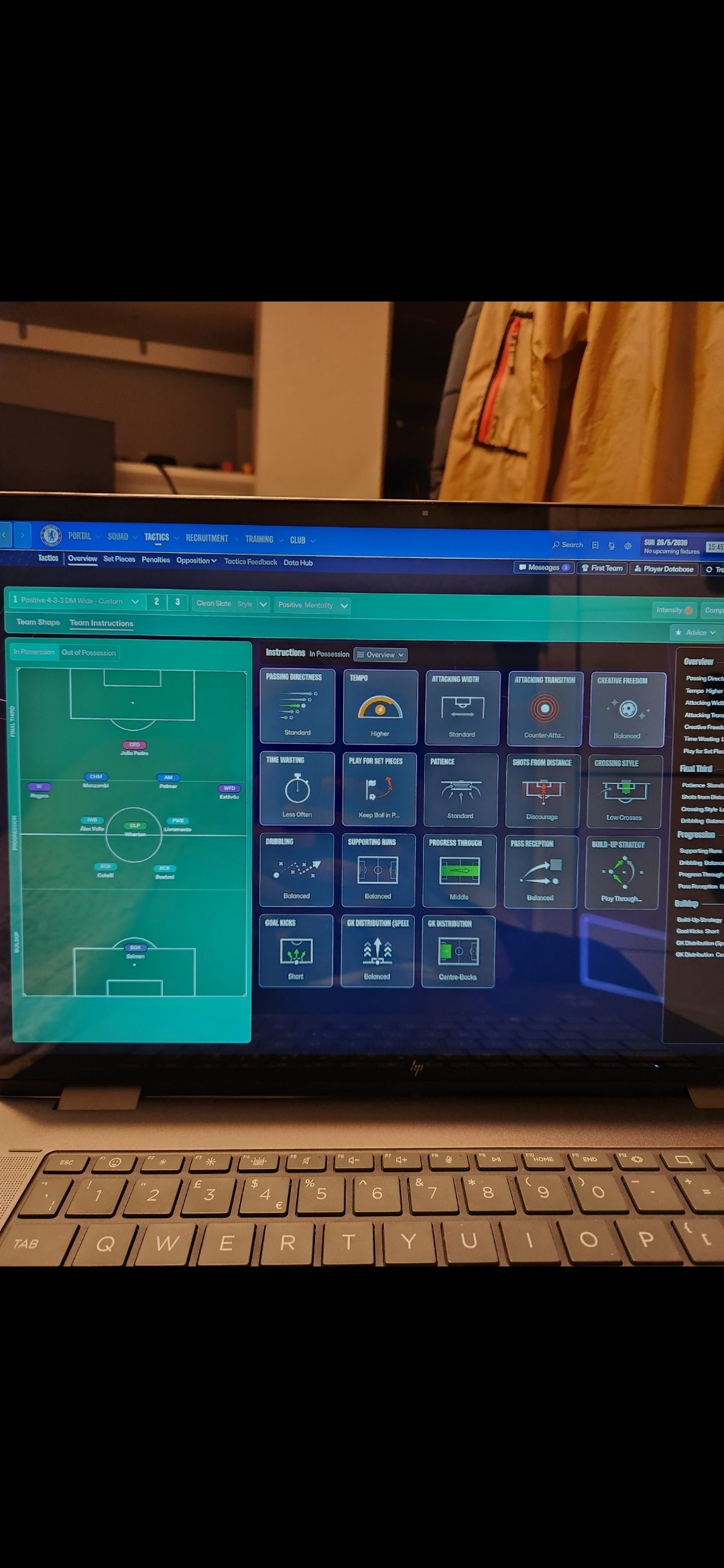
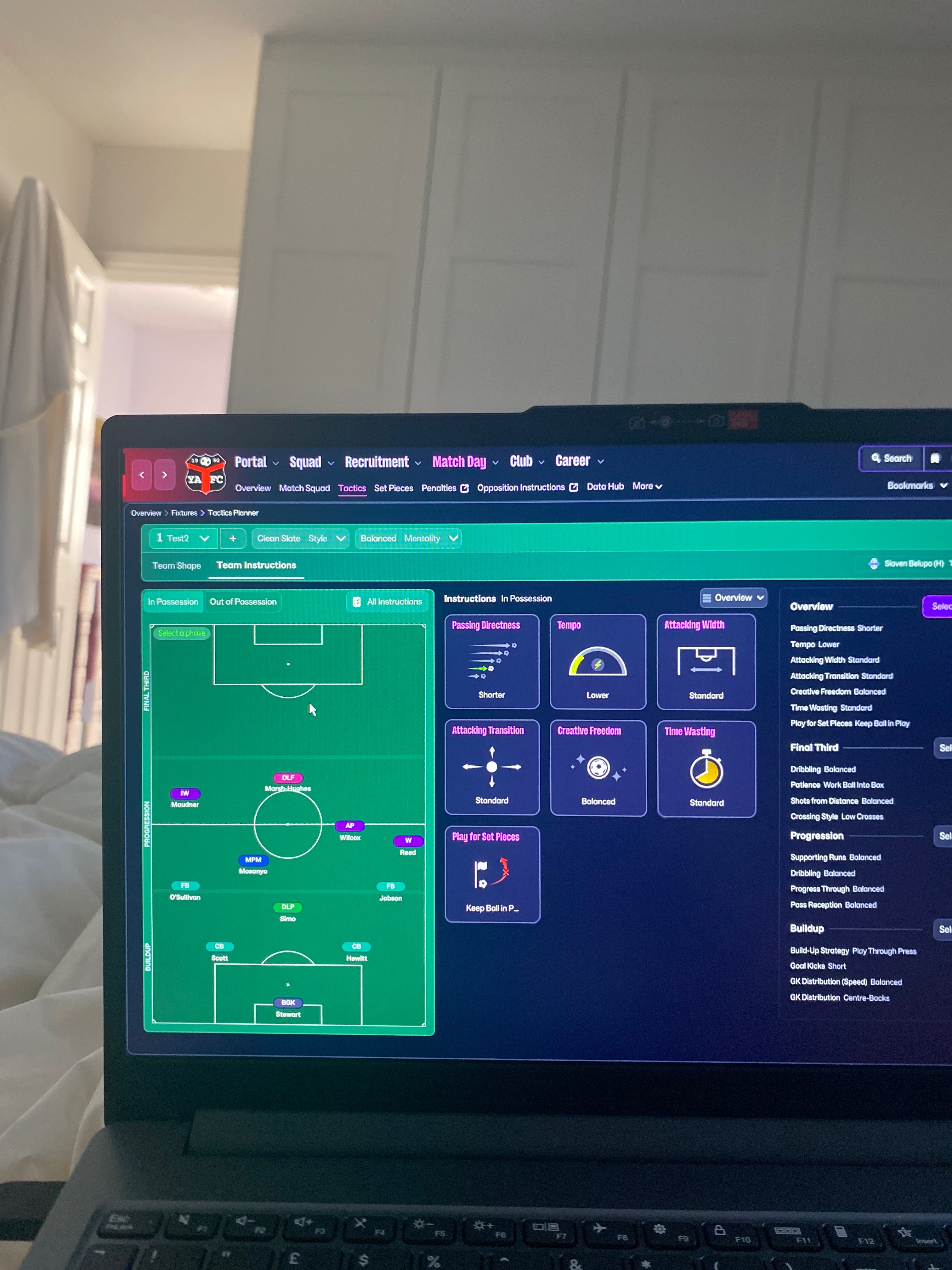
4-3-3 DM Wide
A Positive 4-3-3 combining short build-up and aggressive territory, with the press–defensive-line relationship the priority to improve. Short goal kicks…
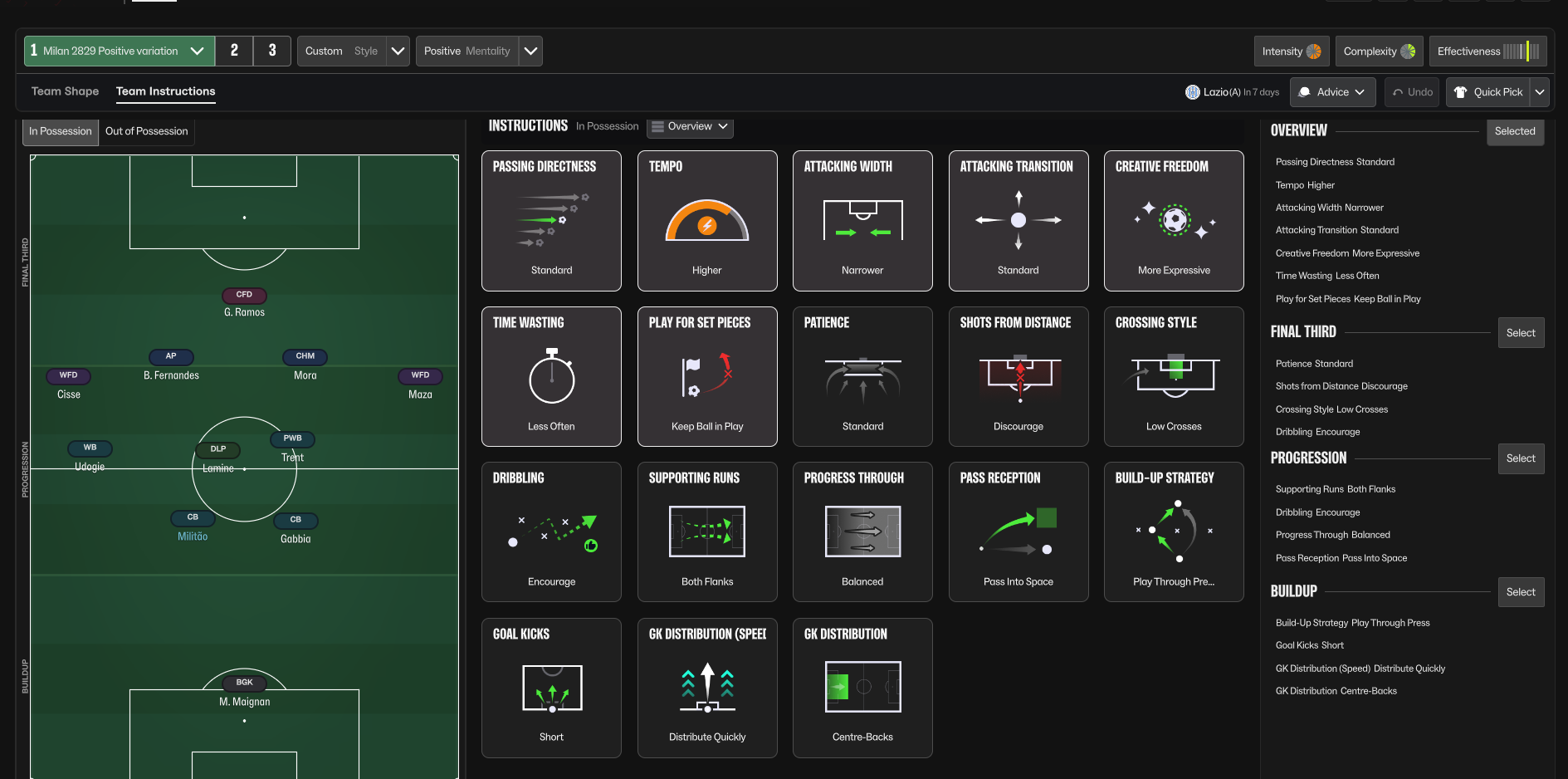
Loading tactical analysis...
4-3-3 DM Wide
4-3-3 DM Wide
Positive
Clean Slate
1
3
Ball-Playing Goalkeeper
Sweeper Keeper
2
2
Centre-Back
Centre-Back
2
4
Centre-Back
Centre-Back
3
1
Wing Back
Full Back
3
4
Playmaking Wing-Back
Full Back
5
1
Wide Forward
Tracking Winger
5
2
Advanced Playmaker
Central Midfielder
5
4
Channel Midfielder
Central Midfielder
6
3
Center Forward
Central Outlet Centre Forward
3
3
Deep-Lying Playmaker
Screening Defensive Midfielder
5
5
Wide Forward
Tracking Winger
Standard
Higher
Narrower
Standard
More Expressive
Less Often
Keep Ball in Play
Standard
Discourage
Low Crosses
Encourage
Encourage
Overlap Both Flanks
Balanced
Pass Into Space
Play Through Press
Short
Distribute Quickly
Center-Backs
Underlap Both Flanks
High Press
Much Higher
Balanced
Less Often
Counter-Press
Standard
Yes
Balanced
Balanced
Balanced
Short goal kicks to the centre-backs give the goalkeeper a clear first pass, while the deeper playmaker offers a central outlet for the next ball.
Ball-Playing Goalkeeper, Centre-Back and Deep-Lying Playmaker support Short goal kicks, Centre-Backs distribution and Play Through Press.
Two wide forwards can run beyond the opposition, with the centre-forward occupying central defenders and two different midfield roles supplying passes.
Wide Forward at [5,1] and [5,5], Centre Forward, Advanced Playmaker and Channel Midfielder.
The high engagement line and attempts to prevent short goalkeeper distribution ask the front line to close down early, but Less Often pressing can leave opponents time to pick a pass over the very high defence.
Central Outlet Centre Forward leads the High Press; Tracking Winger at [5,1] and [5,5] sit ahead of a Much Higher defensive line with Trigger Press set to Less Often.
Distribute Quickly can rush the first pass even though Short goal kicks and Play Through Press rely on the centre-backs and playmaker forming secure passing angles.
Ball-Playing Goalkeeper distributes to Centre-Back at [2,2] and [2,4], with Deep-Lying Playmaker ahead.
Space behind the back four
A Much Higher line leaves little room for recovery if an opponent bypasses the first challenge. The sweeper keeper helps, but cannot cover every ball into the channels.
Centre-Back at [2,2] and [2,4], Full-Back at [3,1] and [3,4], and Sweeper Keeper operate behind a High Press with Less Often pressing.
high
Turnovers during ambitious build-up
Quick short distribution, a higher tempo and encouragement to dribble can surrender possession before the side has settled around the ball.
Ball-Playing Goalkeeper, Centre-Back at [2,2] and [2,4], and Deep-Lying Playmaker are the initial outlets for Short goal kicks and Play Through Press.
medium
Wing-Back and Wide Forward on the left
The full-back's forward support offers an outside route when the wide forward attacks nearer goal; their Tracking Winger and Full-Back roles also restore a wide defensive pairing.
Wing-Back at [3,1] pairs with Wide Forward at [5,1]; out of possession they become Full-Back and Tracking Winger.
Playmaking Wing-Back and Channel Midfielder on the right
One can help progress from deeper on the right while the other offers a passing option further forward; the wide forward supplies a run beyond them.
Playmaking Wing-Back at [3,4], Channel Midfielder at [5,4] and Wide Forward at [5,5].
How can I tell whether my High Press is allowing too much time for passes behind my Much Higher line?
What should I look for in my centre-backs and goalkeeper to make Short goal kicks and Play Through Press reliable?
When would switching my GK Distribution (Speed) away from Distribute Quickly help this build-up?
This Positive 4-3-3 has coherent short-build-up outlets and varied attacking partnerships, but its High Press is undermined by Less Often pressing in front of a Much Higher line. I would first press more often, lower the line one step and make goalkeeper distribution speed Balanced to preserve the approach while reducing its most avoidable risks.
Short distribution to the centre-backs feeds a deeper playmaker, with a higher tempo, runs into space and wide forwards providing the forward threat.
The side Counter-Presses after losses, then forms a back four screened by the defensive midfielder, with both wide forwards tracking back.
A Positive 4-3-3 combining short build-up and aggressive territory, with the press–defensive-line relationship the priority to improve.
The tactical theory behind the 4-3-3 DM Wide: roles, instructions, and the trade-offs that decide whether the system holds up.
Klopp-style gegenpressing in FM, including squad profile, line-and-press pairing, sustainable workload, and the antipatterns to avoid.
Why circulation density and zonal occupation aren't the same thing in FM, and the half-space occupation rule that decides build-up.
FM27 keeps FM26's tactic system. Here is what stays the same, the small changes that can catch you out, and what the new Tactical Effectiveness system asks of you.