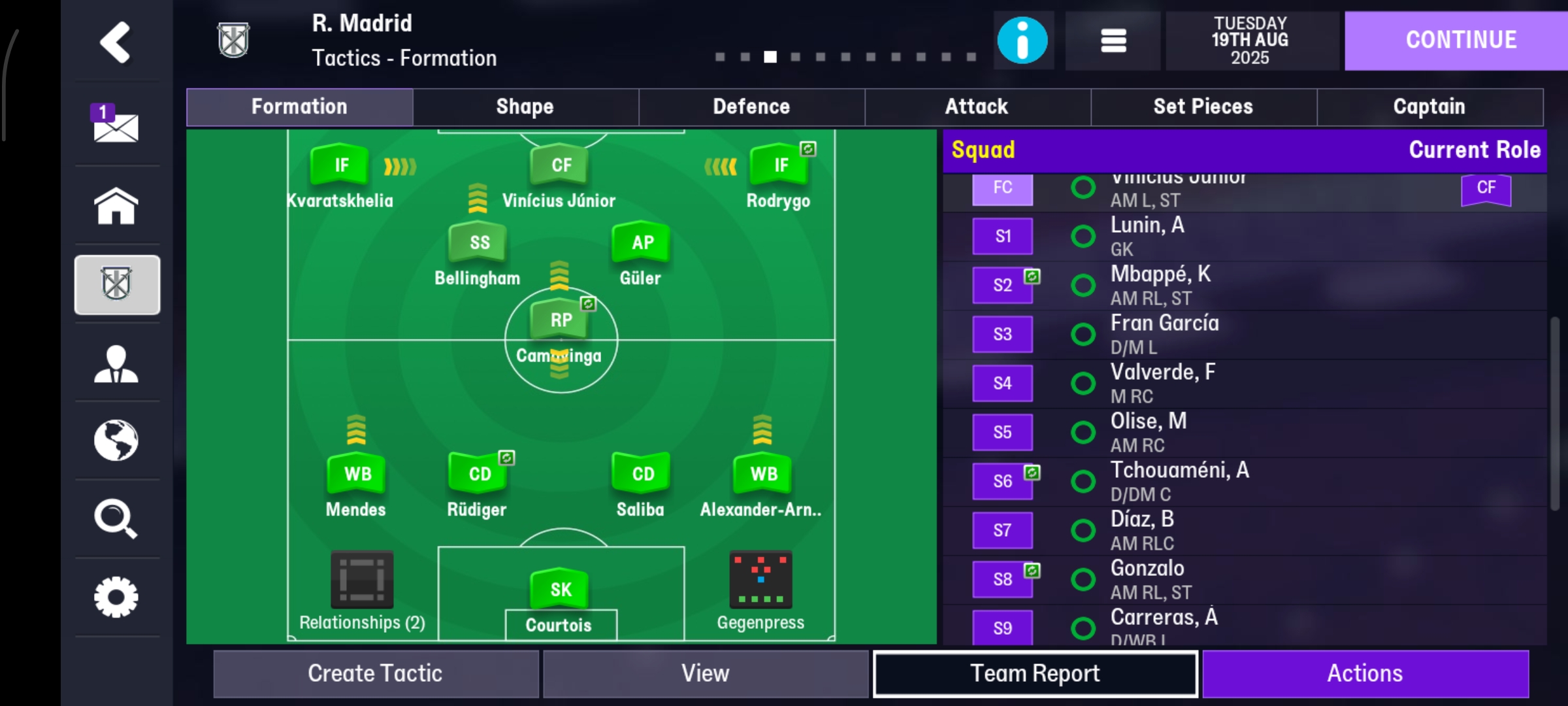
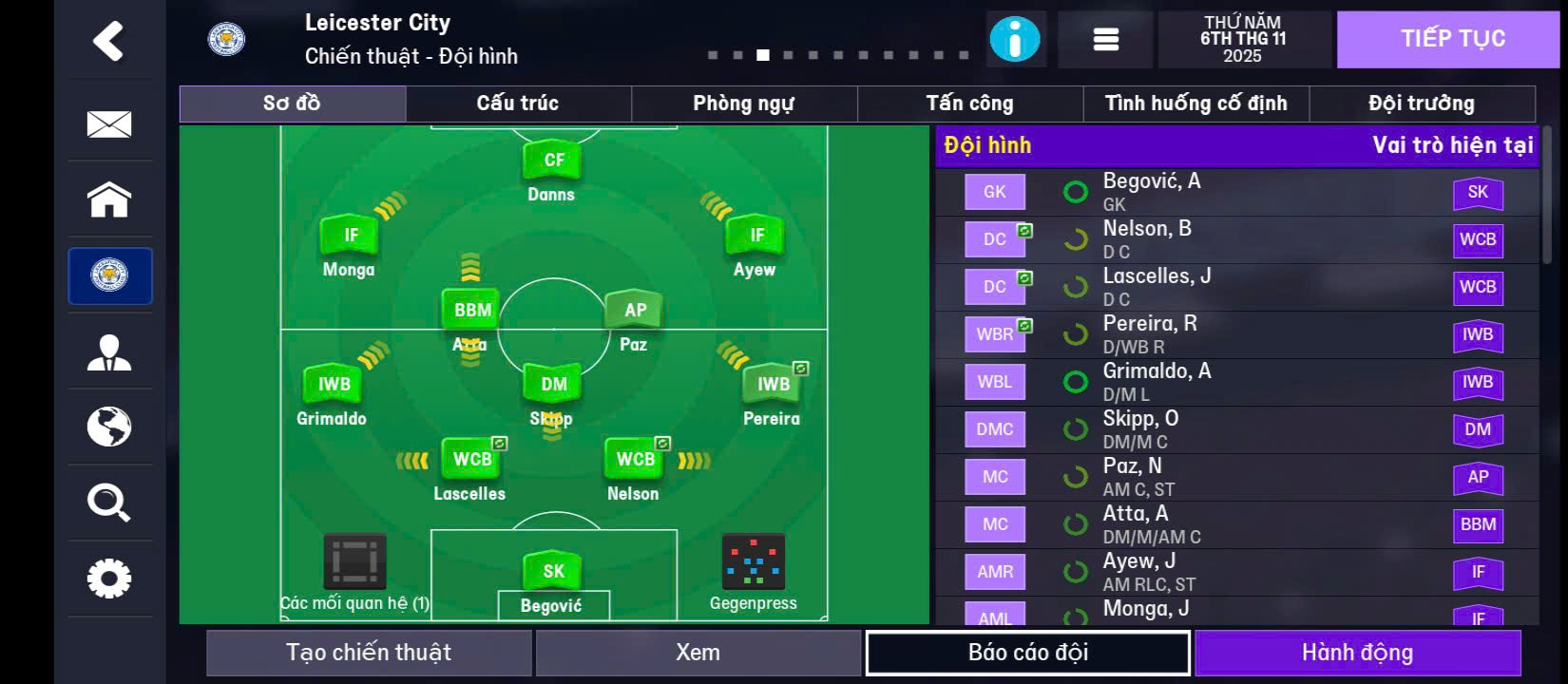
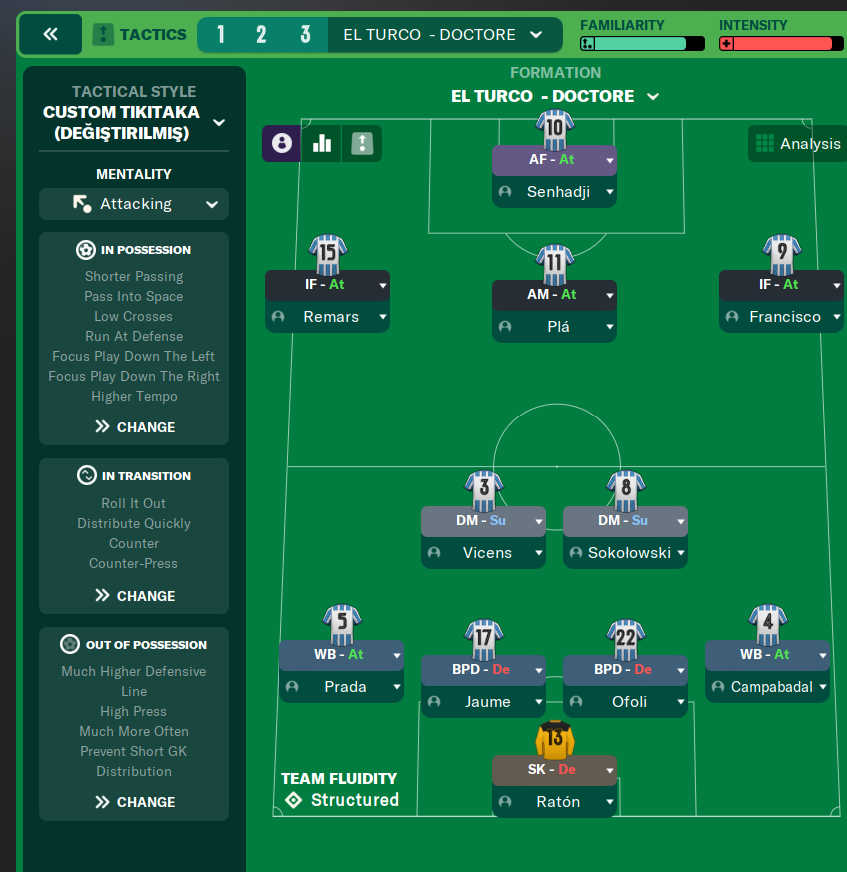
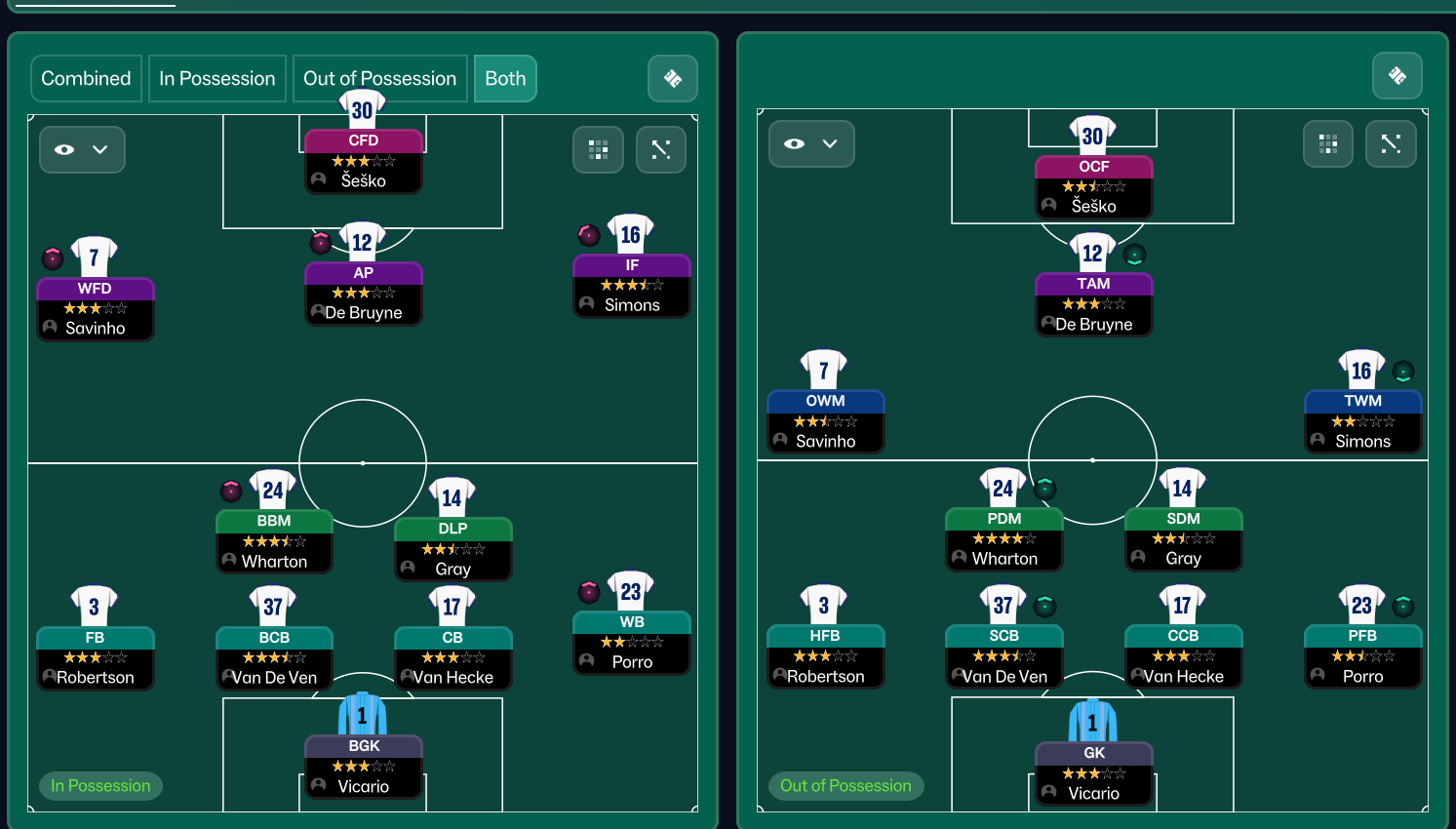
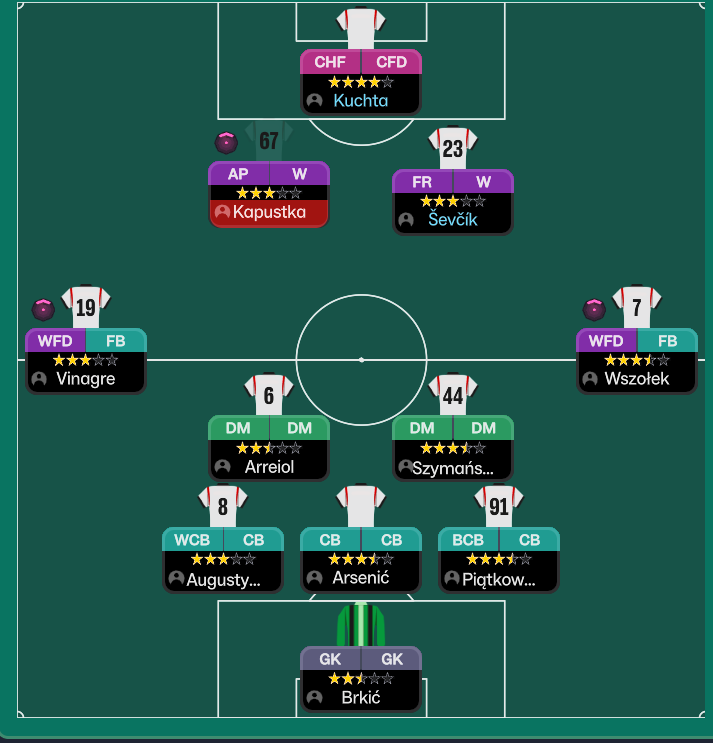
3-2-2-3
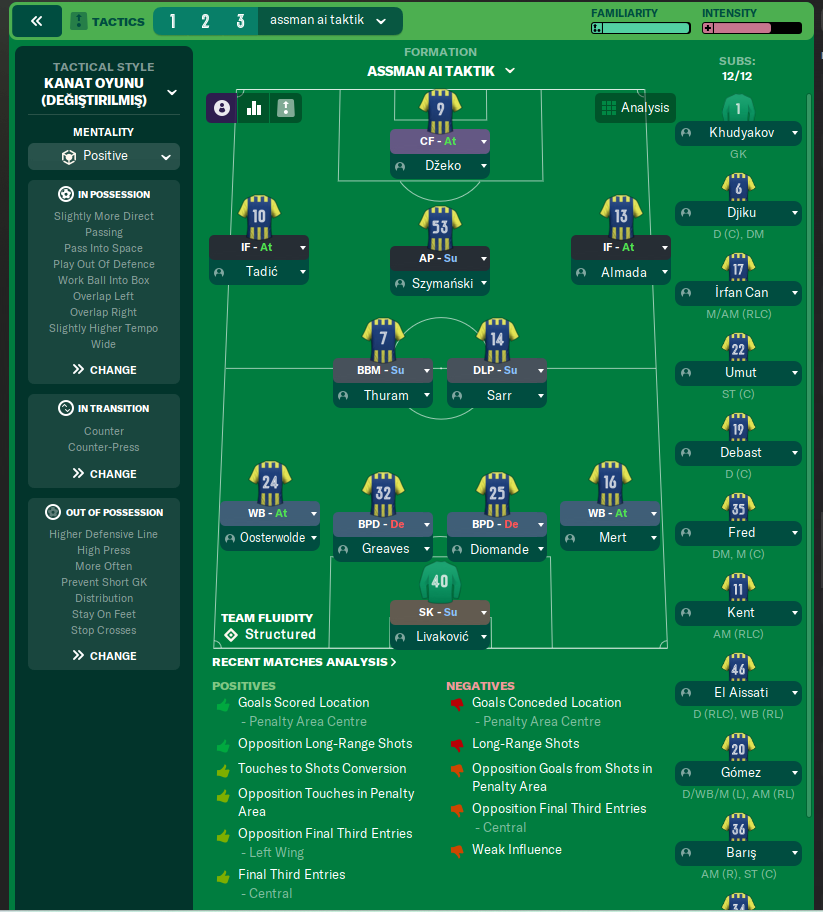
Utilize the pace of wide players and the creativity of the attacking midfield. The three center-backs minimize space and dominate aerial duels.
Loading tactical analysis...
3-2-2-3
Work Ball Into Box
High Tempo
Counter
Counter Press
Higher Defensive Line
Higher Line of Engagement
Press More Often
GK
GK
CB
CB
De
CB
WCB
De
CB
BCB
De
DM
DM
De
DM
DM
De
AM
AP
Su
W
W
At
W
W
At
CF
CF
De
CF
CHF
At
Focus on getting the ball into the final third quickly, using width to create opportunities.
Quickly revert to a compact shape to prevent counter-attacks.
Utilize the pace of wide players and the creativity of the attacking midfield.
Compact
Three central defenders forming a strong base, supported by two defensive midfielders.
DMs at [3,2] and [3,3] provide additional cover.
Fluid
Wide players looking to exploit space, with central players making runs into the box.
Wide Players (W) at [6,1] and [6,5] stretching the field.
The three center-backs minimize space and dominate aerial duels.
CBs at [2,3], [2,4], and [2,5].
Wide players threaten the flanks and create crossing opportunities.
W at [6,1] and [6,5] provide width and support.
The setup may struggle against compact defenses due to a lack of central variation.
AP at [4,3] may not be enough to break down deep blocks.
Relying heavily on wide play can be predictable, leading to counter opportunities.
Heavy use of W roles can be exposed if teams mark them tightly.
Wide Areas
Vulnerable to overlaps if full-backs are caught high up the pitch.
FBs at [2,1] and [2,5] could be isolated.
Counter-Attacks
Counter-attacks can expose the back three, especially with a high defensive line.
Defensive line at higher engagement could be exploited.
DM + W
DMs can cover and support wide players during transitions.
DMs at [3,2] and [3,3] transition effectively to link W at [6,1] and [6,5].
W + CF
Wide players can pull defenders, allowing CFs more space to operate.
W at [6,1] and [6,5] draw defenders away, creating lanes for CF at [6,3].
How can we further enhance central attacking threats?
Should we adjust our mentality during tougher matches?
How can we better utilize our full-backs in the attacking phases?
The tactical theory behind the 3-2-2-3: roles, instructions, and the trade-offs that decide whether the system holds up.
Why circulation density and zonal occupation aren't the same thing in FM, and the half-space occupation rule that decides build-up.
FM27 keeps FM26's tactic system. Here is what stays the same, the small changes that can catch you out, and what the new Tactical Effectiveness system asks of you.
How Mentality, Duty, and Role interact in FM, why duty trumps mentality every time, and the role-on-top-of-duty composition rules.