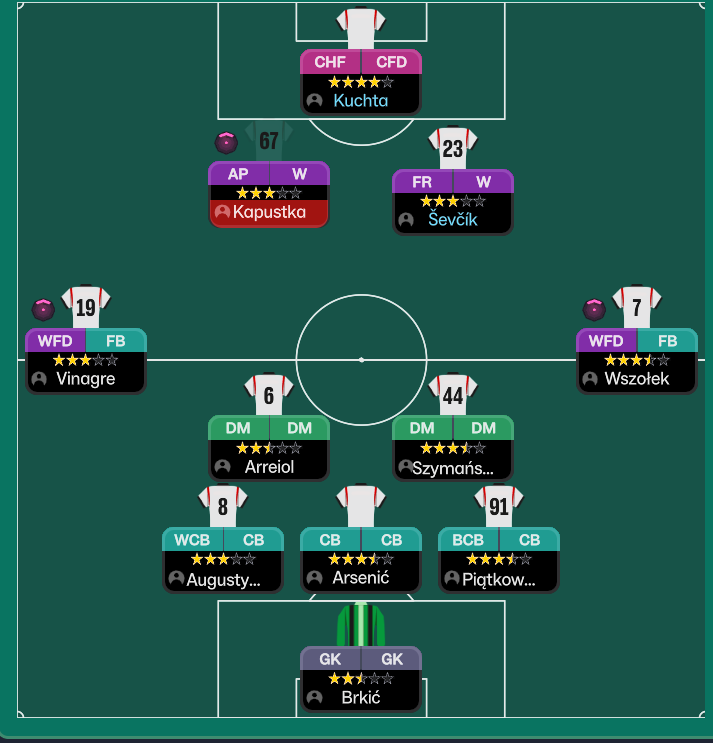
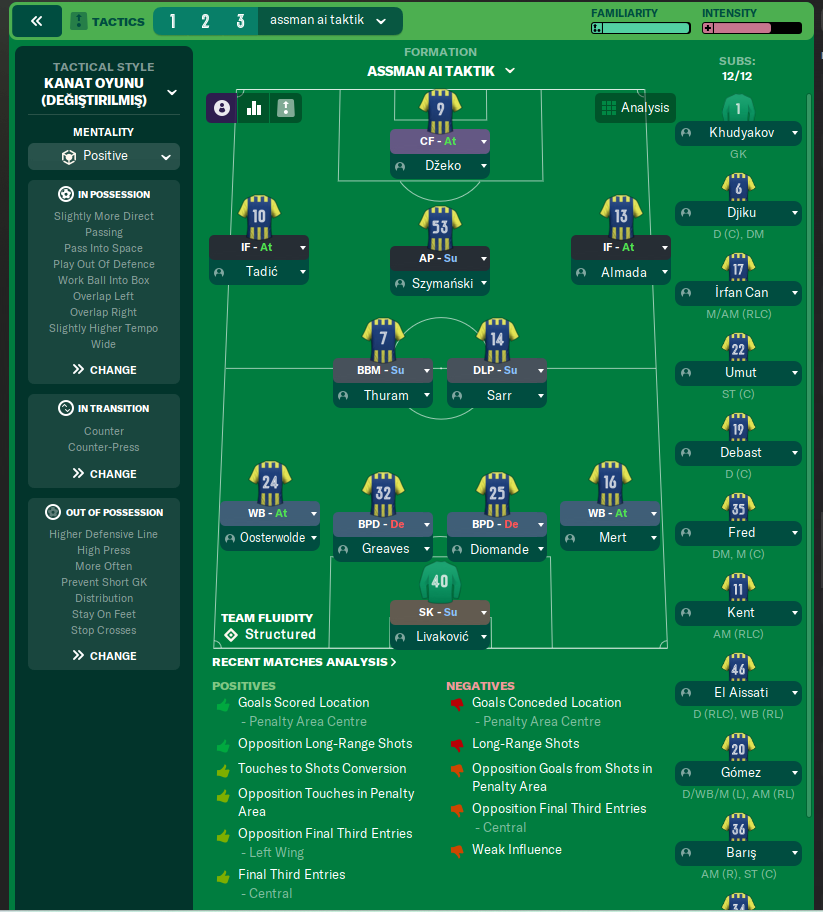
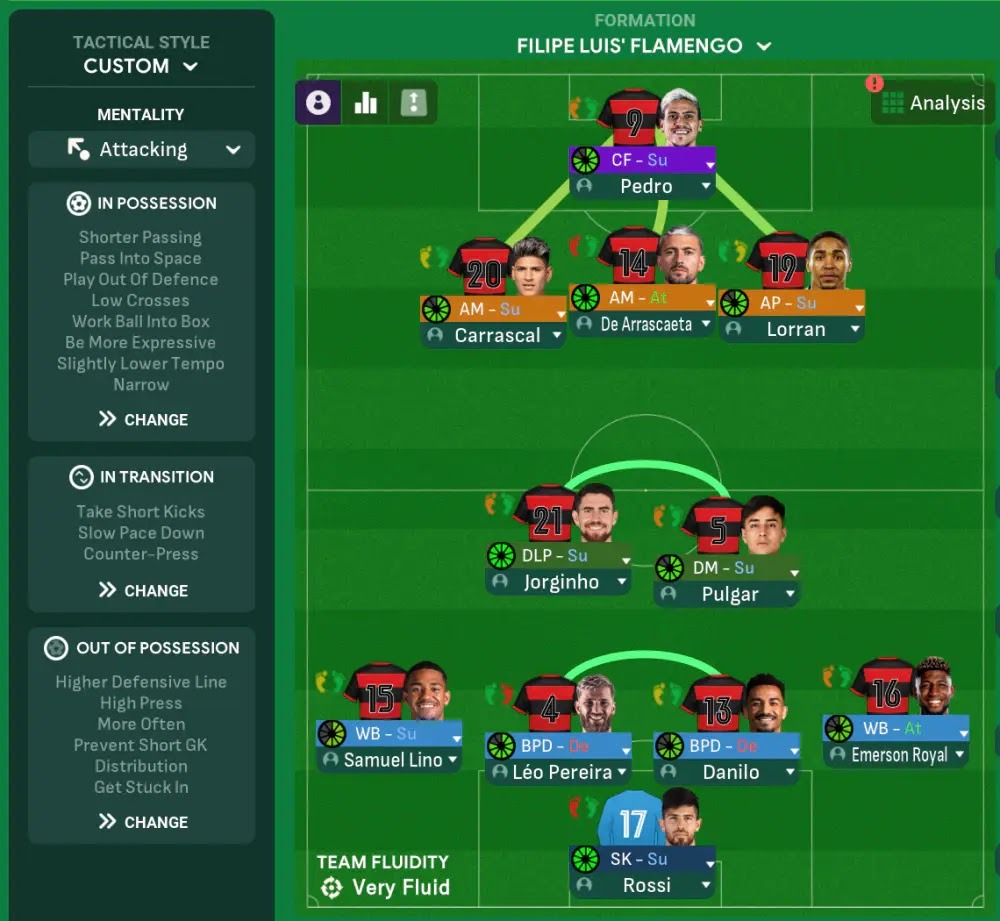
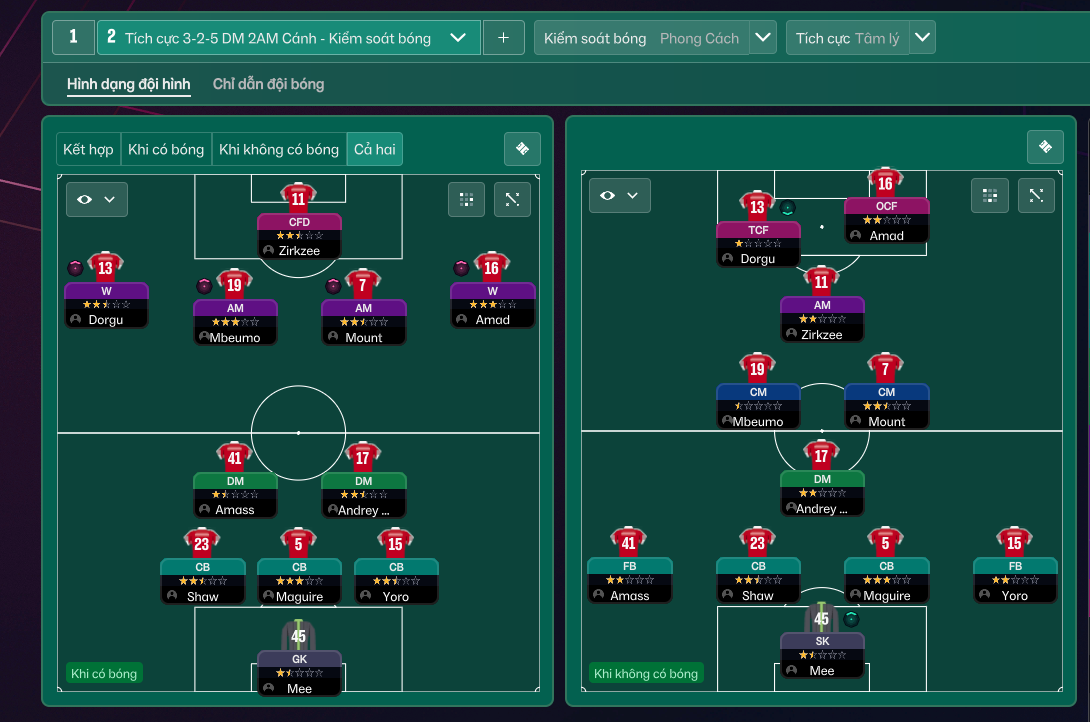
3-2-2-3
Maximizing possession while exploiting the width offered by wing-backs. Wing-backs provide width, stretching the opposition and creating space in central…
Loading tactical analysis...
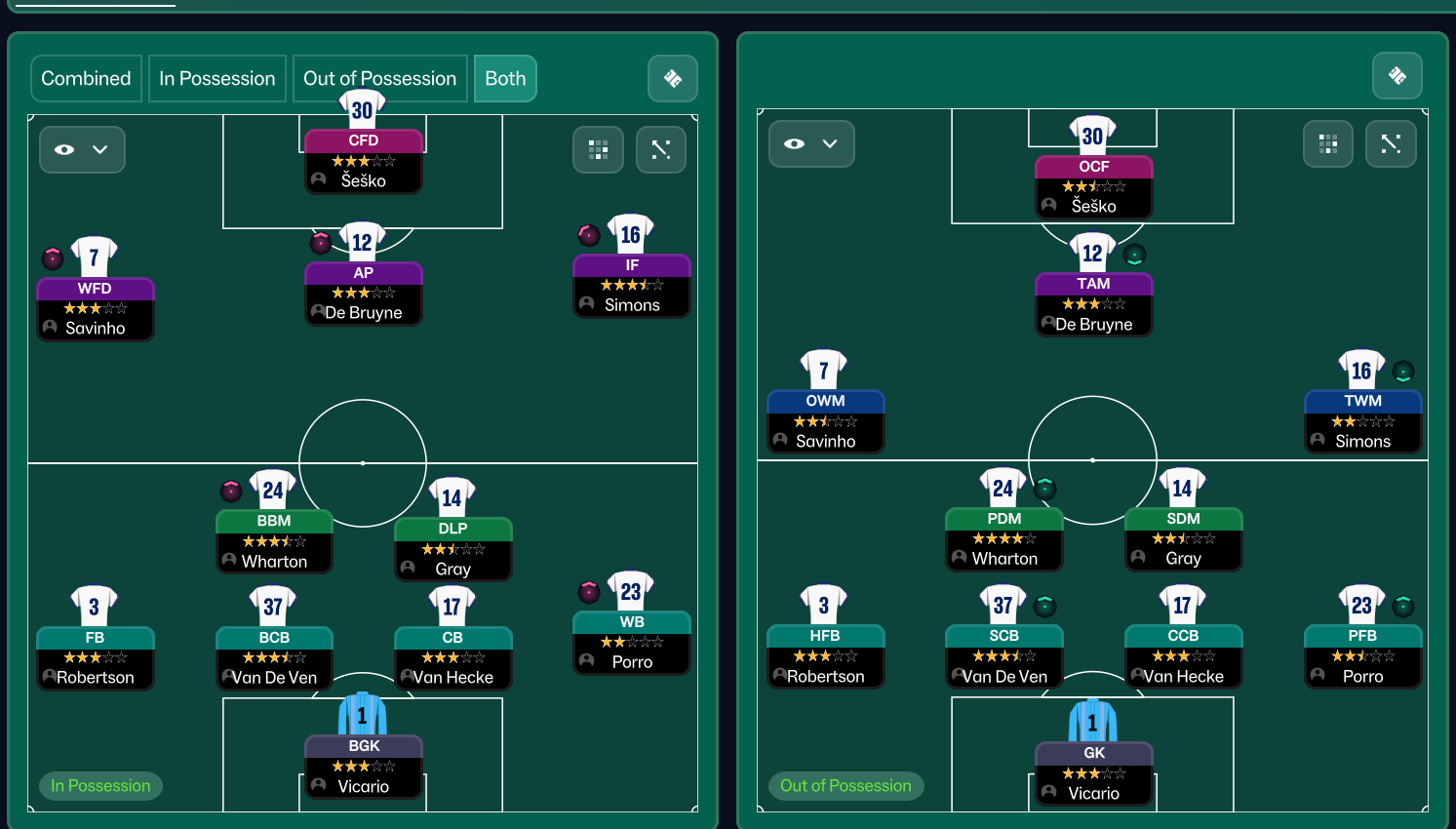
Control Possession
Attacking
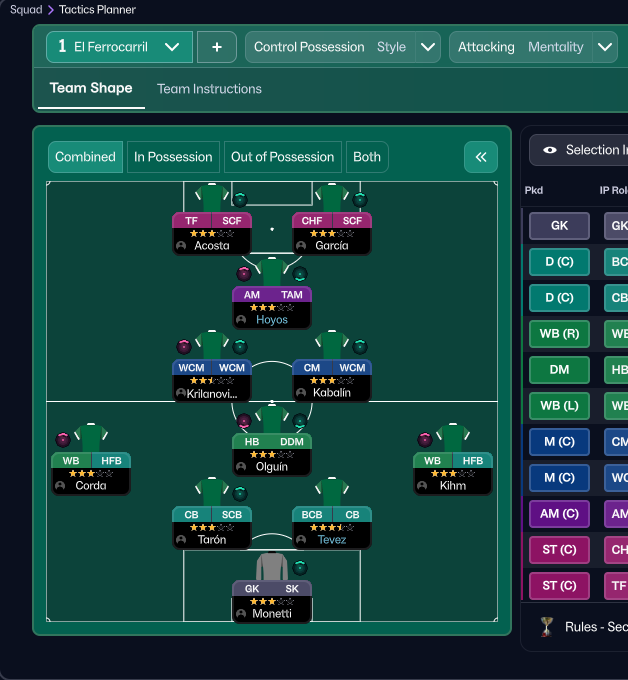
3-2-2-3
Play Out of Defence
Work Ball Into Box
Look for Overlap
Counter-Press
Counter
Higher Defensive Line
Higher Line of Engagement
Prevent Short GK Distribution
GK
Sweeper Keeper
Support
CB
Centre-Back
Defend
CB
Ball-Playing Defender
Defend
CB
Centre-Back
Defend
WB
Wing-Back
Attack
WB
Wing-Back
Support
DM
Half Back
Support
CM
Box-to-Box Midfielder
Support
AM
Attacking Midfielder
Attack
WCM
Wide Central Midfielder
Support
WCM
Wide Central Midfielder
Support
TF
Trequartista
Attack
SCF
Shadow Striker
Attack
CHF
Complete Forward
Attack
The team focuses on maintaining possession and looks to create openings through patient build-up play, utilizing the wing-backs and advanced midfielders.
Quickly regrouping after losing the ball, emphasizing immediate pressure on the opponent's players.
Maximizing possession while exploiting the width offered by wing-backs.
Compact Defence
The three centre-backs provide a solid base, with wing-backs tucking in to support in defensive situations.
Three centre-backs [2,2], [2,3], [2,4] ensure a strong defensive core.
Fluid Offense
The forward line is flexible, with the Trequartista and Shadow Striker interchanging to create opportunities.
Trequartista [6,3] and Shadow Striker [6,2] maintain fluid movement in attacking plays.
Wing-backs provide width, stretching the opposition and creating space in central areas.
Wing-Backs [2,1] and [2,5] allow for attacking overlap.
The trio of forwards combines pace and creativity, making it difficult for defenses to predict movements.
Attacking roles [6,2], [6,3], and [5,3] allow varied approaches and creativity.
While pushing for significant offensive actions, the team might expose itself to counterattacks.
Attacking mentality with high pressing captured by 'Higher Line of Engagement.'
With multiple players in midfield, there's potential for congestion which may hinder quick transition play.
Wide CMs might lead to overlap issues disrupting flow.
Defensive Vulnerability
High line can be exploited by pacey attackers.
Higher Defensive Line exposes defense.
Counterattack Risks
Opponents may exploit spaces left by advancing wing-backs.
Wing-backs' advanced positions create gaps.
Trequartista [6,3] and Shadow Striker [6,2]
These roles complement each other with fluid movement and positional interchange.
Interchanging duties enhance attacking unpredictability.
Wing-Backs [2,1] and [2,5]
Provides width, allowing central players to exploit space.
Effective in binding midfield and offensive regions.
How can I improve defensive stability while maintaining an attacking mindset?
Are there specific player traits that would enhance the current tactical setup?
What adjustments can be made to better exploit opponent weaknesses?
The tactical theory behind the 3-2-2-3: roles, instructions, and the trade-offs that decide whether the system holds up.
Why circulation density and zonal occupation aren't the same thing in FM, and the half-space occupation rule that decides build-up.
Pass map, average position, xG, possession by zone: what each tablet panel tells you in FM and the tactical change it should trigger.
FM27 keeps FM26's tactic system. Here is what stays the same, the small changes that can catch you out, and what the new Tactical Effectiveness system asks of you.