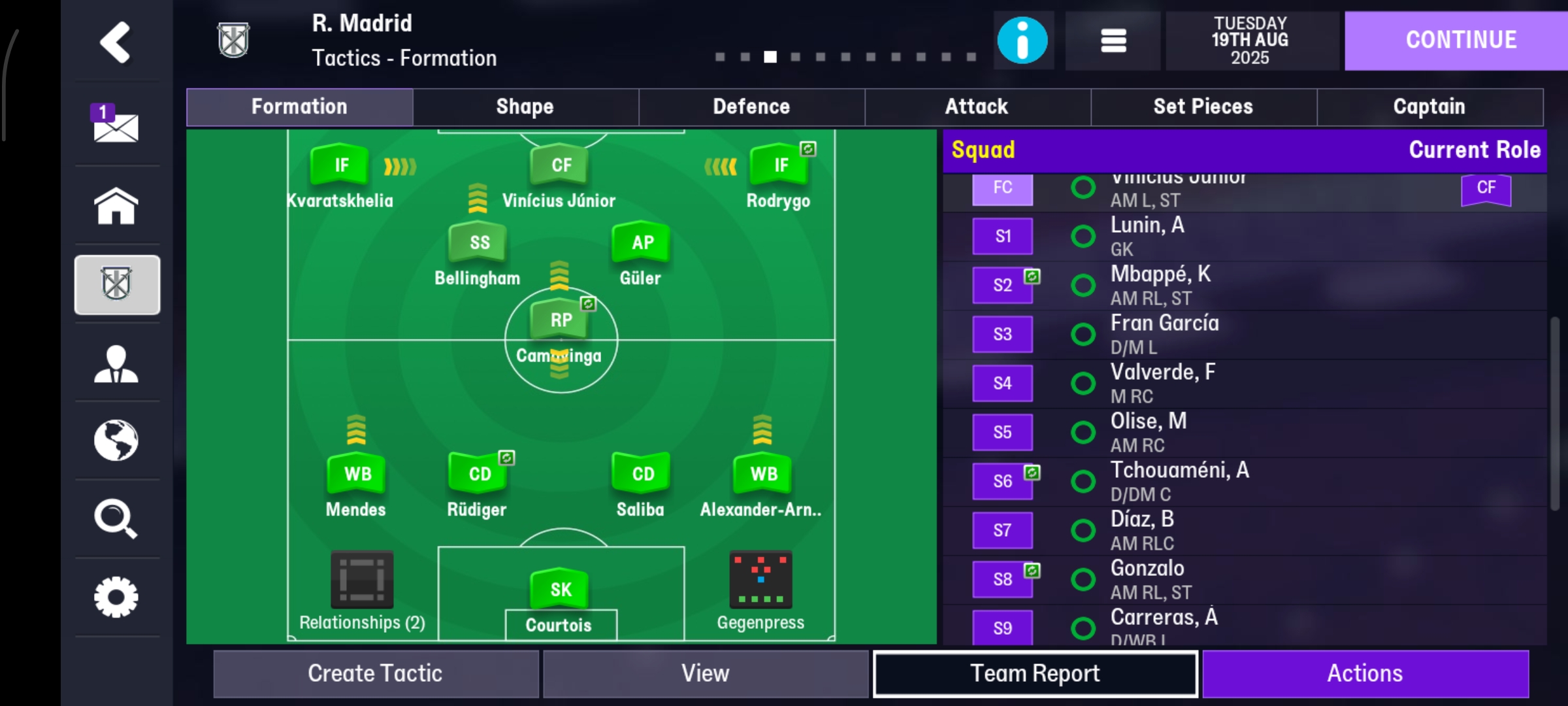
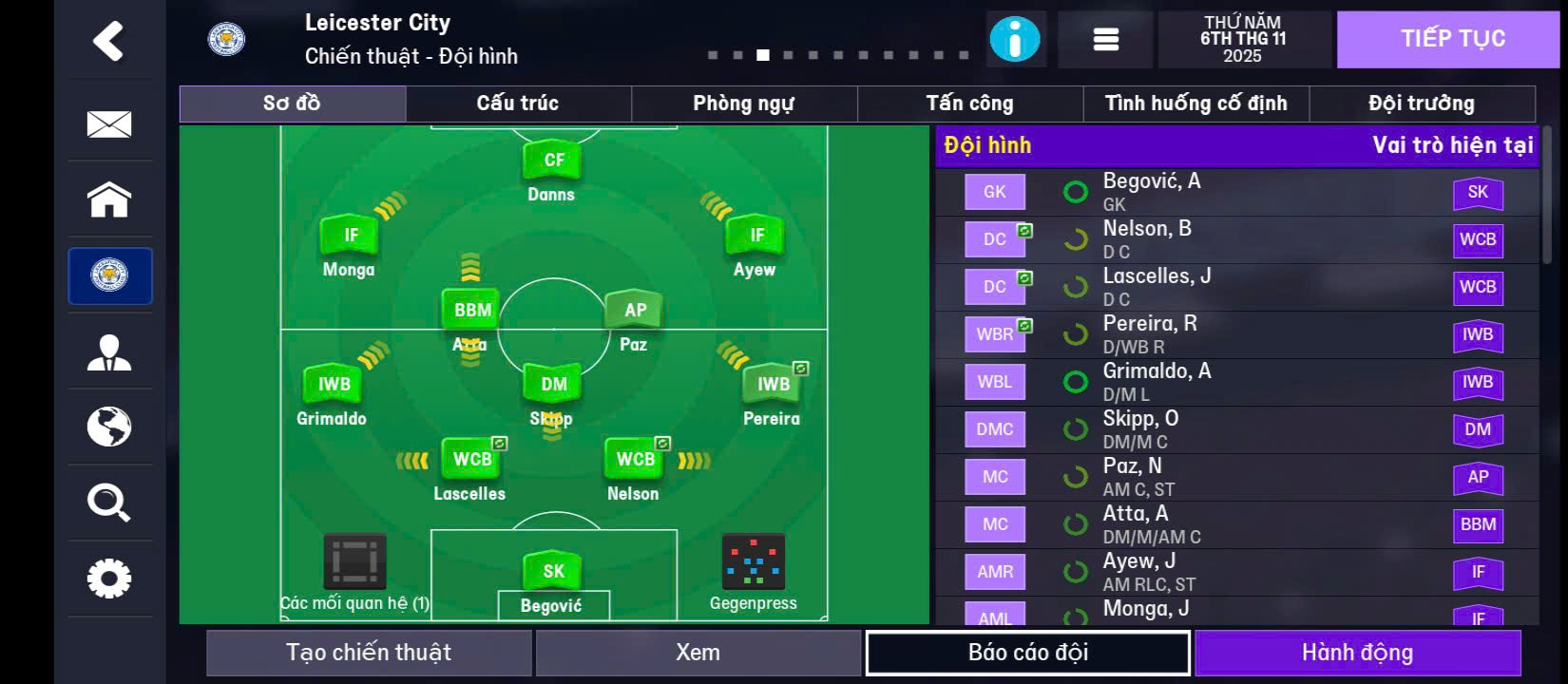
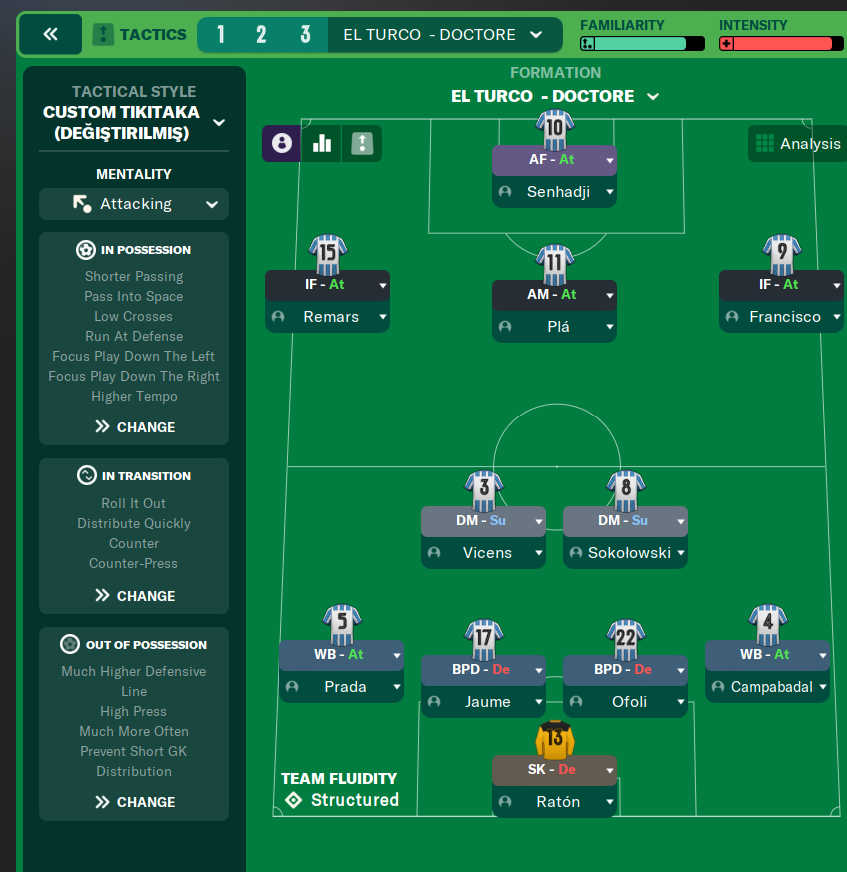
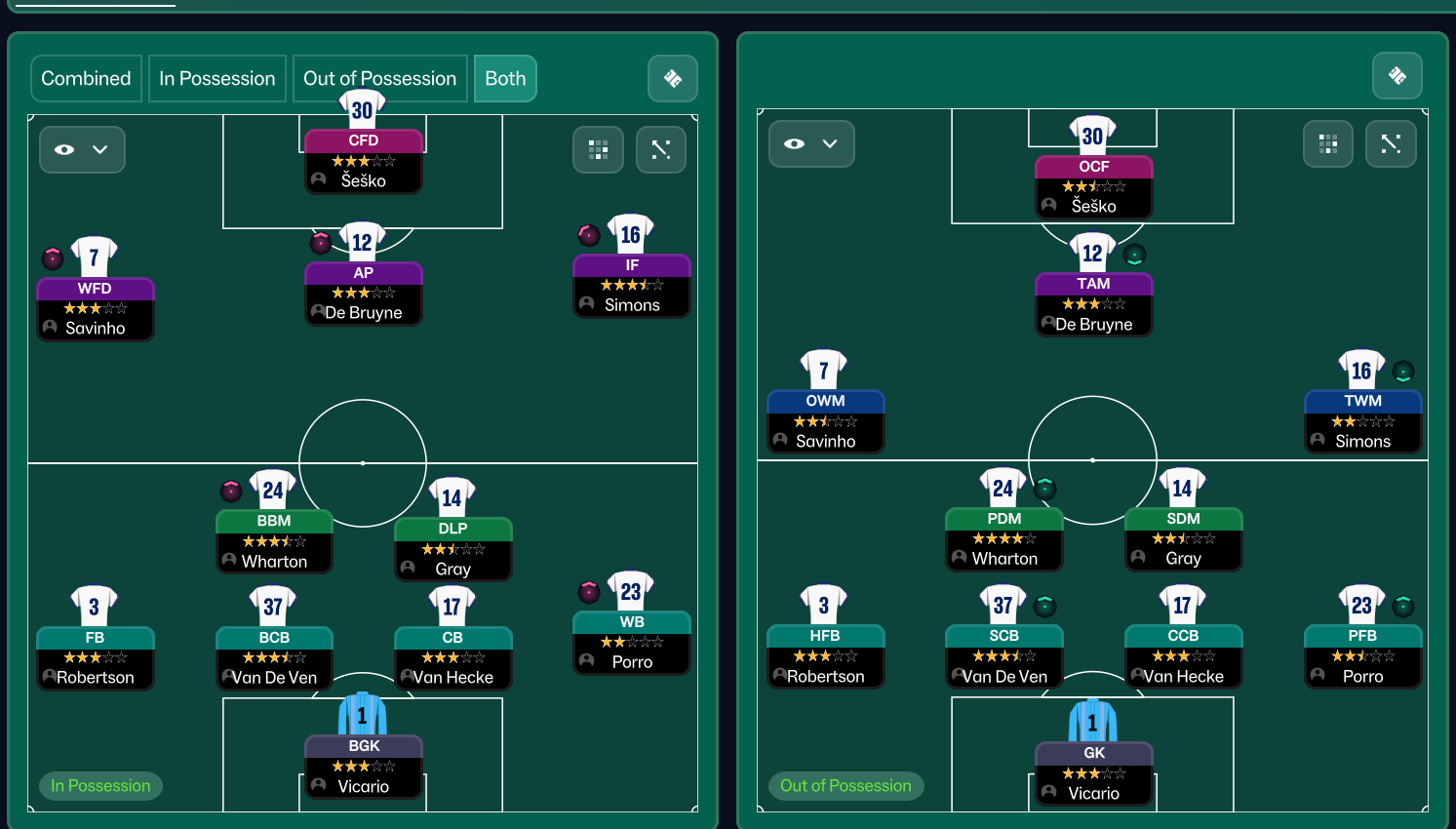
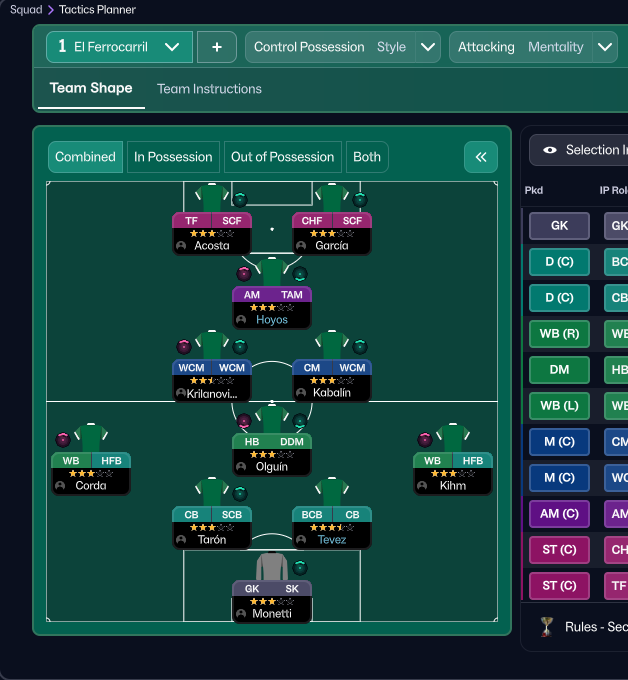
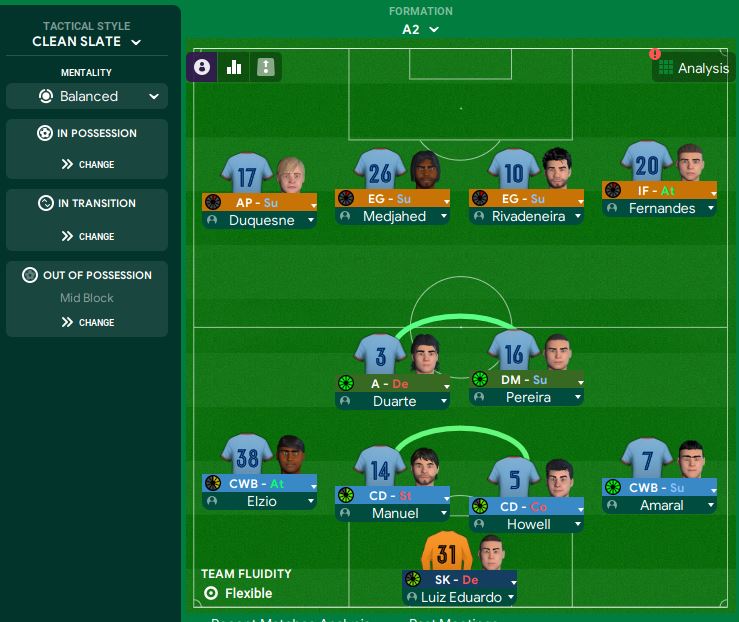
3-2-2-3
Exploiting flanks and quick transitions to catch opponents off-guard. CWB-A provides attacking width, opening lanes for central players.
Loading tactical analysis...
Clean Slate
Balanced
3-2-2-3
Flexible
Play out of defence
Work ball into the box
Focus play down the left
Counter-attack
Distribute to centre-backs
Mid Block
Prevent Short GK Distribution
GK
Sweeper Keeper
Defend
DC
Central Defender
Defend
DC
Central Defender
Defend
CWB
Complete Wing-Back
Attack
CWB
Complete Wing-Back
Support
DM
Defensive Midfielder
Defend
CM
Advanced Playmaker
Support
CM
Enganche
Support
IF
Inside Forward
Attack
AP
Advanced Playmaker
Support
Emphasis on maintaining possession and creating chances through intricate passing and movement.
Quickly regroup into a structured defence to absorb pressure during counter-attacks.
Exploiting flanks and quick transitions to catch opponents off-guard.
Mid Block
Looks to win the ball back in the midfield area, maintaining a compact structure.
DM-D at [3,3] and two DCs providing central solidity.
Fluid Attack
Utilizes width from the wing-backs while central players overload in the final third.
CWB-A at [2,1] and CWB-S at [2,5] facilitating width.
CWB-A provides attacking width, opening lanes for central players.
CWB-A at [2,1] pushes forward to support the attack.
AP-S and EG-S can link up effectively with the strikers.
AP-S at [4,1] and EG-S at [4,2] working together in tight areas.
With heavy reliance on CM roles, there may be vulnerabilities if overrun.
Advanced roles in midfield can lead to lack of defensive support.
High push from CWB can leave gaps in the defence when possession is lost.
CWB-A at [2,1] providing less cover on the counters.
Defensive Midfield
If oppositions break through midfield, defence may be left exposed.
DM-D at [3,3] may lack sufficient cover if caught high.
Wing Defensive Areas
CWB-A may leave gaps if caught out of position.
CWB roles focus on attack, increasing risk of counter-attacks.
CWB and AP
CWB can provide width while AP acts as a playmaker.
CWB-A at [2,1] can combine with AP-S at [4,1] effectively.
DM and DCs
DM-D strengthens the central defence alongside two DCs.
DM-D at [3,3] working cohesively with defensive roles.
How can the midfield be adjusted to maintain better possession?
What strategies can be implemented to combat quick counter-attacks?
Is there a necessity for a more defensive-oriented player in midfield?
The tactical theory behind the 3-2-2-3: roles, instructions, and the trade-offs that decide whether the system holds up.
Why circulation density and zonal occupation aren't the same thing in FM, and the half-space occupation rule that decides build-up.
The pairing rule for Defensive Line and Line of Engagement, all 9 combinations, and the gap that costs goals.
What Higher Tempo, Wider, and Narrower actually do in FM, plus the dial contradictions and antipatterns players run into most often.