
4-2-3-1 Wide
Building from the back and utilizing the width to create opportunities. The combination of BWM-S and AP-S roles allows for both defensive contributions…
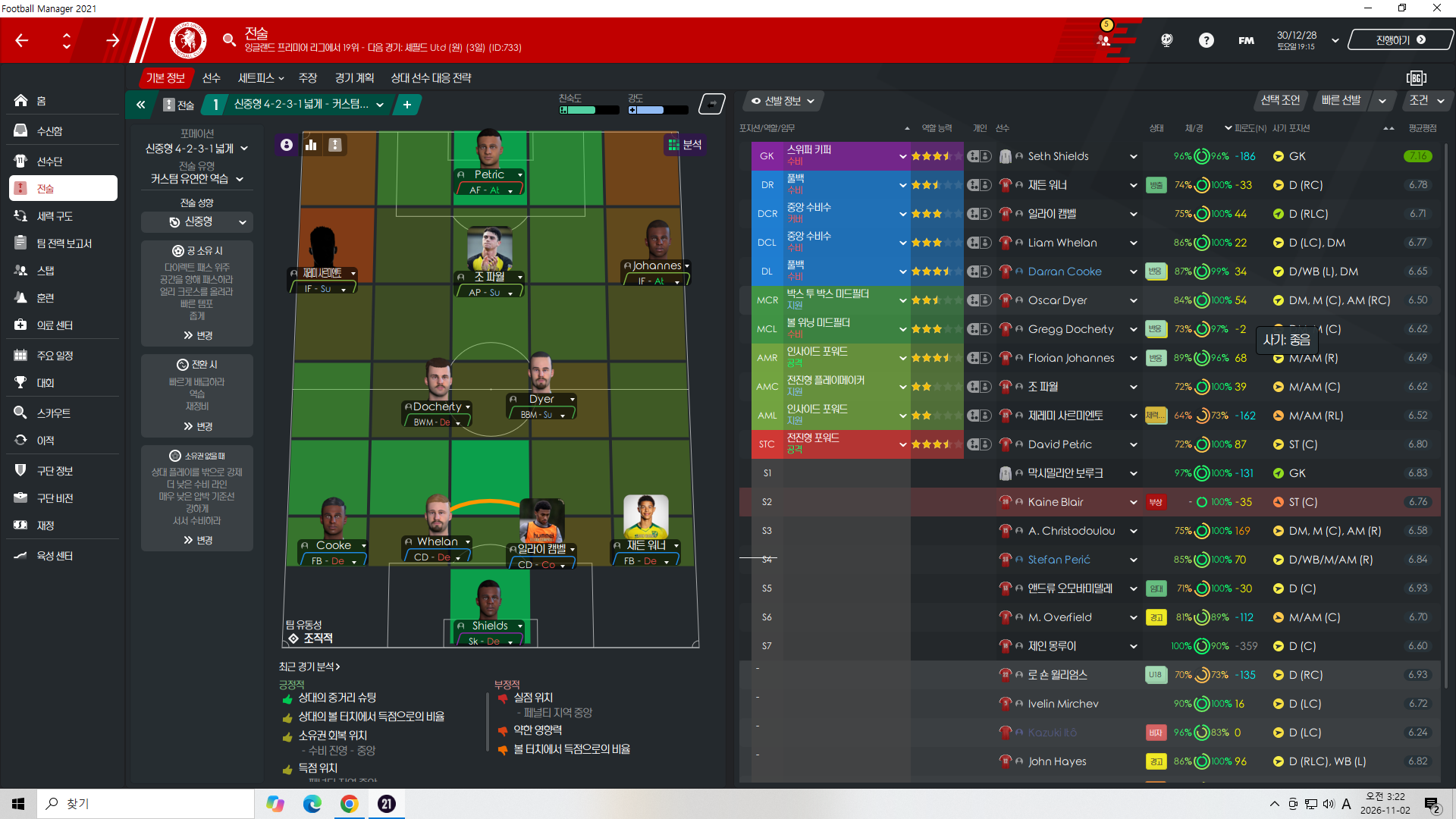
Loading tactical analysis...
4-2-3-1 Wide
Play Out of Defence
Work Ball into Box
Be More Expressive
Counter
Counter-Press
Higher Defensive Line
Much Higher Line of Engagement
Prevent Short GK Distribution
GK
Sweeper Keeper
Support
DR
Full-Back
Defend
DCR
Centre-Back
Defend
DC
Centre-Back
Defend
DL
Full-Back
Defend
DMC
Ball-Winning Midfielder
Support
MCR
Advanced Playmaker
Support
MCL
Box-to-Box Midfielder
Support
AMC
Advanced Playmaker
Support
AMR
Inside Forward
Attack
AML
Inside Forward
Attack
ST
Advanced Forward
Attack
Focus on working the ball into the box with support from inside forwards and midfielders through combinations.
Quick to counter-press to regain possession, maintaining a higher aggressive approach.
Building from the back and utilizing the width to create opportunities.
Flat 4-2
A solid defensive structure with two holding midfielders providing cover for the back four.
DMC as BWM-S at [3,2] supports the defensive organization.
Wide and fluid 4-2-3-1
Wingers cut in to create goal-scoring opportunities while the striker occupies central spaces.
AMR as IF-A at [5,4] and AML as IF-A at [5,2] provide depth during attacking phases.
The combination of BWM-S and AP-S roles allows for both defensive contributions and creativity.
BWM-S at [3,2] and AP-S at [4,3] provide a balanced approach.
Inside forwards stretch the opposing defense, creating space for central players.
IF-A at [6,2] and IF-A at [6,4] help open up the field.
Higher line may expose defenders to fast counter-attacks.
Higher Defensive Line exposes CBs at [2,3] and [2,4] if caught out.
Too many support roles in midfield may reduce attacking threat.
Three midfielders (BWM-S, AP-S, and BBM-S) all in support duties reduce direct attacks.
Central Defence
Vulnerable to quick transitions if full-backs push forward.
CBs at [2,3] and [2,4] may be isolated.
Midfield Overload
Support roles may lead to congestion in midfield.
Multiple supportive midfielders reduce direct penetration.
BWM-S and AP-S
BWM provides cover while AP can exploit spaces created by transitions.
BWM-S at [3,2] and AP-S at [4,3] working together builds play effectively.
IF-A and AF-A
Inside forwards draw defenders away, creating space for the central striker.
IFs at [5,4] and [5,2] opening gaps for AF at [6,3].
How can I improve midfield attacking options?
What adjustments are needed for better defensive stability?
Are the player roles aligned with my tactical vision?
The tactical theory behind the 4-2-3-1 Wide: roles, instructions, and the trade-offs that decide whether the system holds up.
Double pivots and flat pairs in 4-2-3-1 and 4-4-2: when each pairing works, when it collapses, and the AMC unicorn that rescues both.
Klopp-style gegenpressing in FM, including squad profile, line-and-press pairing, sustainable workload, and the antipatterns to avoid.
FM27 keeps FM26's tactic system. Here is what stays the same, the small changes that can catch you out, and what the new Tactical Effectiveness system asks of you.







