
4-2-3-1 Wide
Create space for forwards while solidifying the midfield. The combination of a Deep-Lying Playmaker and a Box-to-Box Midfielder offers support both…
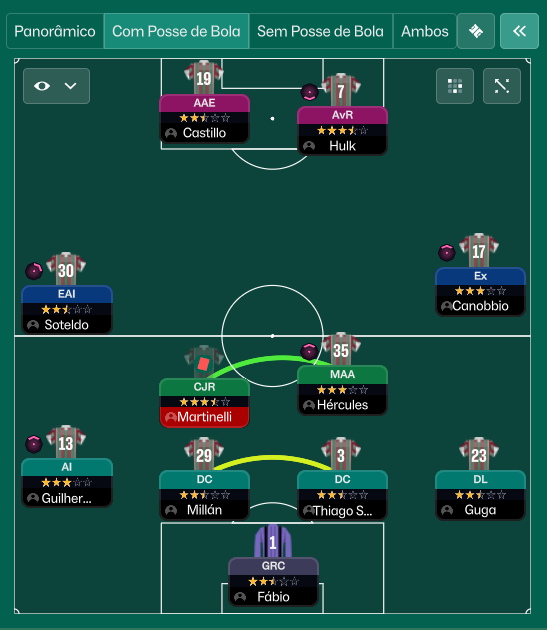
Loading tactical analysis...
4-2-3-1 Wide
Play Out of Defence
Pass into Space
Be More Expressive
Counter
Counter-Press
Higher Defensive Line
Much Higher Line of Engagement
Prevent Short GK Distribution
GK
Goalkeeper
Defend
DL
Full-Back
Support
DC
Ball-Playing Defender
Defend
DC
Ball-Playing Defender
Defend
DR
Full-Back
Support
DM
Deep-Lying Playmaker
Support
CM
Central Midfielder
Support
CM
Box-to-Box Midfielder
Support
AML
Inside Forward
Attack
AM
Advanced Playmaker
Support
AMR
Inside Forward
Attack
ST
Complete Forward
Attack
The team focuses on quick transitions with a balance of possession and entering the final third through inside forwards.
Pressing aggressively upon losing possession to quickly regain control.
Create space for forwards while solidifying the midfield.
Compact
Defensive shape remains compact to limit space for the opposition.
Incorporation of a higher defensive line and proactive engagement.
Fluid
Dynamic shape with inside forwards tucking in, allowing full-backs to overlap.
Positioning of Inside Forwards on the flanks combined with overlapping full-backs.
The combination of a Deep-Lying Playmaker and a Box-to-Box Midfielder offers support both defensively and offensively.
DLP-S at [3,3] and BBM-S at [4,3] working in tandem.
Inside Forwards cutting in create goal-scoring opportunities and space for overlapping full-backs.
IF-A at [6,1] and IF-A at [6,3] providing width.
If the inside forwards are marked tightly, the team may struggle to progress the ball.
IF-A and AM in opposing roles lack alternative width.
High line can be exposed by quick counter-attacks if the midfielders do not track back.
Higher Defensive Line noted in settings.
Defensive Line
Higher line increases space behind for opposing attackers.
Higher Defensive Line noted in tactical setup.
Midfield Transition
Potential lack of cover if midfielders fail to track back during counter-attacks.
DM-S duties.
BPD-D and DLP-S
The synergy between these roles facilitates effective ball progression.
BPD-D at [2,2] and DLP-S at [3,3] demonstrate this.
IF-A and Full-Backs
Inside Forwards and overlapping Full-Backs create multiple attacking angles.
The positioning of IFs and FBs at [6,1] and [2,1] respectively.
How effective has the team been at transitioning from defense to attack?
Are there specific match scenarios where this tactic excels or struggles?
How do the players adapt to the high line in various match situations?
The tactical theory behind the 4-2-3-1 Wide: roles, instructions, and the trade-offs that decide whether the system holds up.
Klopp-style gegenpressing in FM, including squad profile, line-and-press pairing, sustainable workload, and the antipatterns to avoid.
Double pivots and flat pairs in 4-2-3-1 and 4-4-2: when each pairing works, when it collapses, and the AMC unicorn that rescues both.
Routines, takers, and target picks. How to turn corners and free-kicks into a reliable third of your goal output.







