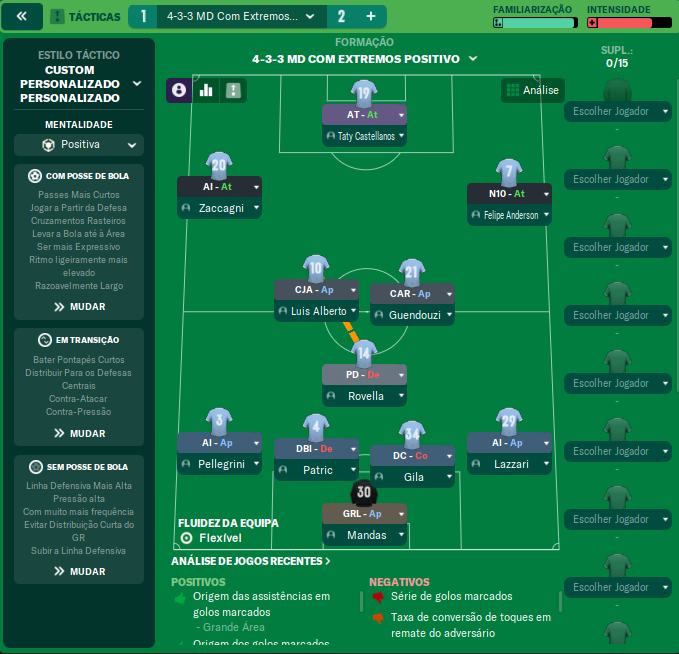
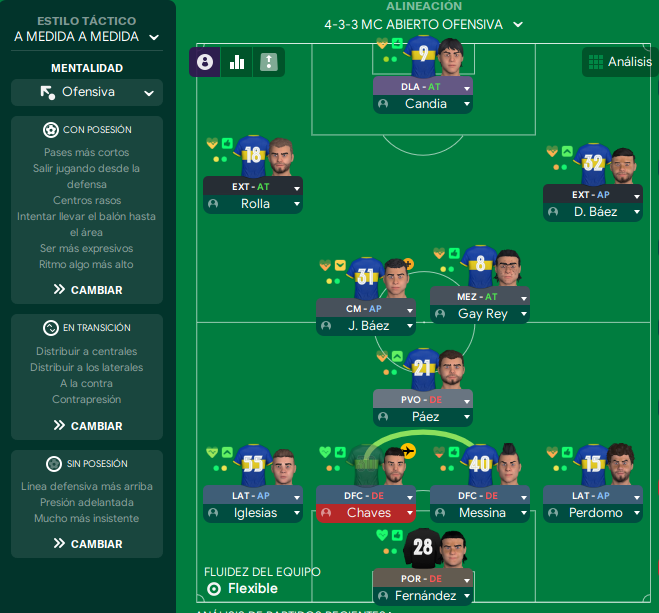
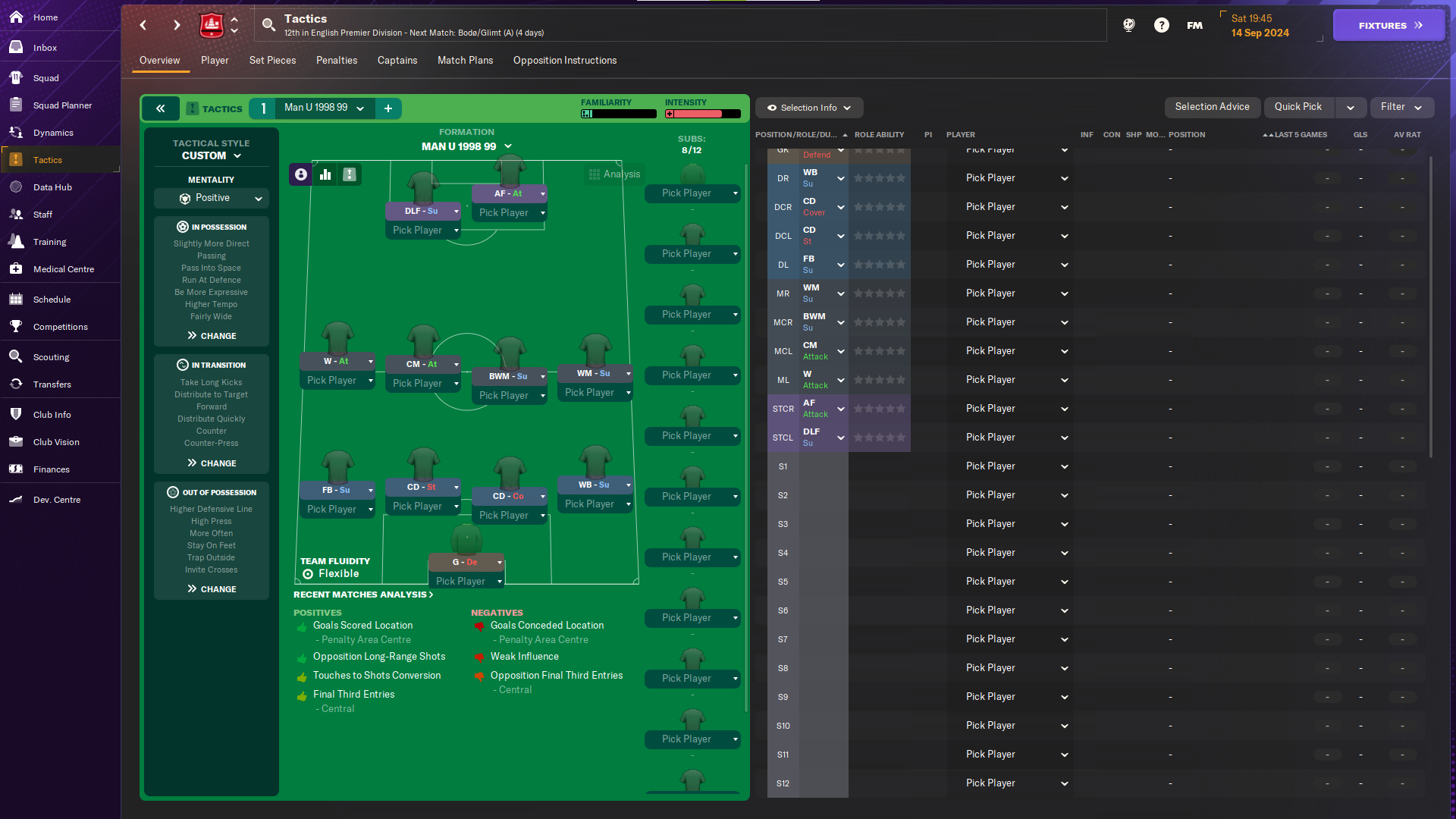
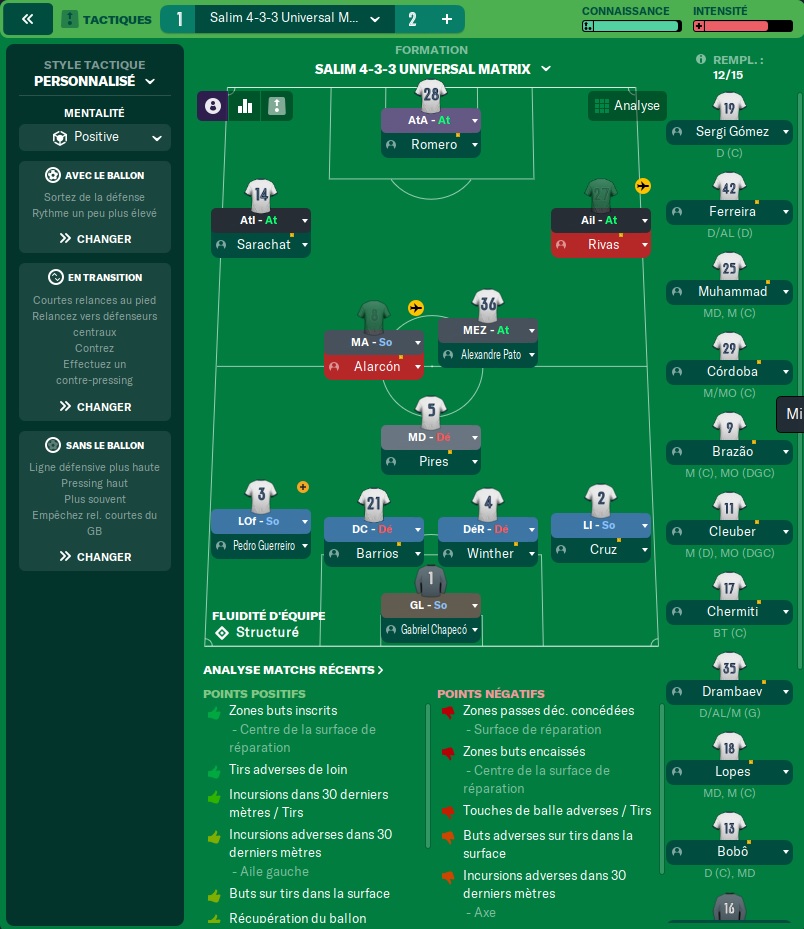
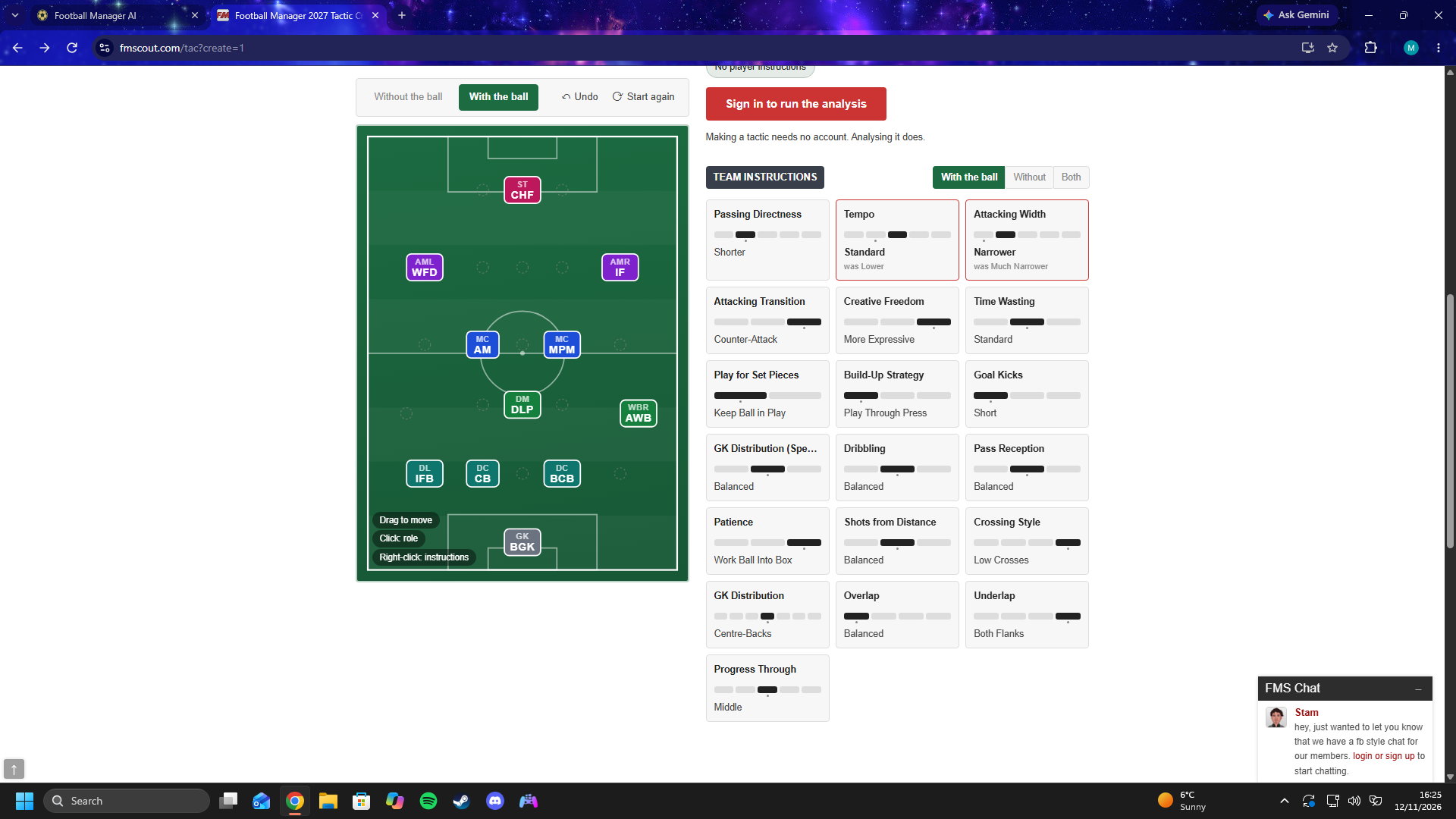
4-3-3
Utilizing width and maintaining possession in the opposition half. Three central players provide stability and versatility in transition.
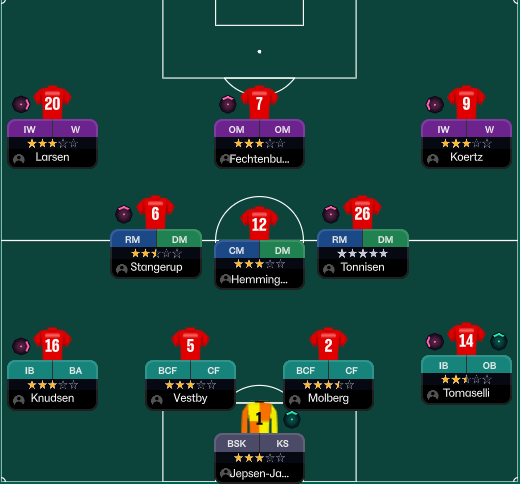
Loading tactical analysis...
4-3-3
Play Out of Defence
Focus Play Down the Right
Work Ball Into Box
Counter
Counter-Press
Higher Defensive Line
Much Higher Line of Engagement
Prevent Short GK Distribution
GK
Goalkeeper
Support
DEF
Ball-Playing Defender
Defend
DEF
Ball-Playing Defender
Defend
DEF
Inverted Wing-Back
Attack
DEF
Inverted Wing-Back
Attack
DM
Deep-Lying Playmaker
Support
CM
Central Midfielder
Support
RM
Wide Midfielder
Support
OM
Attacking Midfielder
Support
IW
Inside Forward
Attack
ST
Advanced Forward
Attack
Focus on building play through the midfield and utilizing width through inverted wing-backs.
Quickly fall back into a compact shape with emphasis on counter-pressing.
Utilizing width and maintaining possession in the opposition half.
High Press
The team maintains a higher line and engages the opponent aggressively.
Much Higher Line of Engagement with Prevent Short GK Distribution.
Wide Attack
Utilizes width to stretch the opposition, with inside forwards cutting in.
Use of Inside Wingers and Inverted Wing-Backs creating overloads on the flanks.
Three central players provide stability and versatility in transition.
DLP-S at [3,3] combined with CM-S at [3,2] and RM-S at [3,4].
Inverted wing-backs and inside forwards create multiple angles for attack.
IW-A at [6,1] and IWB-A at [5,1] provide width while attacking.
Heavy use of width might lead to lack of central penetration.
Wide Midfielder at [4,2] may become isolated if central support is insufficient.
High line may expose the back line to fast counter-attacks.
Higher Defensive Line paired with counter-oriented opponents may exploit this.
Defensive Vulnerability
High defensive line risks getting caught out by fast attackers.
Positioning of ball-playing defenders who could be dragged out of shape.
Midfield Congestion
Too many central players can lead to crowding and reduced threat.
Three CM roles may result in lack of clear passing lanes.
IWB-A with IW-A
Creates overlapping runs and unpredictability in attacks.
IWB-A at [5,1] provides width as IW-A at [6,1] cuts inside.
DLP-S and CM-S
Creates a strong base for transitioning from defense to attack.
DLP-S at [3,3] supports CM-S at [3,2] in possession phases.
How can we improve central attacking options?
What adjustments should be made to enhance defensive solidity?
Are the width strategies effective against teams employing narrow formations?
The tactical theory behind the 4-3-3: roles, instructions, and the trade-offs that decide whether the system holds up.
Master the classic 4-3-3: player roles, tactical variations, and the trade-offs that decide whether it sings or stalls.
Holder, runner, creator: the role distribution rule for three-man midfields, the AMC variants, and the antipatterns that break them.
FM27 keeps FM26's tactic system. Here is what stays the same, the small changes that can catch you out, and what the new Tactical Effectiveness system asks of you.