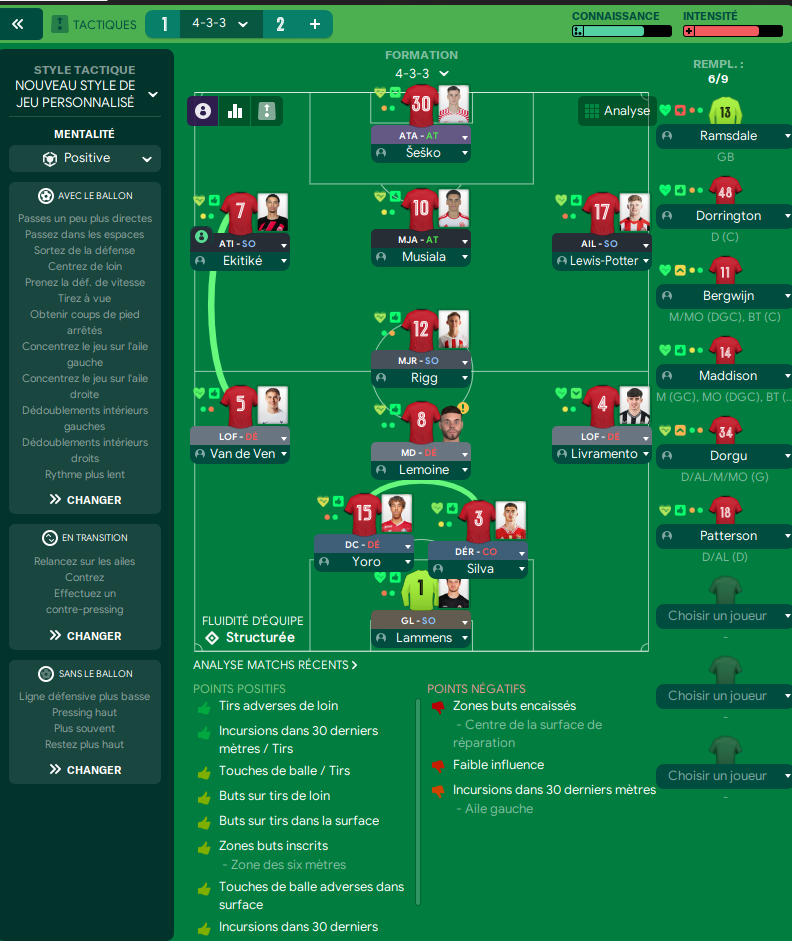
Uploaded Tactic
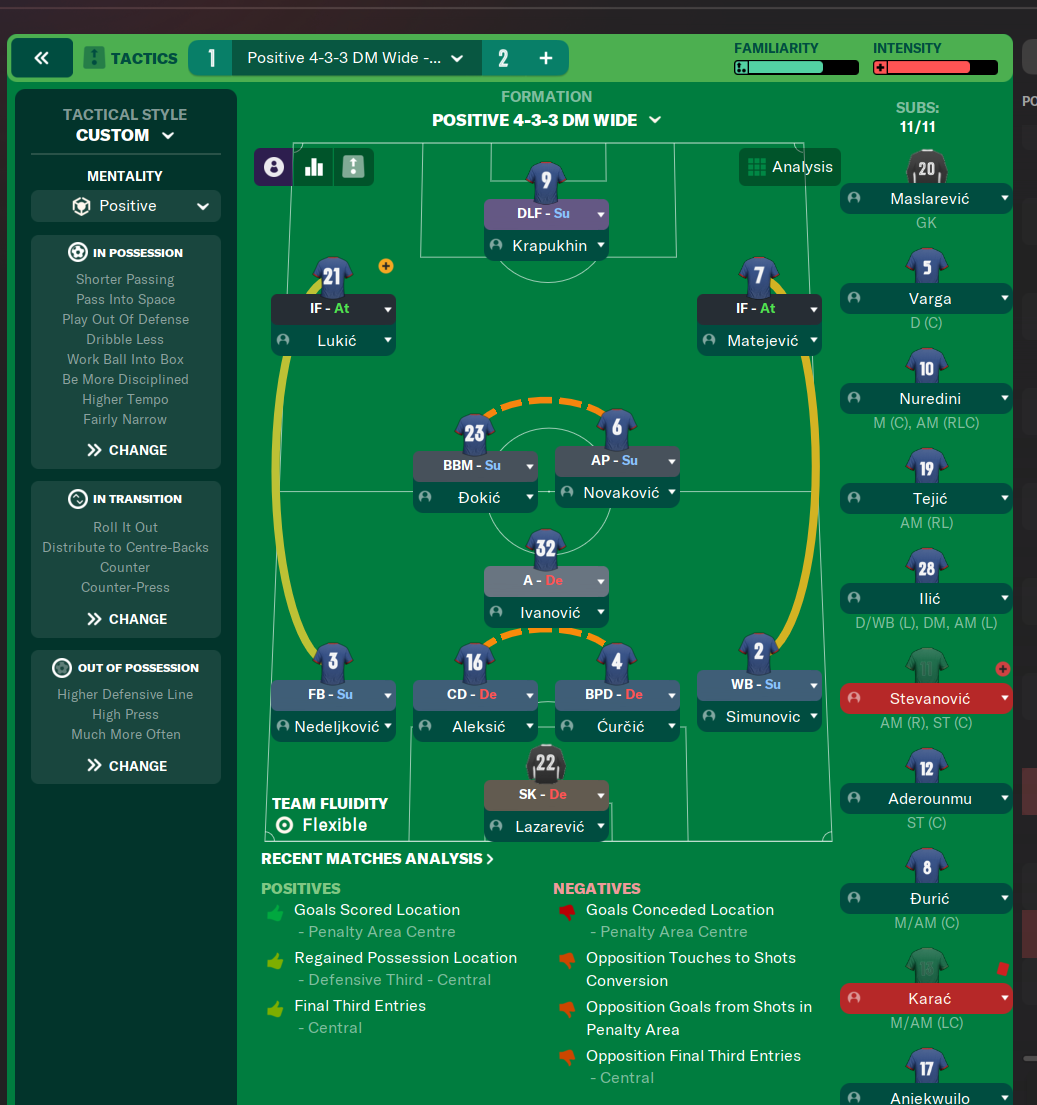
Formation & Style
Tactical Style:Positive
Mentality:Positive
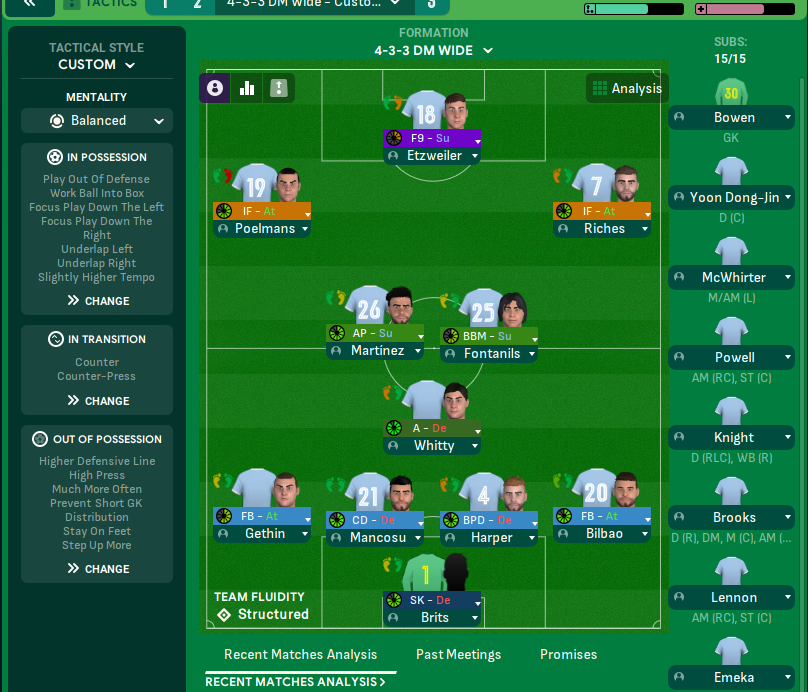
Formation:4-3-3 DM Wide
Team Fluidity:Flexible
In Possession
Shorter Passing
Pass Into Space
Play Out Of Defence
Dribble Less
Work Ball Into Box
Be More Disciplined
Higher Tempo
In Transition
Roll It Out
Distribute to Centre-Backs
Counter
Counter-Press
Out of Possession
Higher Defensive Line
High Press
Much More Often
Team Shape Without Ball
Shape:4-1-4-1
Description:Defensive block tightens with the anchor dropping in front of the backline, while full-backs support width.
Evidence:Anchor at [3,3] supports the back four, enhancing defensive stability.
Team Shape With Ball
Shape:4-3-3
Description:The attacking shape maintains width to stretch opposition while keeping central players for combinations.
Evidence:Inside Forwards at [6,2] and [6,4] provide attacking width with support from the midfield.
Phase Description
Attacking Play
The team focuses on shorter passing, utilizing width with inside forwards moving towards goal while the deep-lying forward supports buildup.
Defensive Transition
Upon losing possession, the team quickly transitions into a counter-pressing setup to regain control while also being prepared for counters.
Main Focus
Controlling midfield and utilizing width to create goal-scoring opportunities.
Key Strengths
Midfield Control
With a Box-to-Box Midfielder and an Advanced Playmaker, the team can effectively control play in the center.
Dynamic Attack
The inside forwards create vertical threats and spacing that can destabilize defenses.
Strong Defensive Base
As the team utilizes a BPD and an Anchor, they have a solid platform for defensive stability.
Conflicting Directions
Counter-Press vs. Counter
While pressing high to win the ball back quickly, the team may leave gaps for counters.
High Defensive Line Risk
Employing a higher defensive line exposes the team to fast attackers.
Flexibility vs. Structure
Flexible team fluidity may confuse player positioning during key phases of matches.
Tactical Suggestions
Adjust Defensive Line
Consider lowering the defensive line to mitigate space for faster opposition counter-attacks.
Refine Pressing Triggers
Adjust press intensity to maintain balance between pressing and maintaining shape.
Utilize Wider Build-Up
Encourage wider build-up play to maximize the strengths of inside forwards.
Ask Questions About Your Lineup
Related Tactics
More Positive tactics
Guides for this formation
The tactical theory behind the 4-3-3 DM Wide: roles, instructions, and the trade-offs that decide whether the system holds up.
Foundations
Understanding the 4-3-3 Formation
Master the classic 4-3-3: player roles, tactical variations, and the trade-offs that decide whether it sings or stalls.
Read guide
Player pairings
Midfield Trios
Holder, runner, creator: the role distribution rule for three-man midfields, the AMC variants, and the antipatterns that break them.
Read guide
Playing styles
Gegenpressing: A Full Guide
Klopp-style gegenpressing in FM, including squad profile, line-and-press pairing, sustainable workload, and the antipatterns to avoid.
Read guide