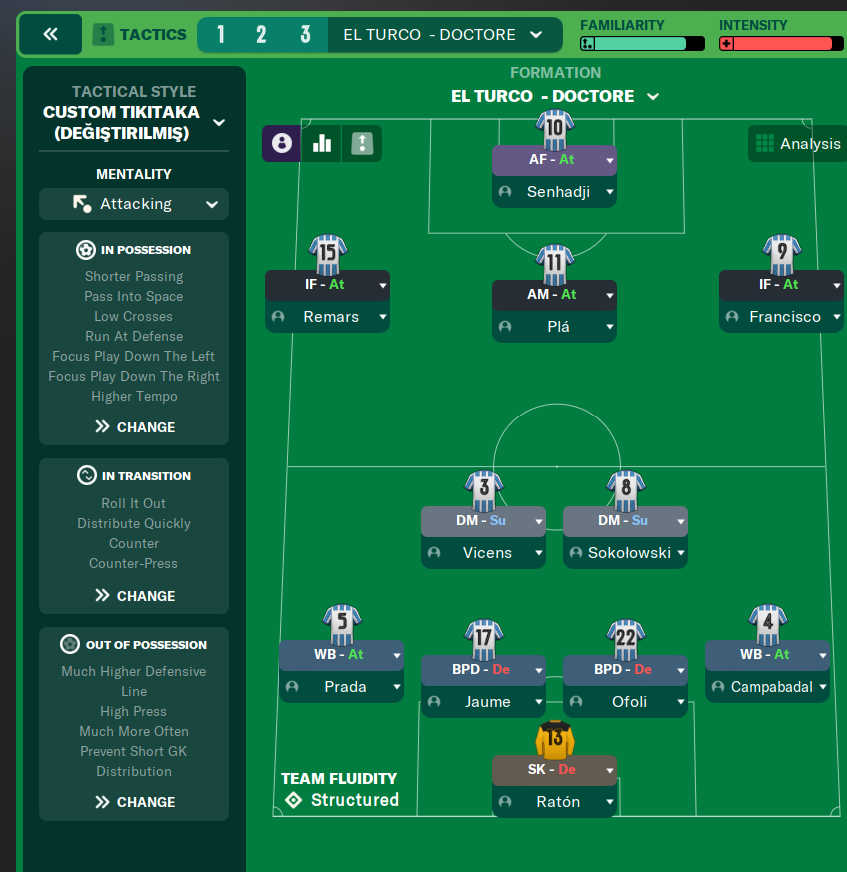
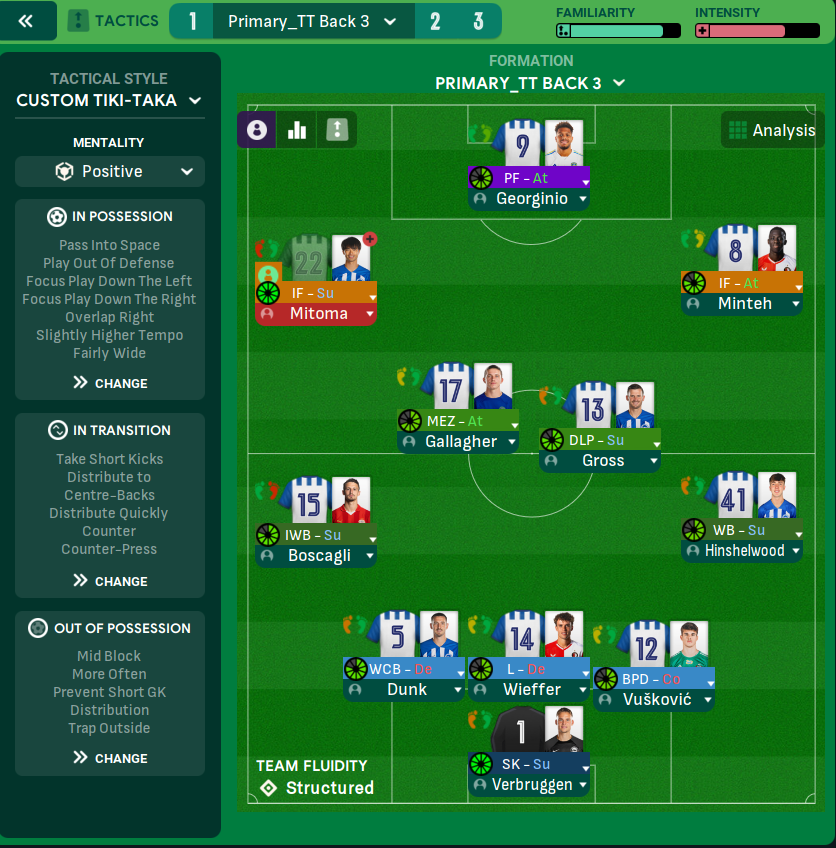
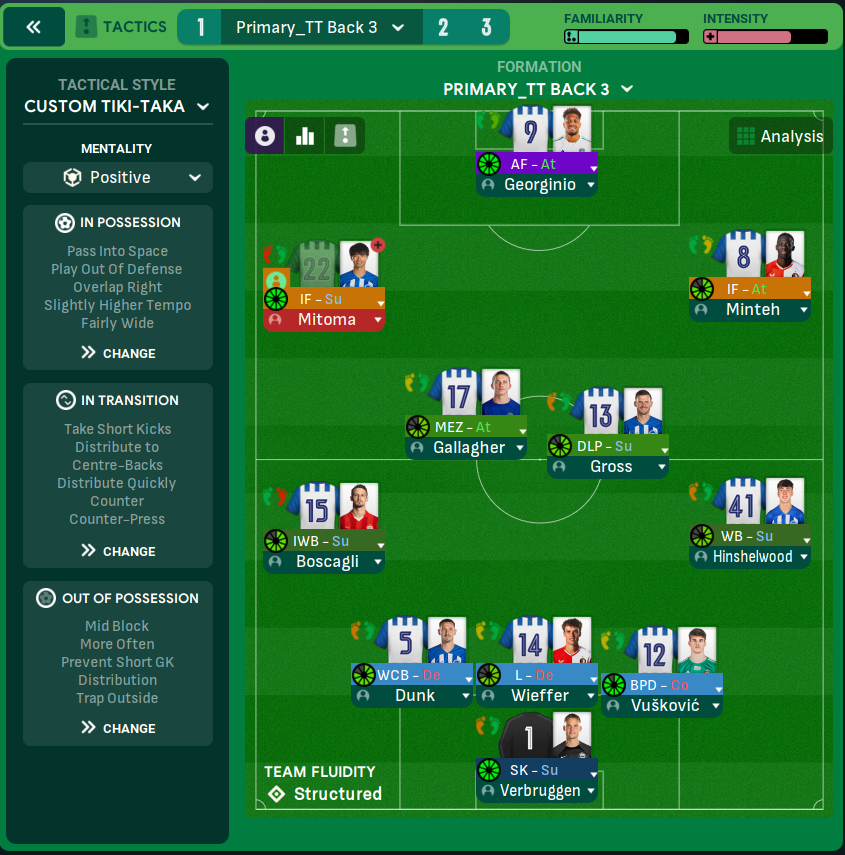
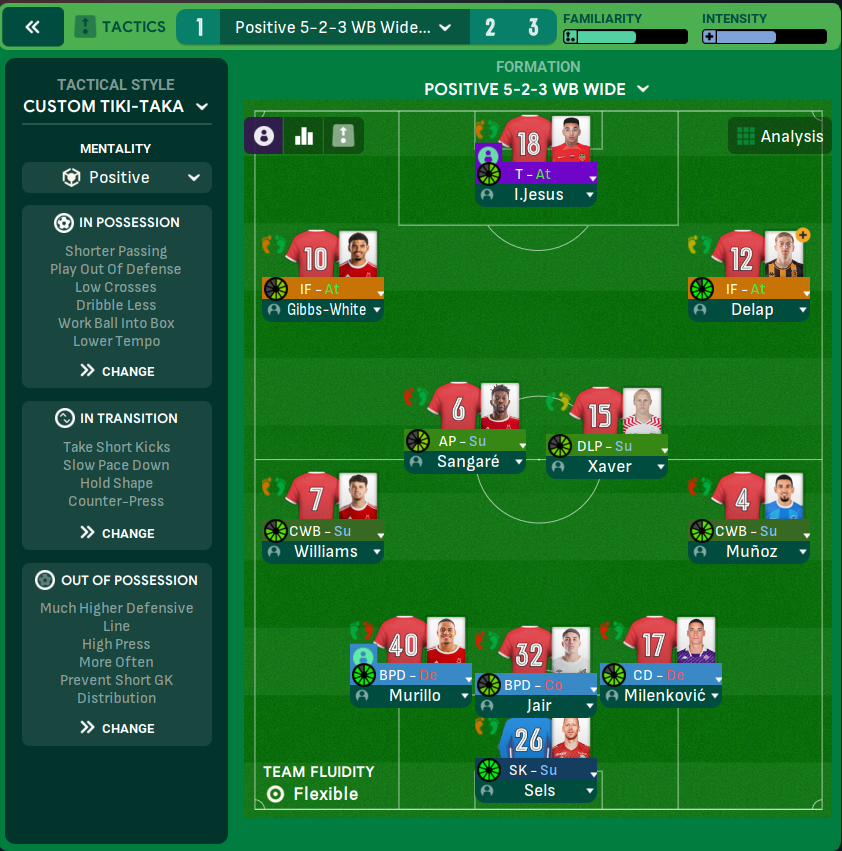
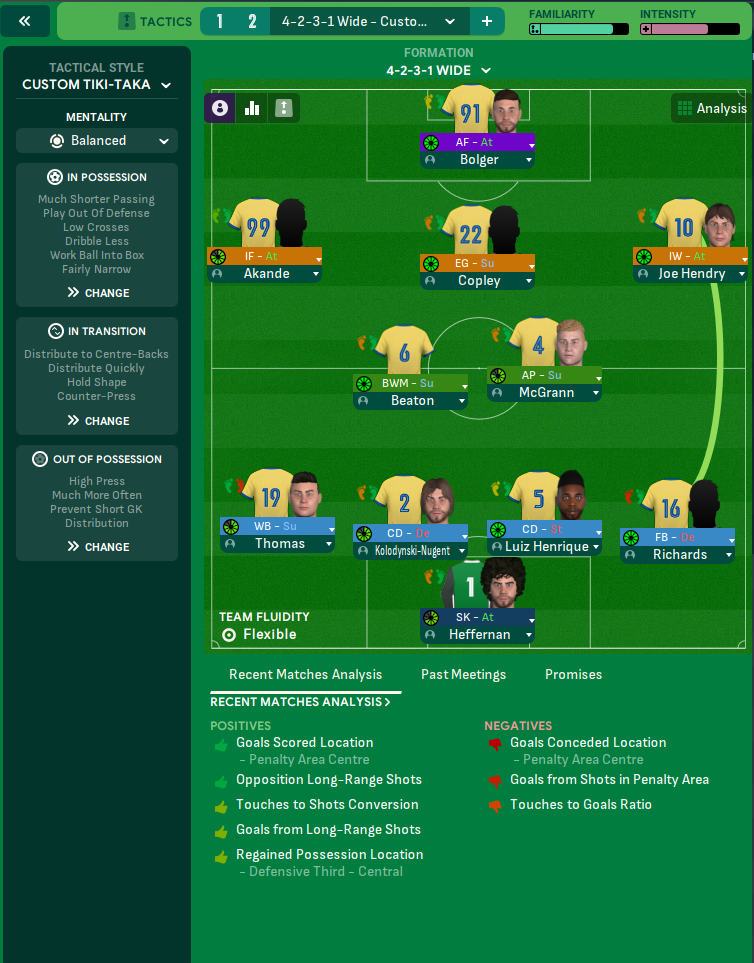
4-2-3-1 Wide
The Tiki-Taka style promotes strong ball retention through short passing and working the ball into the box.
Loading tactical analysis...
Custom Tiki-Taka
Balanced
4-2-3-1 Wide
Flexible
Much Shorter Passing
Play Out Of Defense
Low Crosses
Dribble Less
Work Ball Into Box
Fairly Narrow
Distribute Quickly
Hold Shape
Counter-Press
High Press
Much More Often
Prevent Short GK Distribution
ST
Advanced Forward
Attack
IF
Inside Forward
Attack
EG
Enganche
Support
BWM
Ball Winning Midfielder
Support
AP
Advanced Playmaker
Support
WB
Wing Back
Support
CD
Central Defender
Defend
SK
Sweeper Keeper
Attack
The Tiki-Taka style promotes strong ball retention through short passing and working the ball into the box.
The combination of Inside Forwards and an Advanced Forward allows for versatile attacking options and quick movement for goal scoring opportunities.
The tactics of counter-pressing after losing the ball conflict with the instruction to hold shape, which may lead to gaps in defense.
A high press might require wider positioning to compress space, conflicting with the fairly narrow attacking setup.
How can we better integrate wide players into our attacking phase?
Is the balance between pressing and shape maintenance effective in our current setup?
How can we leverage our midfield to create more goal-scoring opportunities?
What adjustments can mitigate the defensive vulnerabilities in the penalty area?
Are player roles aligning with our attacking and defending philosophy?
How can we improve our conversion rate from touches to shots?
The tactical theory behind the 4-2-3-1 Wide: roles, instructions, and the trade-offs that decide whether the system holds up.
Klopp-style gegenpressing in FM, including squad profile, line-and-press pairing, sustainable workload, and the antipatterns to avoid.
Double pivots and flat pairs in 4-2-3-1 and 4-4-2: when each pairing works, when it collapses, and the AMC unicorn that rescues both.
Mentality, duty, role, instruction, sub. The change hierarchy from lightest to heaviest intervention, and 60th-minute patterns by game state.