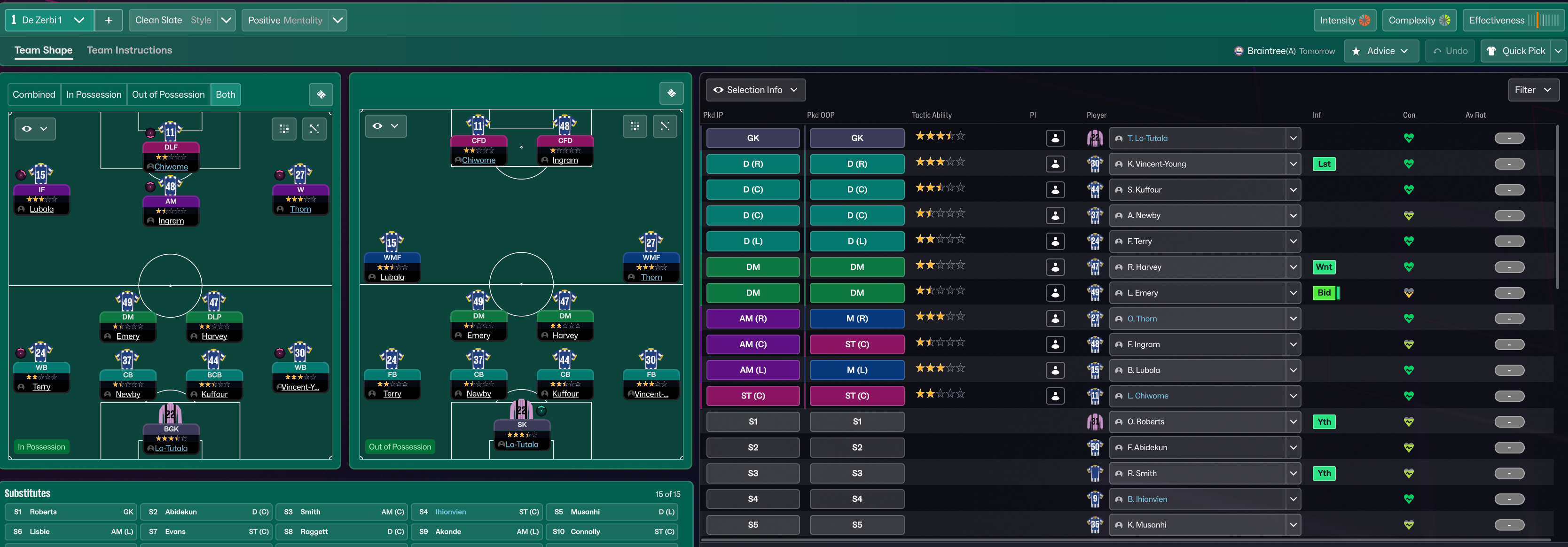
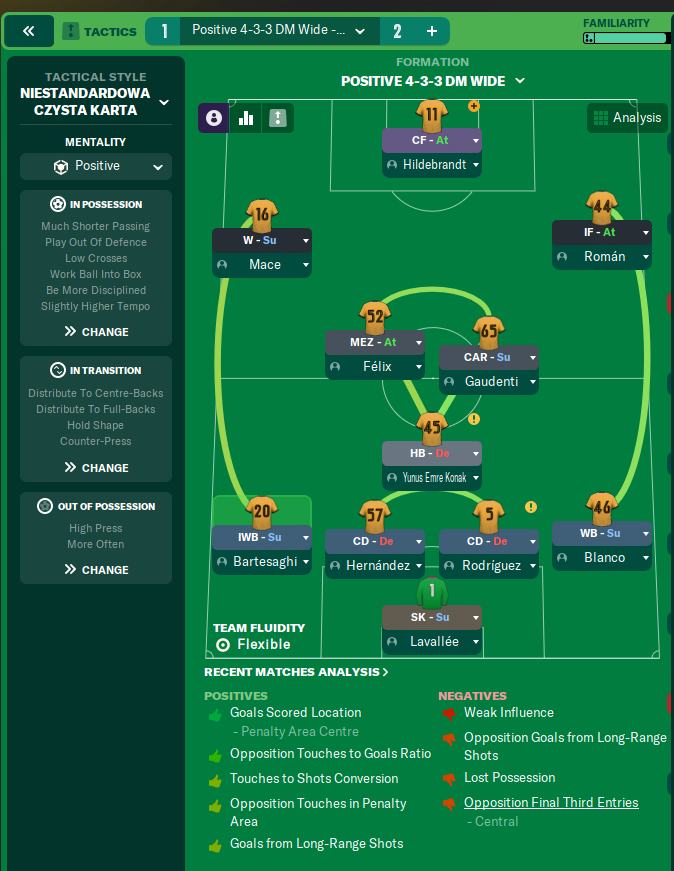
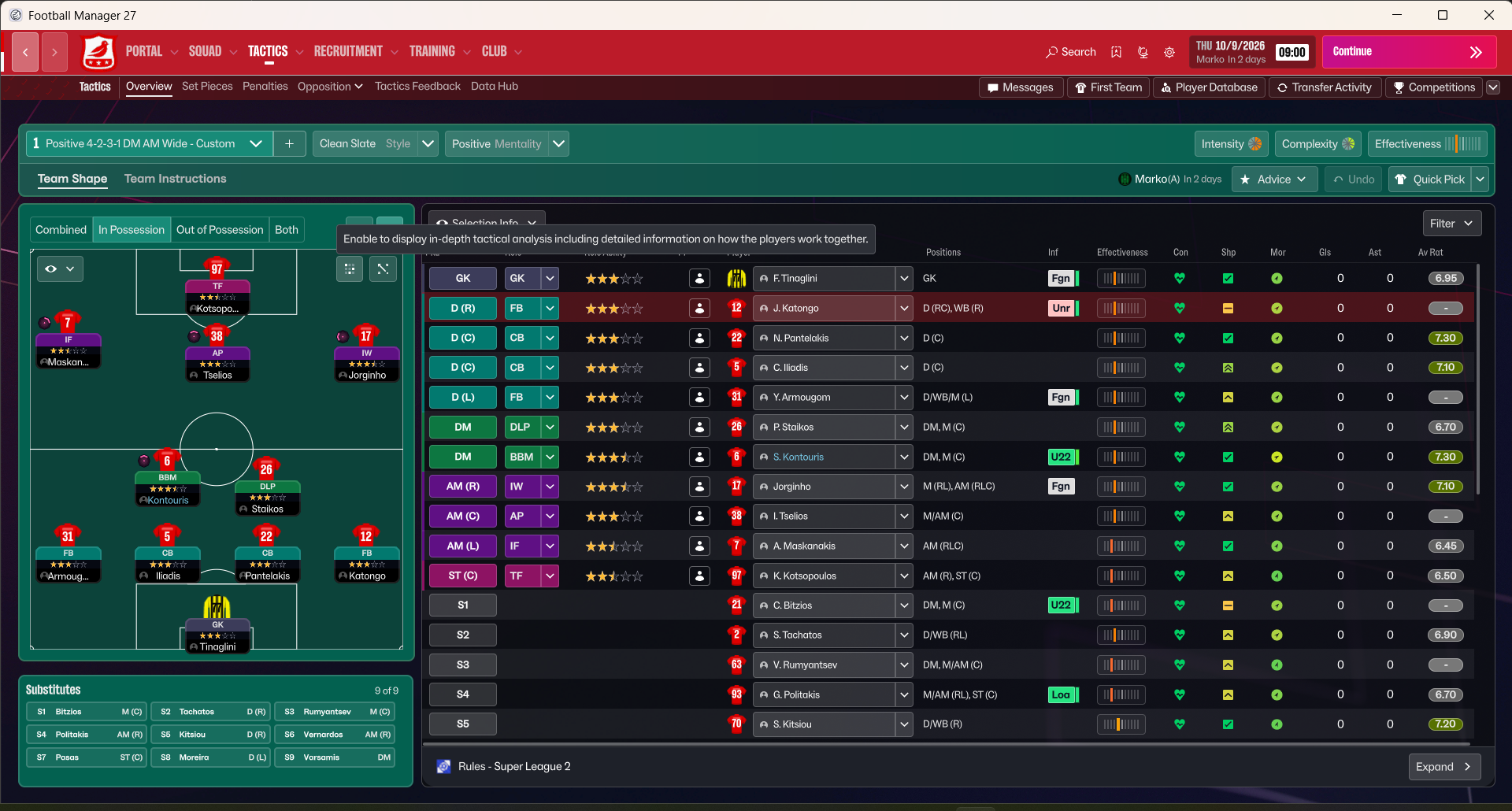
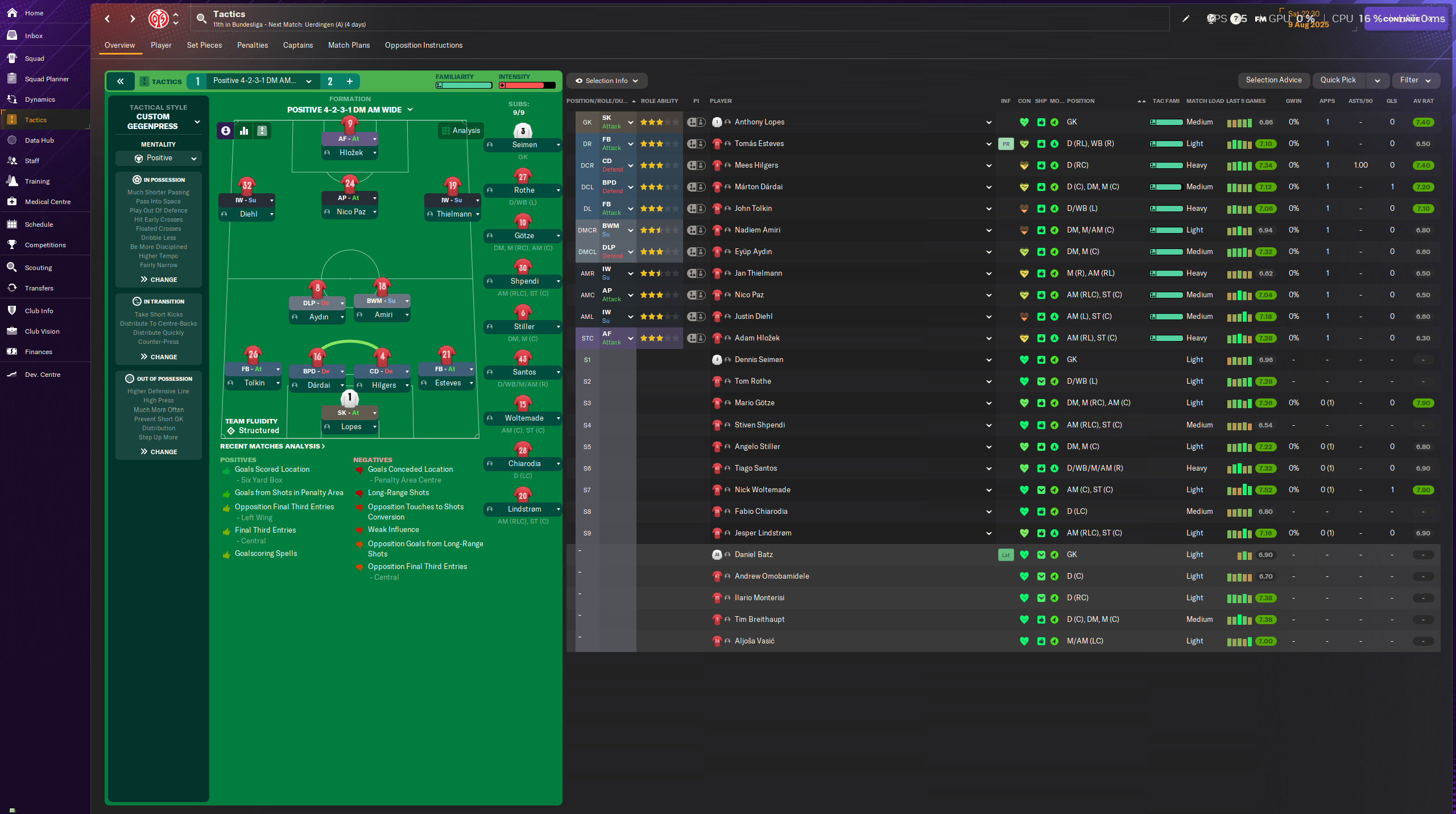
4-3-3 DM Wide
Creating goal-scoring opportunities through a combination of inside forward and deep-lying forward movements. Utilizing inside forwards and a deep-lying…
Loading tactical analysis...
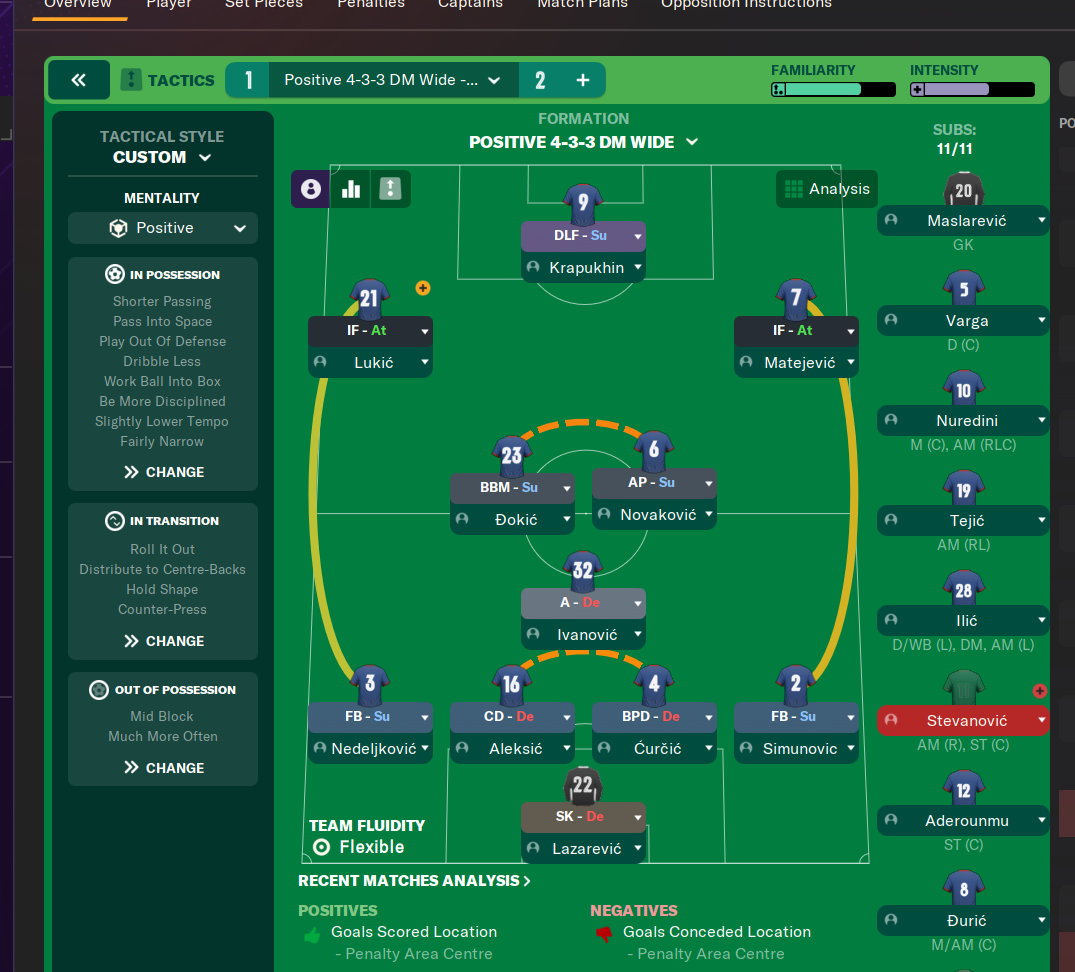
Positive
Positive
4-3-3 DM Wide
Flexible
Shorter Passing
Pass Into Space
Play Out Of Defence
Dribble Less
Work Ball Into Box
Be More Disciplined
Slightly Lower Tempo
Fairly Narrow
Roll It Out
Distribute to Centre-Backs
Hold Shape
Counter-Press
Mid Block
Much More Often
GK
Sweeper Keeper
Defend
DC
Centre-Back
Defend
DC
Ball-Playing Defender
Defend
FB
Full-Back
Defend
DM
Anchor
Defend
CM
Box-to-Box Midfielder
Support
CM
Advanced Playmaker
Support
IF
Inside Forward
Attack
IF
Inside Forward
Attack
CF
Deep-Lying Forward
Support
Focus on working the ball into the box through controlled passing, leveraging inside forwards for width.
Counter-pressing when possession is lost to recover quickly.
Creating goal-scoring opportunities through a combination of inside forward and deep-lying forward movements.
Mid Block
Defensive structure aims to compact the space and force the opponent wide.
FB-De, BPD-De, CD-De and A-De work in unison to maintain a solid line at the back.
Fluid Width
Attack utilizes wide play from inside forwards and varied movement from the deep-lying forward.
IF-A at [6,2] and [6,4] along with DLF-S at [6,3] create opportunities for both central and wide plays.
Utilizing inside forwards and a deep-lying forward allows for intricate offensive play.
IF-A at [6,2] and [6,4], DLF-S at [6,3] create multiple attacking angles.
The combination of a Box-to-Box Midfielder and Advanced Playmaker allows for effective ball progression.
BBM-S at [3,3] and AP-S at [3,4] ensure midfield dominance.
Mid block may be susceptible to quick counter-attacks if possession is lost.
BBM-S at [3,3] may leave gaps when he pushes up.
Heavy focus on inside forwards may lead to predictability in attack.
IF-A at [6,2] and [6,4] could be marked out easily.
Defensive Stability
With a mid block, the back-line must remain cohesive to avoid breakdowns.
BPD-De and CD-De at [2,2] and [2,3] need proper cohesion.
Flow of Play
Overlapping might be sacrificed for being too compact.
Fairly narrow approach could limit full-backs' effectiveness.
BBM-S and AP-S
Complementary roles ensure midfield link-up and movement.
BBM-S at [3,3] supports AP-S at [3,4] for transitions.
IF-A and DLF-S
Together, they can exploit defensive gaps created by their movements.
Dynamic interplay at the front line can create chances.
How will the team adapt against teams that utilize a high press?
What strategies are in place to capitalize on set-pieces?
How can the team maintain defensive solidity during transitions?
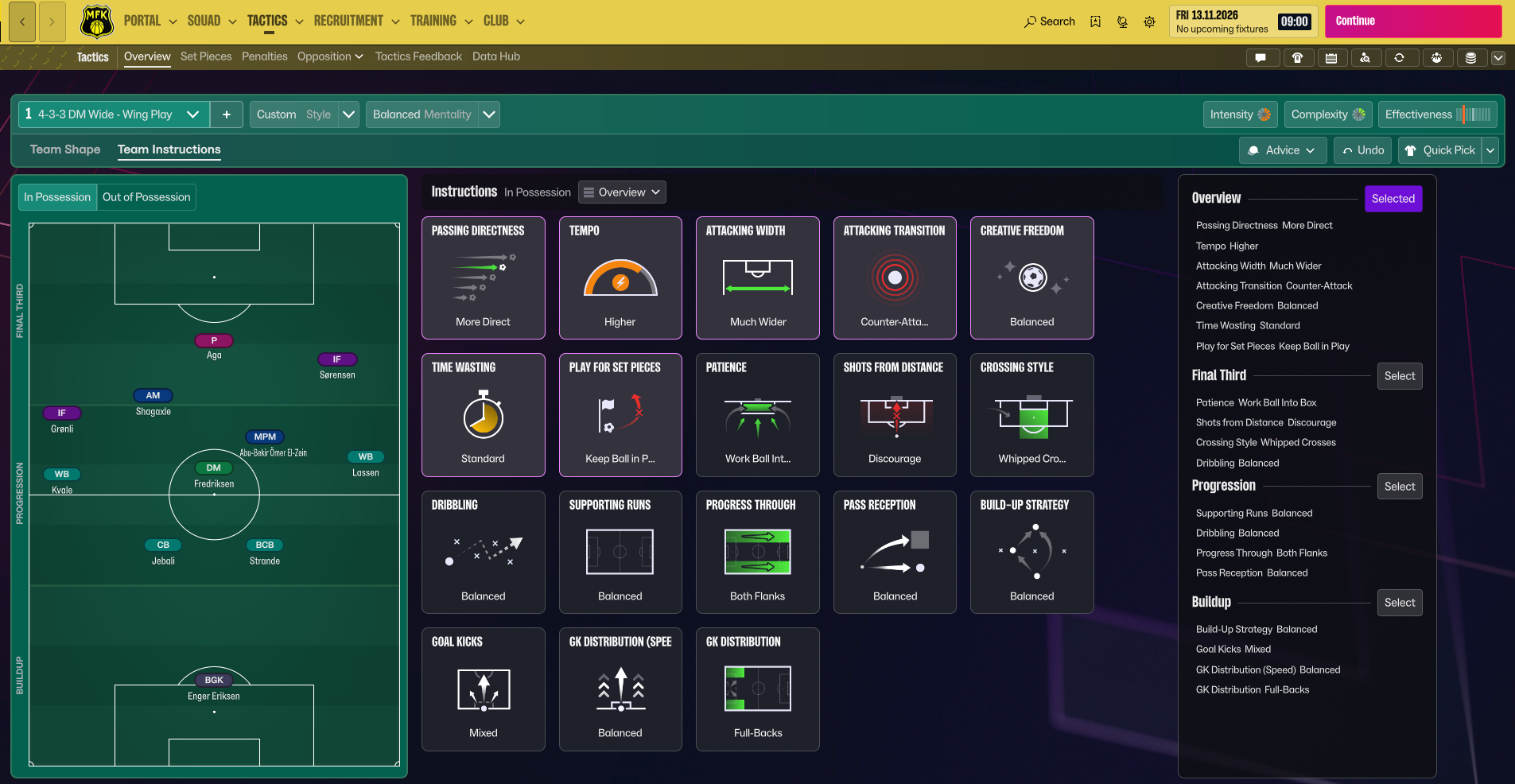
wing play
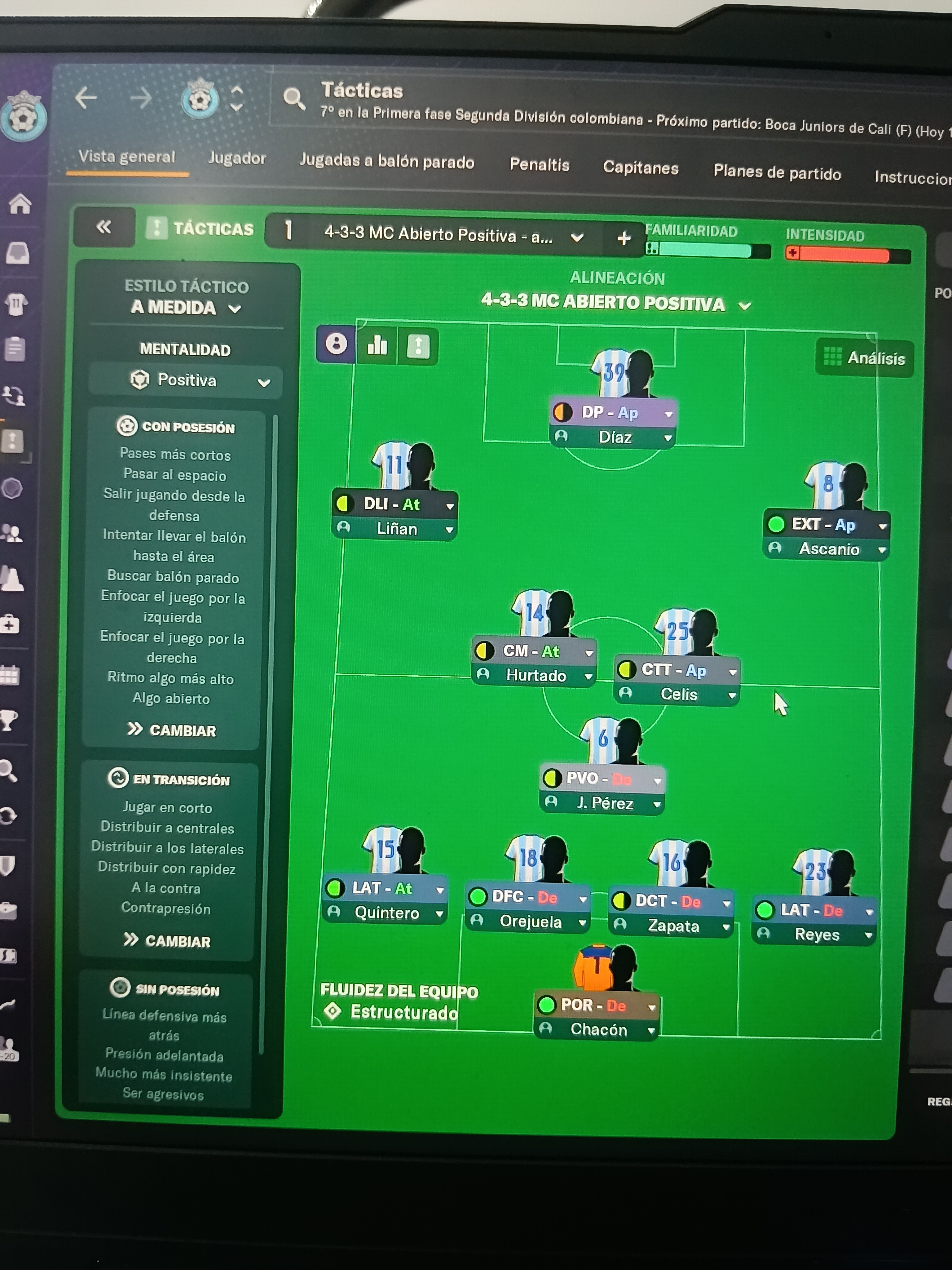
Gegenpress
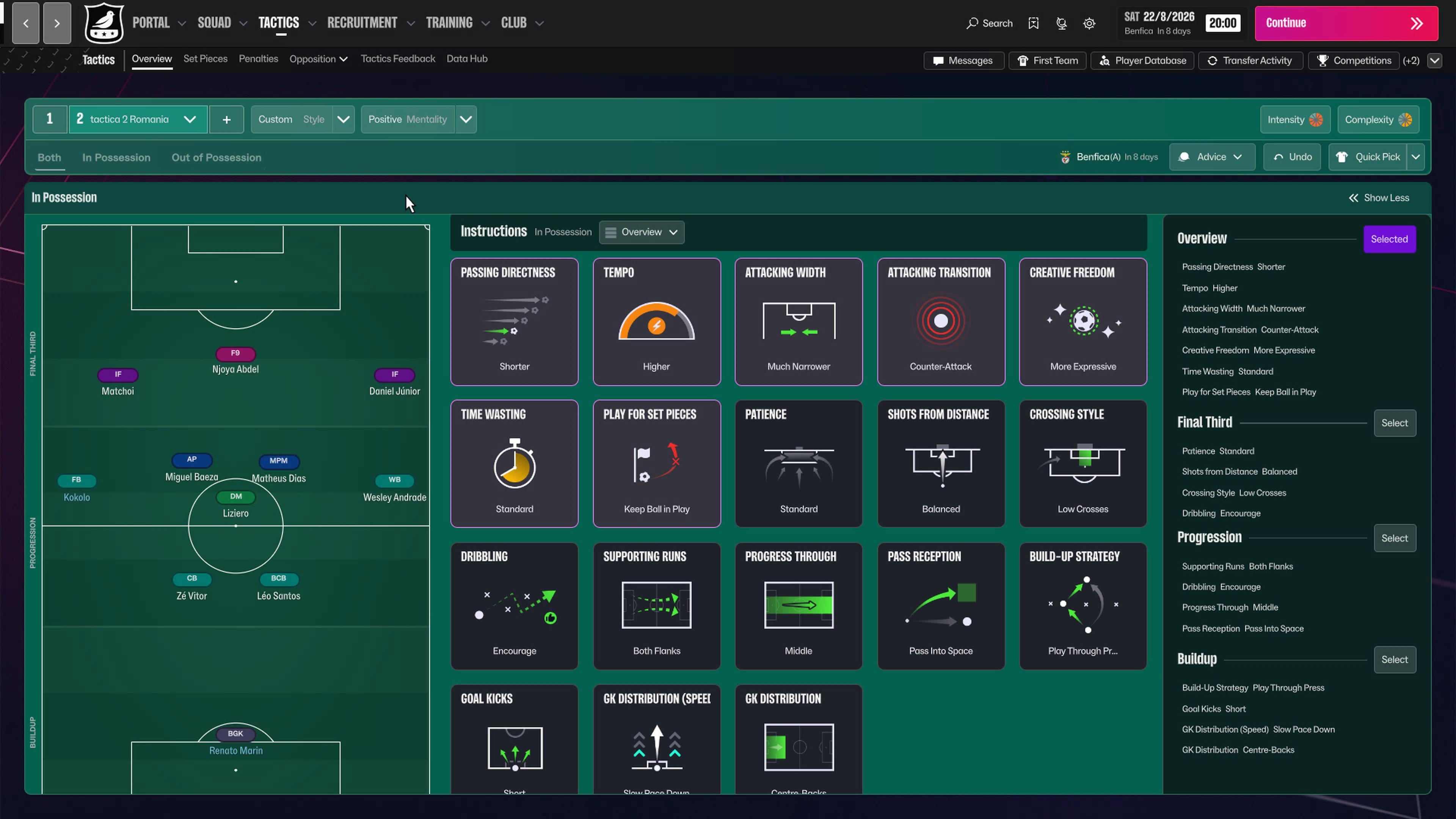
vertical tiki taka
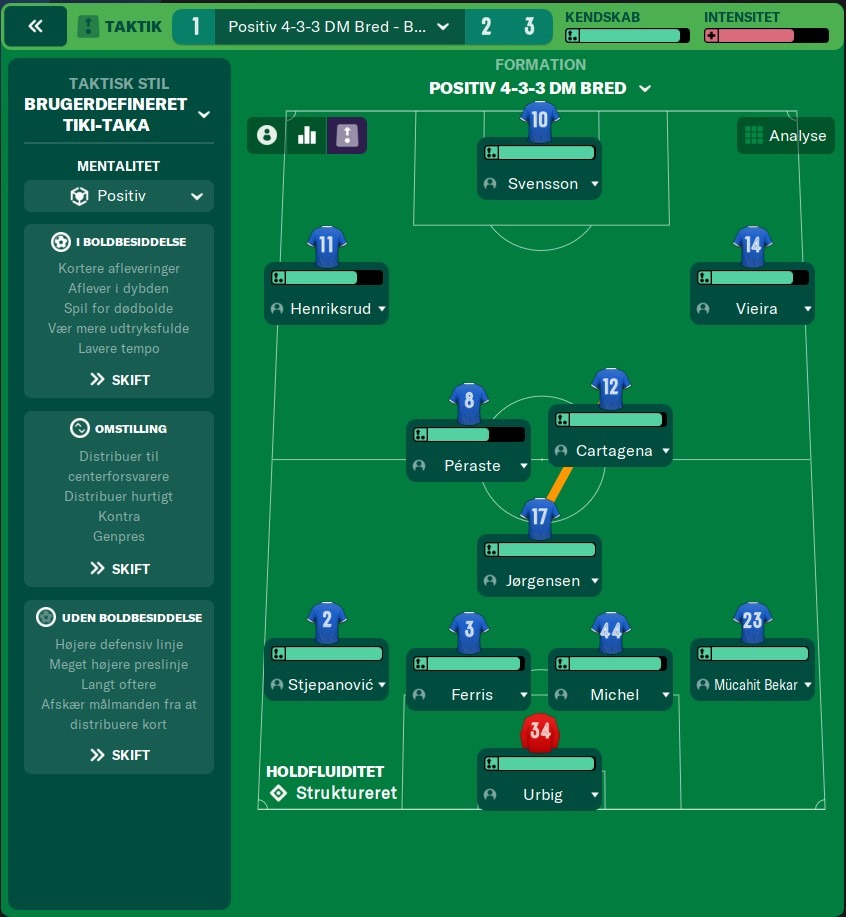
Tiki-Taka
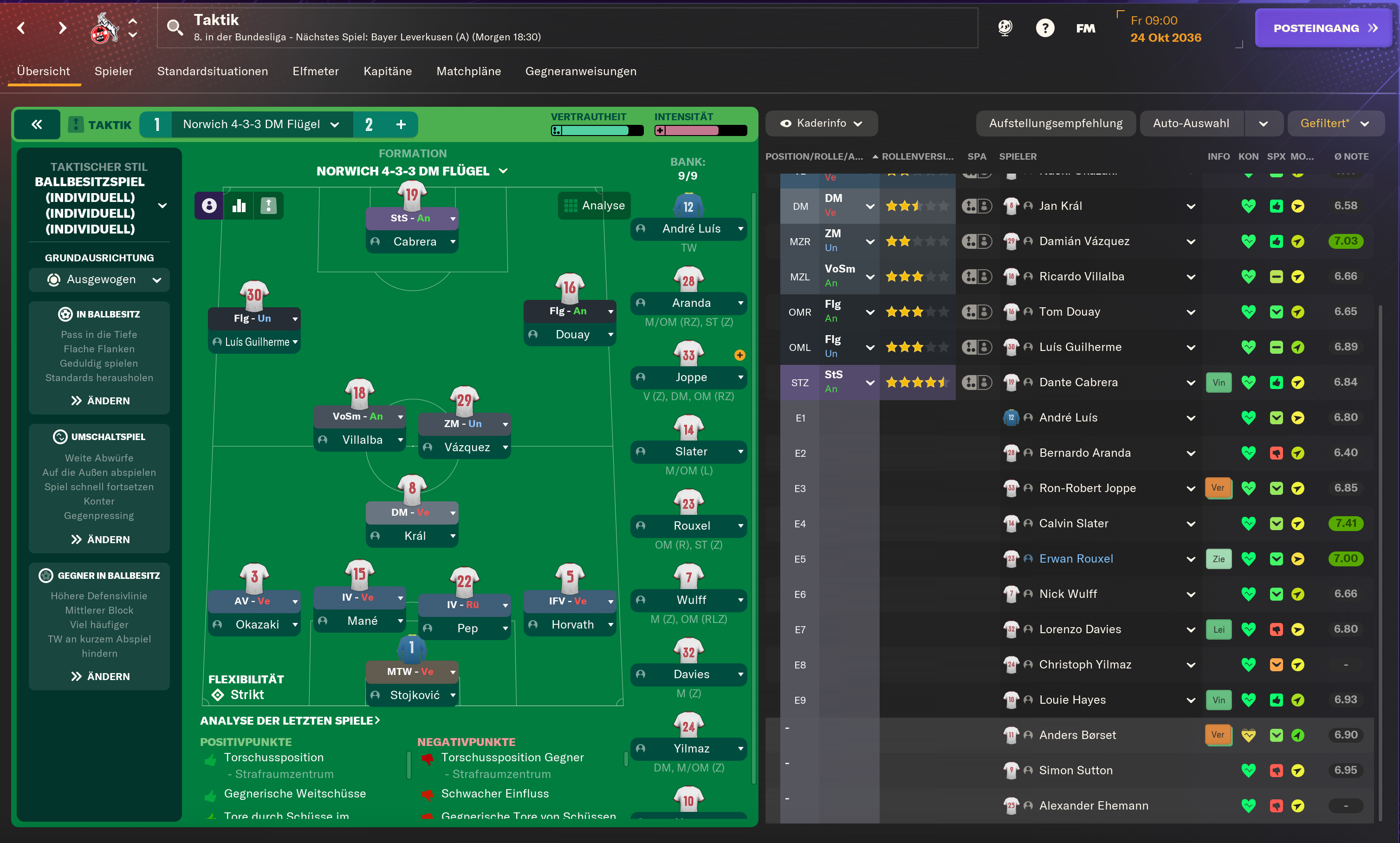
Wing Play
Vertical Tiki-Taka
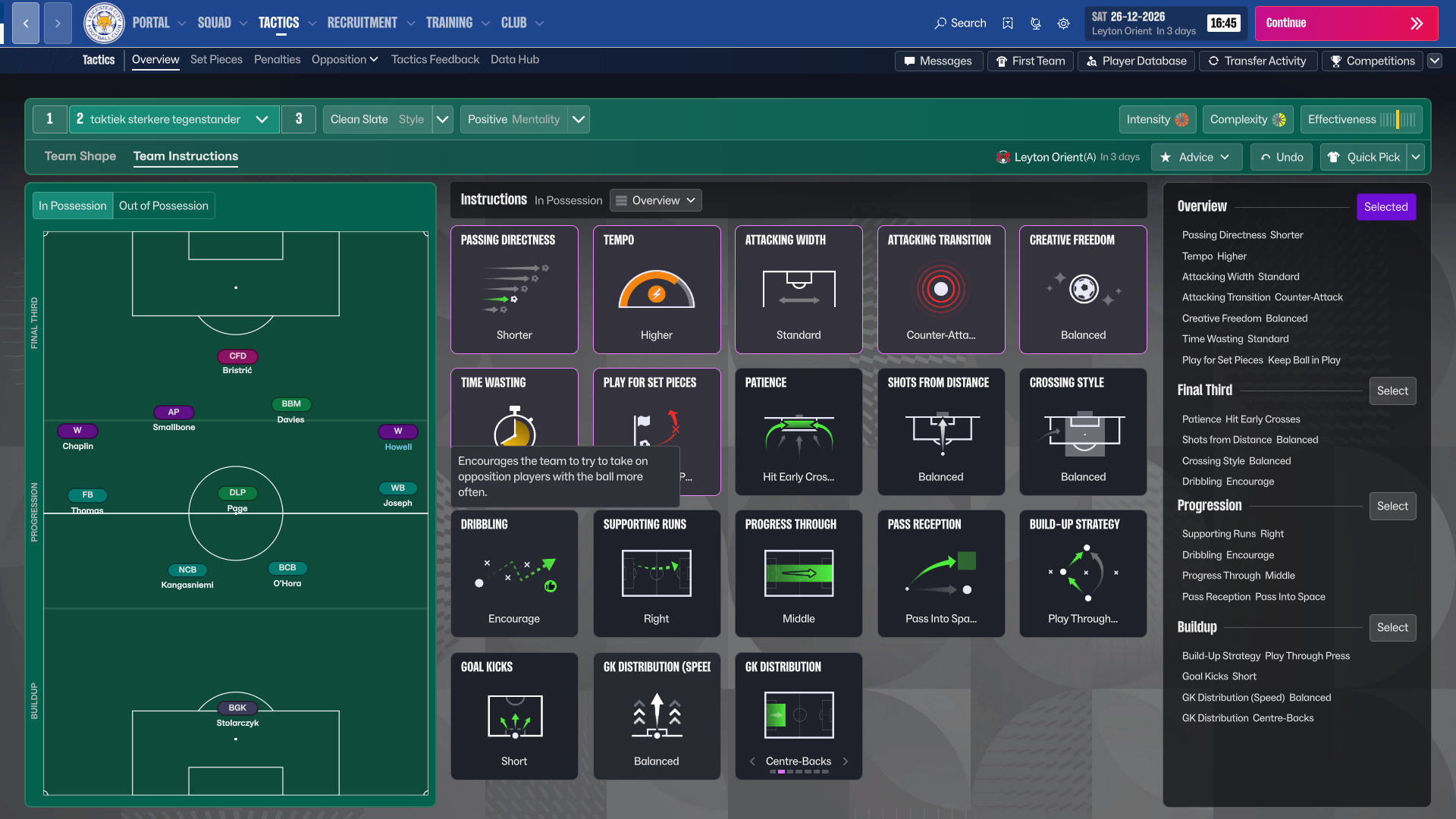
clean slate
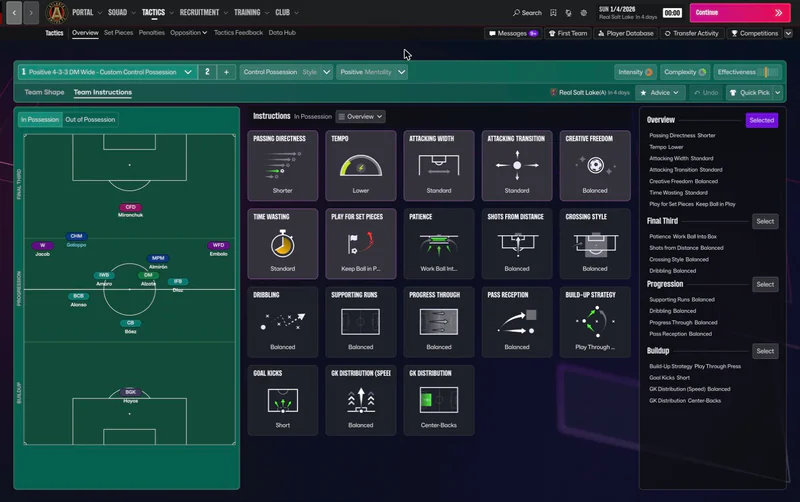
control possession
The tactical theory behind the 4-3-3 DM Wide: roles, instructions, and the trade-offs that decide whether the system holds up.
Klopp-style gegenpressing in FM, including squad profile, line-and-press pairing, sustainable workload, and the antipatterns to avoid.
Why circulation density and zonal occupation aren't the same thing in FM, and the half-space occupation rule that decides build-up.
FM27 keeps FM26's tactic system. Here is what stays the same, the small changes that can catch you out, and what the new Tactical Effectiveness system asks of you.