4-2-3-1 (Positive) Tactic
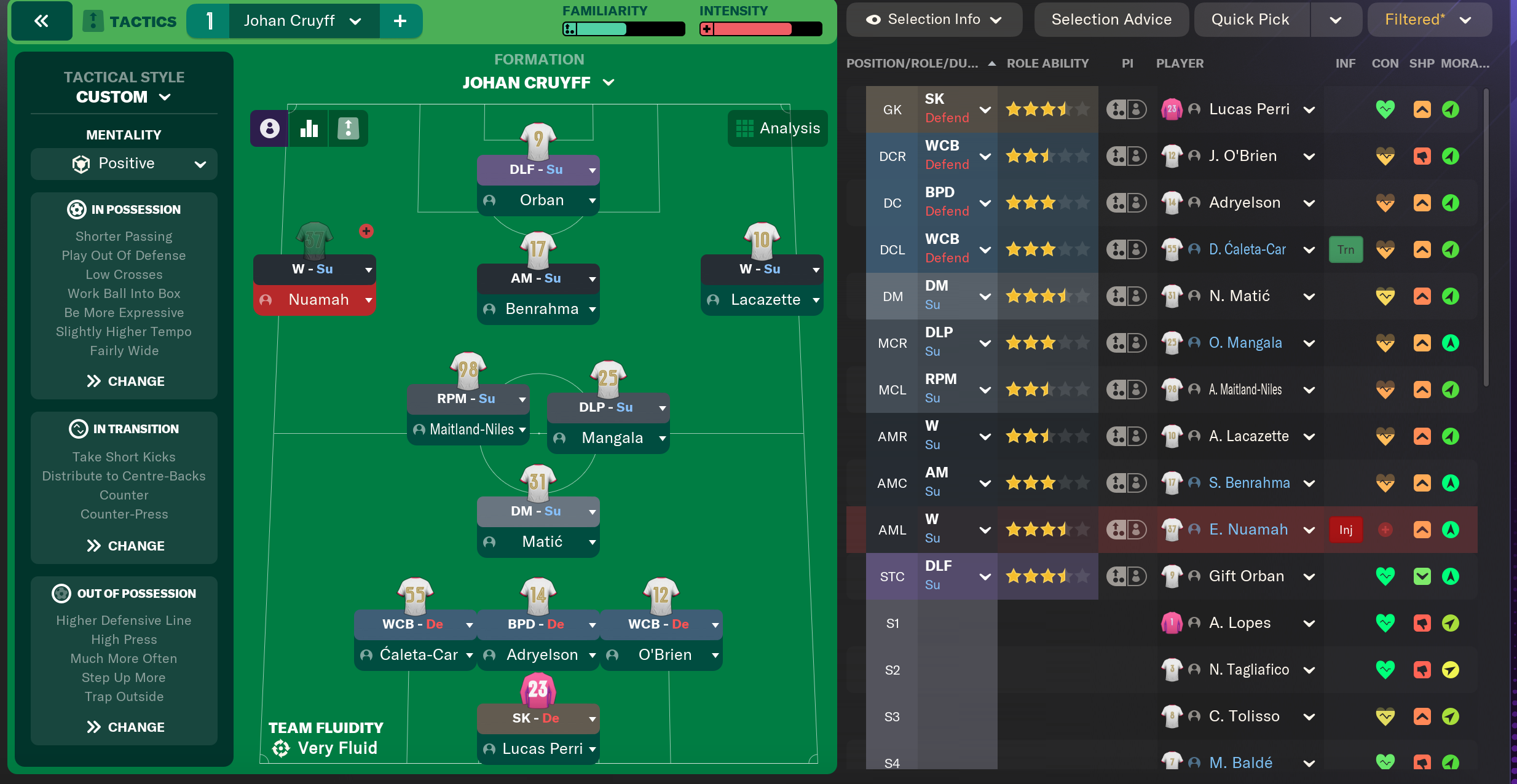
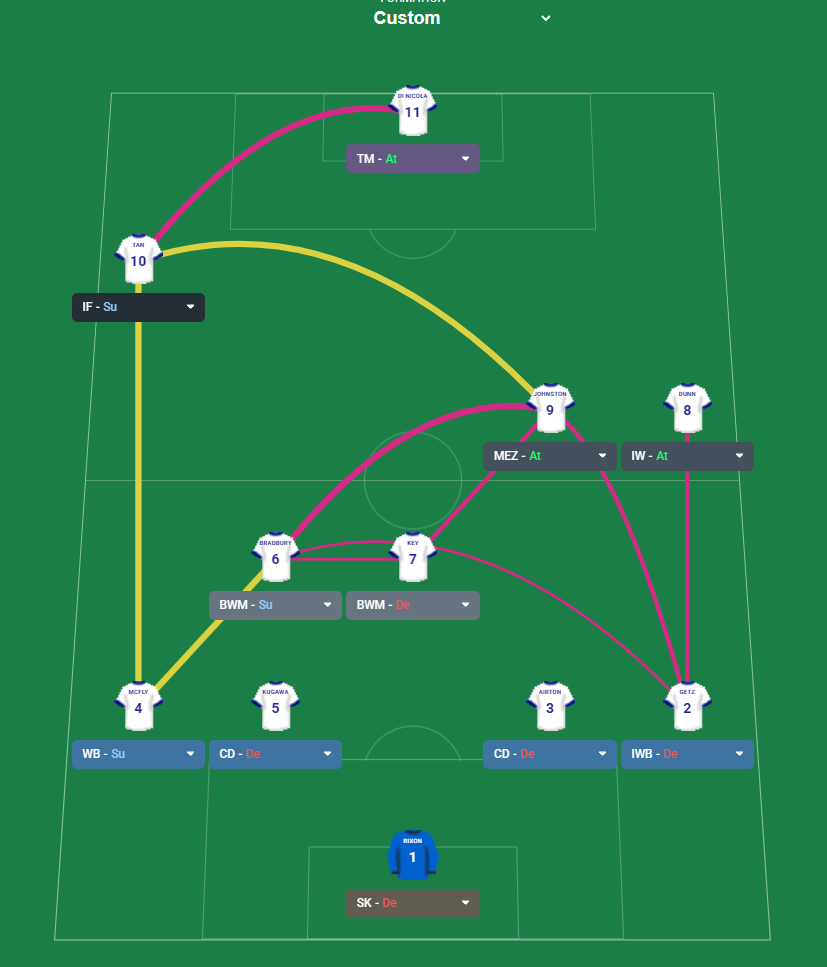
4-2-3-1
Control possession while creating high-quality chances through patient build-up. Strong ball-playing defenders facilitate quick transitions from defense…
Loading tactical analysis...
Formation and style
Custom
Positive
4-2-3-1
Very Fluid
In possession
Shorter Passing
Play Out Of Defence
Low Crosses
Work Ball Into Box
Be More Expressive
Slightly Higher Tempo
Fairly Wide
In transition
Take Short Kicks
Distribute to Centre-Backs
Counter
Counter-Press
Out of possession
Higher Defensive Line
High Press
Much More Often
Step Up More
Trap Outside
Player roles
GK
Sweeper Keeper
Defend
DC
Ball-Playing Defender
Defend
DC
Wide Centre-Back
Defend
DC
Wide Centre-Back
Defend
DM
Defensive Midfielder
Support
MCR
Deep-Lying Playmaker
Support
MCL
Roaming Playmaker
Support
AM
Attacking Midfielder
Support
W
Winger
Support
W
Winger
Support
ST
Deep-Lying Forward
Support
Phase description
Focus on fluid passing and movement, utilizing width and creating space for through balls.
Quick reorganization into a compact shape, ready to press or counter-press.
Control possession while creating high-quality chances through patient build-up.
Team shape defence
Compact 4-2-3-1
Defensive midfielders support the back line while wingers track back to assist in defense.
Higher Defensive Line and High Press.
Team shape attack
Fluid 4-2-3-1
Wingers and an attacking midfielder create overloads on the flanks for decisive attacks.
Wingers positioned to exploit space in wider regions.
Key strengths
Ball Distribution
Strong ball-playing defenders facilitate quick transitions from defense to attack.
BPD at [2,3] with 'Play Out Of Defence'.
Midfield Control
The combination of a Defensive Midfielder and playmakers offers a strong grip on midfield dynamics.
DLP-S at [3,2] with 'Work Ball Into Box'.
Conflicting tactics
High Defensive Line Risks
A high defensive line exposes the team to quick counter-attacks.
Higher Defensive Line combined with High Press.
Heavy Reliance on Wingers
Over-emphasis on wingers may leave the team vulnerable when they are out of position.
W-Su role at wide positions [6,2] and [6,4].
Risk exposures
Risk Exposures
Items
Defensive Transition
Quick counter-attacks may catch the team off-guard.
DM-S at [3,1].
Midfield Overload
The midfield may be outnumbered leading to gaps.
2 DM roles versus multiple attacking threats from the opposition.
Role synergies
Role Synergies
Items
DLP-S and RPM-S
Complimentary roles that can control tempo and create chances.
DLP-S at [3,2] and RPM-S at [3,3].
W-Su with DLF-S
Wingers and the deep-lying forward can create overloads in wide areas.
W-Su at [5,2] and [6,3].
Suggested questions
How can I better utilize my wingers offensively?
What adjustments should I consider for better defensive stability?
Are there specific roles that can create more scoring chances?
Related Tactics
Guides for this tactic
The tactical theory behind the 4-2-3-1: roles, instructions, and the trade-offs that decide whether the system holds up.
Playing styles
Gegenpressing: A Full Guide
Klopp-style gegenpressing in FM, including squad profile, line-and-press pairing, sustainable workload, and the antipatterns to avoid.
Read guide
Player pairings
Midfield Pairs in 4-2-3-1 and 4-4-2
Double pivots and flat pairs in 4-2-3-1 and 4-4-2: when each pairing works, when it collapses, and the AMC unicorn that rescues both.
Read guide
Foundations
Width, Compactness, and Tempo
What Higher Tempo, Wider, and Narrower actually do in FM, plus the dial contradictions and antipatterns players run into most often.
Read guide