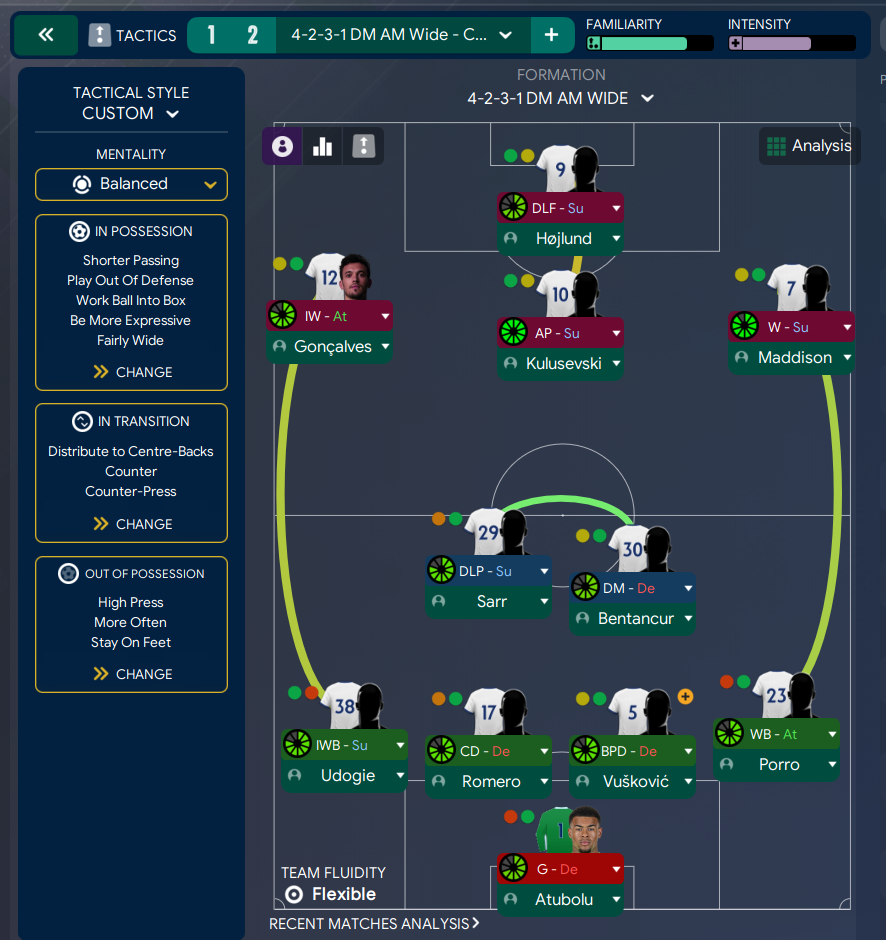
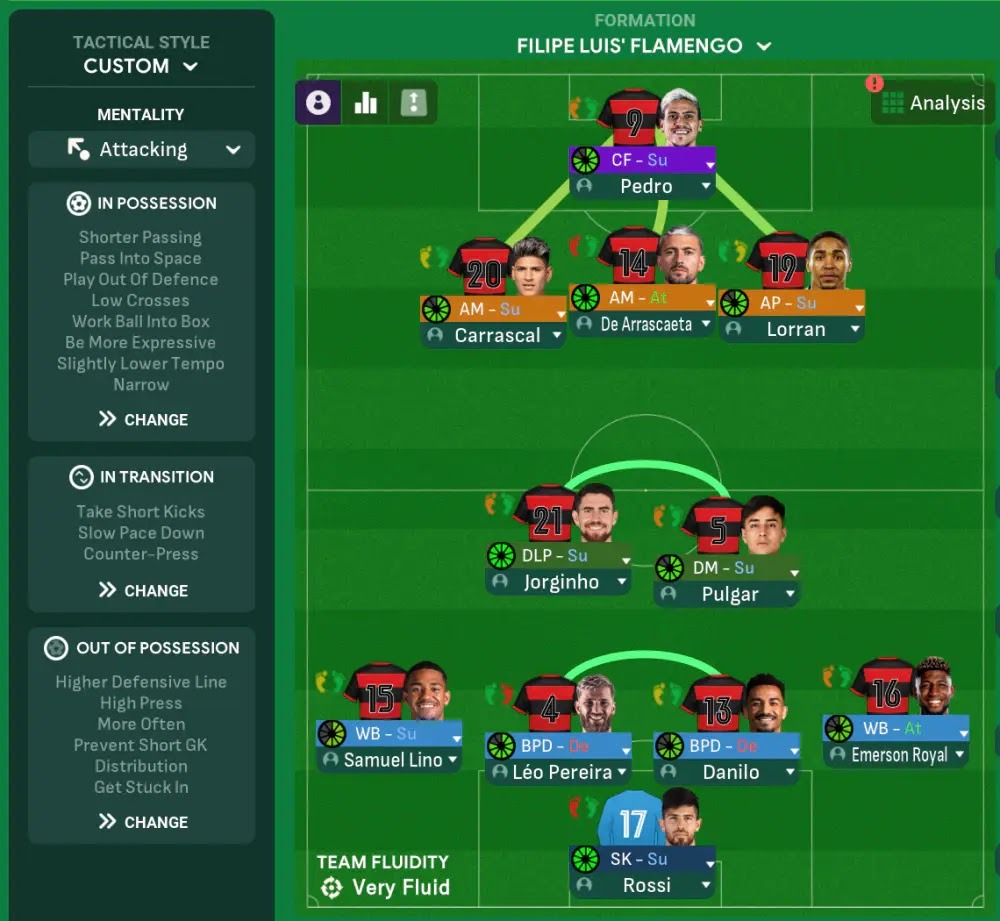
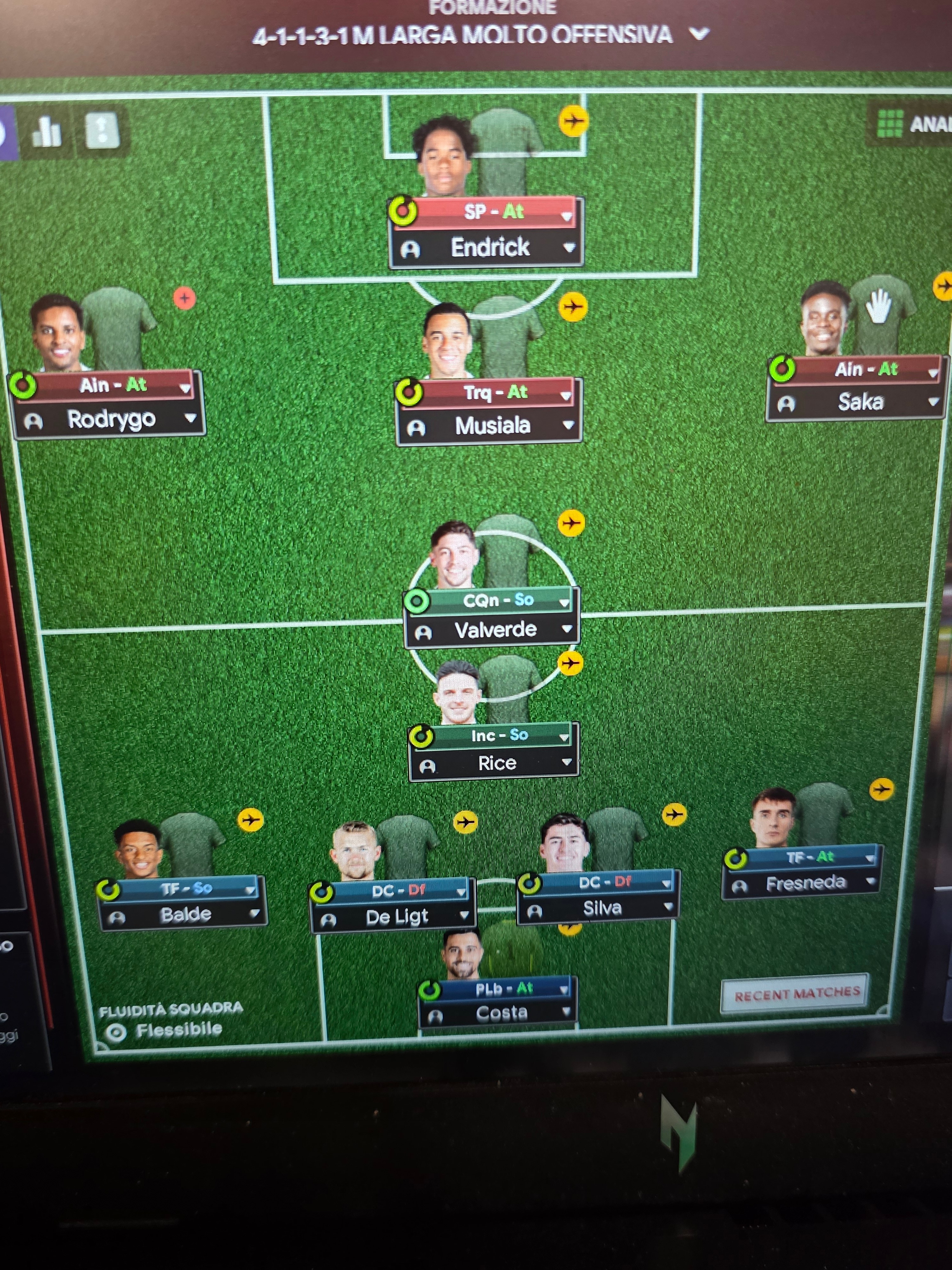
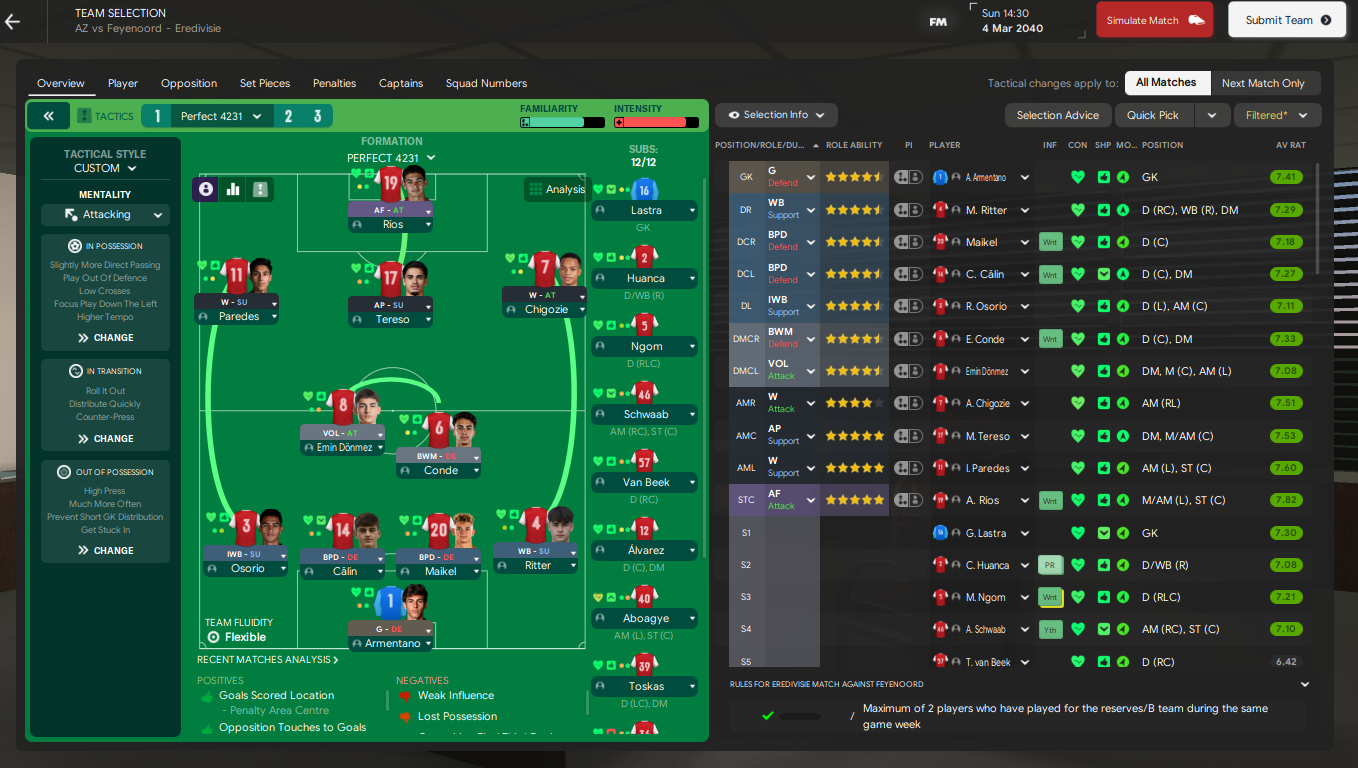
4-2-3-1
Creating goal-scoring opportunities through aggressive attacking movement. The presence of three attacking players allows for fluid offensive movements.
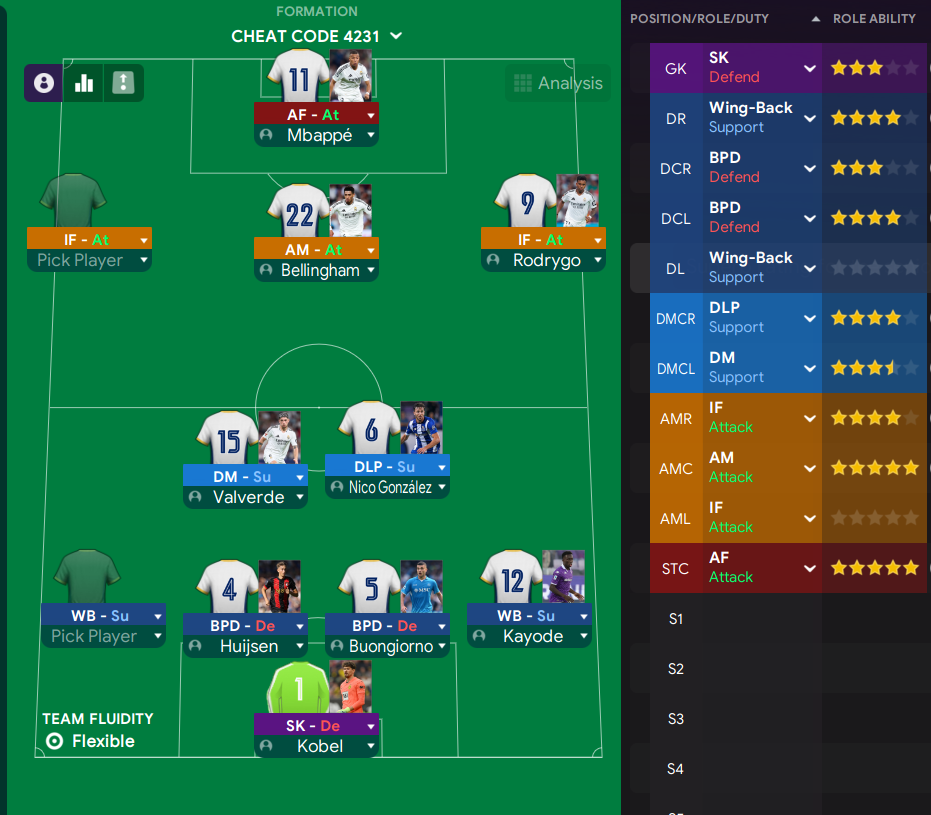
Loading tactical analysis...
Attacking
4-2-3-1
Flexible
High Tempo
Work Ball Into Box
Be More Expressive
Counter-Press
Counter
Higher Defensive Line
Higher Line of Engagement
Prevent Short GK Distribution
GK
Sweeper Keeper
Defend
DR
Wing-Back
Support
DCR
Ball-Playing Defender
Defend
DCL
Ball-Playing Defender
Defend
DL
Wing-Back
Support
DMCR
Deep-Lying Playmaker
Support
DMCL
Defensive Midfielder
Support
AMR
Inside Forward
Attack
AMC
Attacking Midfielder
Attack
AML
Inside Forward
Attack
STC
Advanced Forward
Attack
Quick build-up play with emphasis on wide play through wing-backs and attacking midfielders.
High pressing to win the ball back quickly after losing possession.
Creating goal-scoring opportunities through aggressive attacking movement.
4-2
Compact formation with two defensive midfielders providing protection for the back line.
BPD - De at [2,2] and BPD - De at [2,3] with DM-Su at [3,2] and DLP-Su at [3,3].
4-3
Fluid attacking shape with inside forwards creating width and flexibility.
IF-A at [6,2], AM-A at [6,3], and IF-A at [6,4] with an AF-A at [5,3].
The presence of three attacking players allows for fluid offensive movements.
AM-A at [5,3], IF-A at [6,2], and IF-A at [6,4] creating various goal-scoring options.
Ball-Playing Defenders facilitate ball progression from the back.
BPD - De at [2,2] and BPD - De at [2,3] allow effective transitions.
With aggressive attacking tactics, midfield may become exposed during transitions.
Higher Defensive Line with AM-A at [5,3], risking counter-attacks.
Wing-backs may leave gaps defensively if caught out of position.
WB-Su at [2,1] and [2,5] pushing forward, potentially exposing wide areas.
Transitions
Fast transitions could lead to gaps defensively if not managed.
Counter-Press with higher defensive line increasing vulnerability.
Wide Areas
Wing-backs advancing can leave vulnerable spaces for opposition to exploit.
WB-Su at [2,1] and [2,5] risking counters on the break.
DLP-Su & DM-Su
Together, they provide a balance of creativity and defensive solidity.
DLP-Su at [3,3] with DM-Su at [3,2] covering each other's roles.
WB-Su & IF-A
Wing-backs support the inside forwards, creating 2v1 situations.
WB-Su at [2,1] with IF-A at [6,2] can create overloads.
How can we enhance defensive cover during counter-attacks?
Should we adjust the mentality to be more balanced in certain matches?
What alternative roles could improve midfield dynamics?
The tactical theory behind the 4-2-3-1: roles, instructions, and the trade-offs that decide whether the system holds up.
Double pivots and flat pairs in 4-2-3-1 and 4-4-2: when each pairing works, when it collapses, and the AMC unicorn that rescues both.
Klopp-style gegenpressing in FM, including squad profile, line-and-press pairing, sustainable workload, and the antipatterns to avoid.
The five seconds after losing the ball decide most matches. Counter-press, drop-and-recover, and how to know which one you should be doing.