
4-2-3-1 Wide
The use of inside forwards allows for dynamic movement and quick interplay between the forwards, creating goal-scoring opportunities.
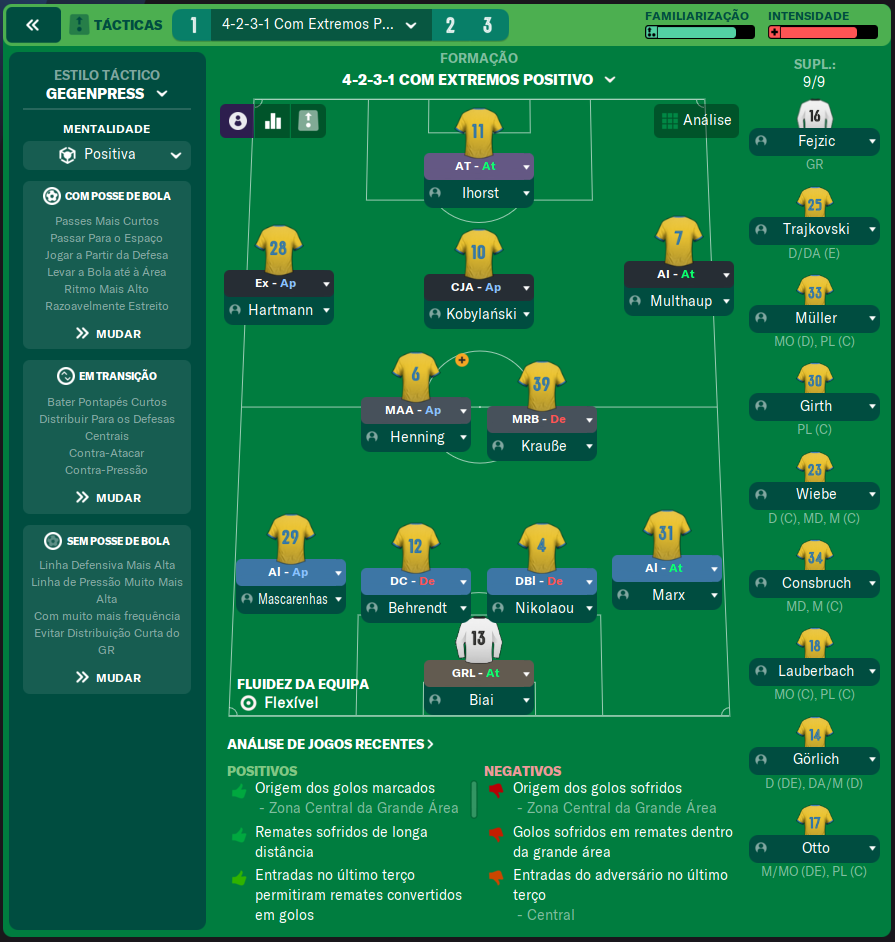
Loading tactical analysis...
Gegenpress
Positive
4-2-3-1 Wide
Flexible
Shorter Passing
Distribute to Central Defenders
Play Out of Defence
Higher Tempo
Counter-Press
Counter
Distribute to Flanks
Higher Defensive Line
More Urgent Pressing
Prevent Goalkeeper Distribution
ST
Advanced Forward
Attack
AML
Inside Forward
Attack
AMR
Inside Forward
Attack
CM
Advanced Playmaker
Attack
DM
Deep-Lying Playmaker
Defend
DC
Central Defender
Defend
The use of inside forwards allows for dynamic movement and quick interplay between the forwards, creating goal-scoring opportunities.
The gegenpress style applies constant pressure on the opposition when possession is lost, maximizing chances to win the ball back quickly.
A high defensive line can leave spaces vulnerable against rapid counter-attacks, which needs to be balanced with positioning.
The deep-lying playmaker needs to balance between defensive duties and supporting attacks, which can sometimes create gaps.
How can we better protect against counters when pressing higher?
Is the midfield balance sufficient between attacking and defensive duties?
Are the inside forwards consistently contributing defensively?
What adjustments can be made against teams using a low block?
How effectively are the full-backs supporting the offense?
Should we consider rotating player roles in specific matches?
The tactical theory behind the 4-2-3-1 Wide: roles, instructions, and the trade-offs that decide whether the system holds up.
Klopp-style gegenpressing in FM, including squad profile, line-and-press pairing, sustainable workload, and the antipatterns to avoid.
Double pivots and flat pairs in 4-2-3-1 and 4-4-2: when each pairing works, when it collapses, and the AMC unicorn that rescues both.
Pass map, average position, xG, possession by zone: what each tablet panel tells you in FM and the tactical change it should trigger.











