
4-2-3-1 Wide
The attacking setup allows for dynamic interplay between forwards and midfielders, utilizing the width provided by the wing-backs.
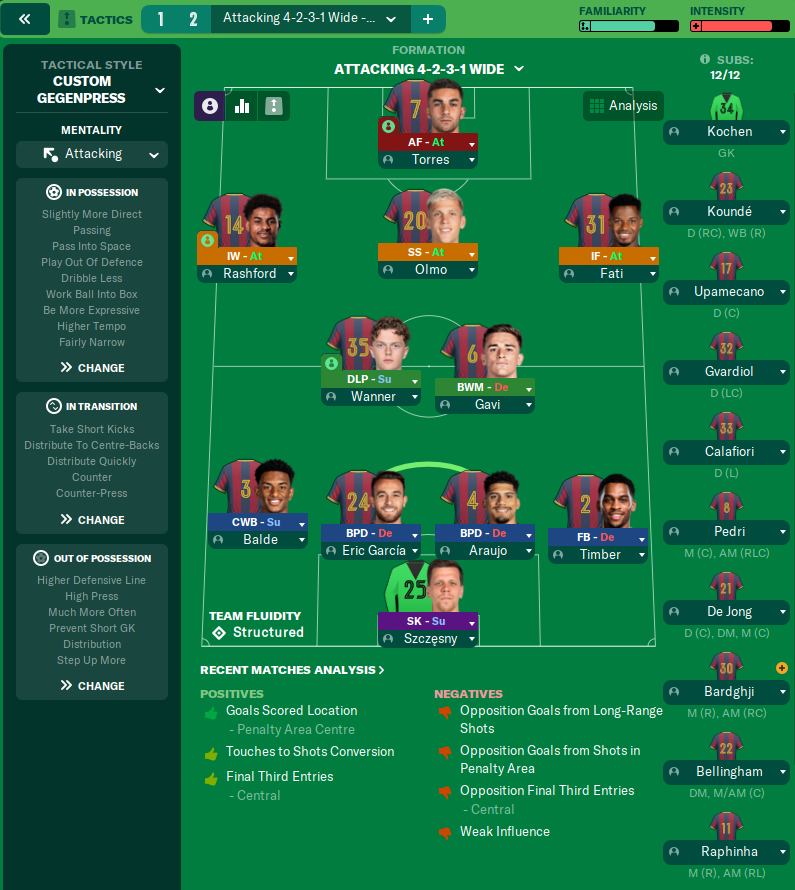
Loading tactical analysis...
Gegenpress
Attacking
4-2-3-1 Wide
Structured
Slightly More Direct Passing
Pass Into Space
Play Out of Defence
Work Ball Into Box
Be More Expressive
Fairly Narrow
Take Short Kicks
Distribute to Centre-Backs
Distribute Quickly
Counter
Counter-Press
Higher Defensive Line
High Press
Much More Often
Prevent Short GK Distribution
Step Up More
ST
Advanced Forward
Attack
SS
Supporting Striker
Attack
IW
Inside Forward
Attack
DLP
Deep Lying Playmaker
Support
BWM
Ball-Winning Midfielder
Defend
CWB
Complete Wing-Back
Support
BPD
Ball-Playing Defender
Defend
SK
Sweeper Keeper
Support
The attacking setup allows for dynamic interplay between forwards and midfielders, utilizing the width provided by the wing-backs.
The gegenpressing philosophy enables quick recoveries of possession after losing the ball, putting pressure on opponents immediately.
While a high line suits pressing, it may leave the defense exposed to quick counter-attacks and long-range shots.
The use of inside forwards and complete wing-backs focuses on width, which may conflict with the strategy of creating central opportunities.
How can I improve defensive stability while maintaining an attacking mindset?
Should I adjust the mentality to a slightly more balanced approach during matches against stronger opponents?
What role adjustments can optimize the midfield's link-up play?
How can I ensure effective support from the wing-backs without compromising defense?
What specific scenarios lead to reliance on long-range shots from opponents?
How can I better utilize substitutions to maintain the intensity of pressing during late game situations?
The tactical theory behind the 4-2-3-1 Wide: roles, instructions, and the trade-offs that decide whether the system holds up.
Klopp-style gegenpressing in FM, including squad profile, line-and-press pairing, sustainable workload, and the antipatterns to avoid.
Double pivots and flat pairs in 4-2-3-1 and 4-4-2: when each pairing works, when it collapses, and the AMC unicorn that rescues both.
FM27 keeps FM26's tactic system. Here is what stays the same, the small changes that can catch you out, and what the new Tactical Effectiveness system asks of you.











