
4-2-3-1 Wide
Utilizes gegenpressing to regain possession quickly and disrupt opponent's buildup.
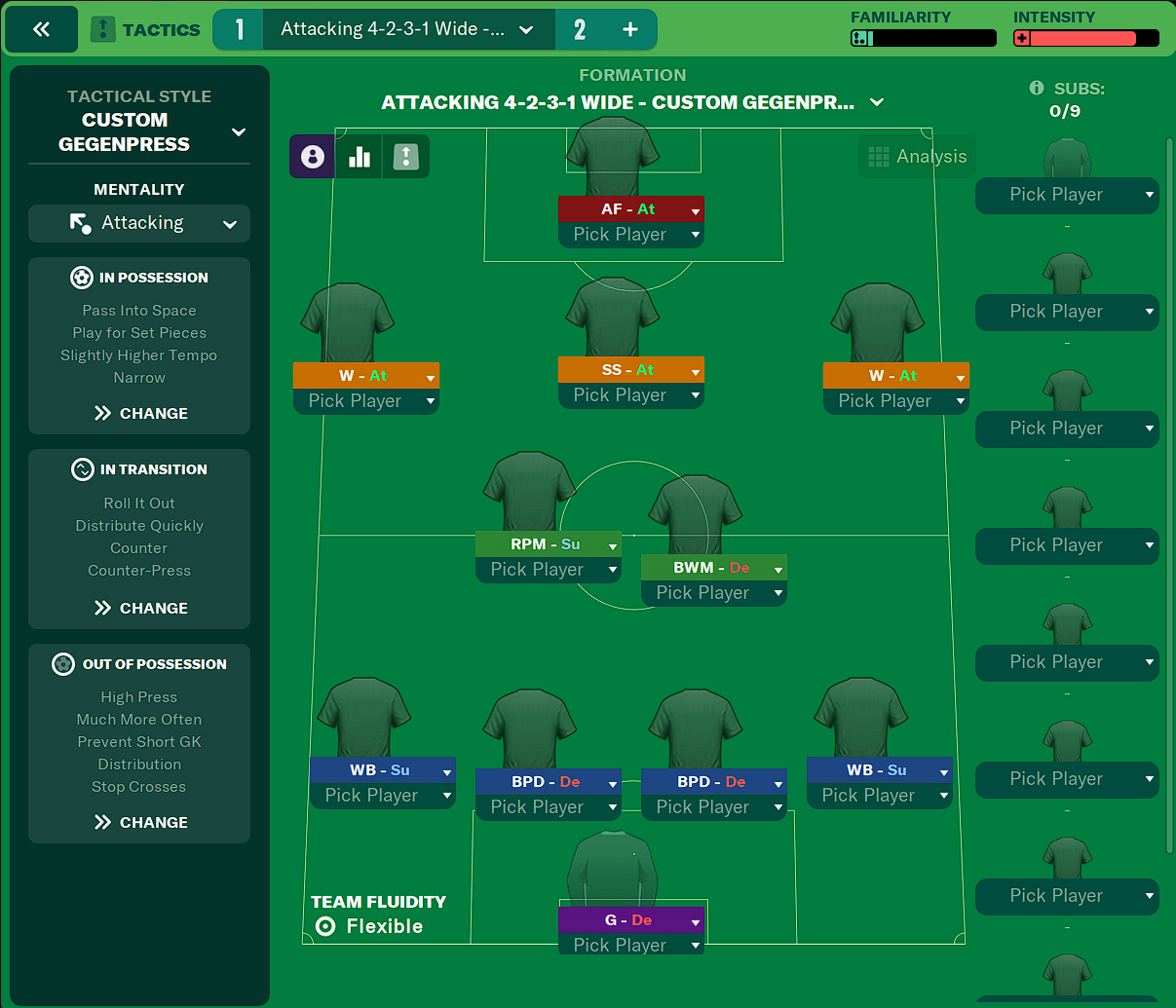
Loading tactical analysis...
Gegenpress
Attacking
4-2-3-1 Wide
Flexible
Pass Into Space
Play for Set Pieces
Slightly Higher Tempo
Narrow
Roll It Out
Distribute Quickly
Counter
Counter-Press
High Press
Much More Often
Prevent Short GK Distribution
AF
Advanced Forward
Attack
SS
Shadow Striker
Attack
W
Winger
Attack
RPM
Raumdeuter
Support
BWM
Ball Winning Midfielder
Defend
WB
Wing Back
Support
BPD
Ball Playing Defender
Defend
G
Goalkeeper
Defend
Utilizes gegenpressing to regain possession quickly and disrupt opponent's buildup.
The attacking mentality combined with a flexible approach promotes dynamic movement and multiple attacking options.
The high tempo may conflict with the BWM's defensive duties, potentially leading to gaps during transition.
Counter-pressing demands high intensity, which can be counterproductive if the team is focused on an attacking mentality.
How does the team perform under high-pressure scenarios?
Are the players physically conditioned to sustain a high-intensity game?
Is the balance between attack and defense maintained effectively?
How does the width of play impact overall attacking effectiveness?
Are the player roles optimized for current squad strengths?
What adjustments can be made for opponents who enjoy possession?
The tactical theory behind the 4-2-3-1 Wide: roles, instructions, and the trade-offs that decide whether the system holds up.
Klopp-style gegenpressing in FM, including squad profile, line-and-press pairing, sustainable workload, and the antipatterns to avoid.
Double pivots and flat pairs in 4-2-3-1 and 4-4-2: when each pairing works, when it collapses, and the AMC unicorn that rescues both.
Pass map, average position, xG, possession by zone: what each tablet panel tells you in FM and the tactical change it should trigger.











